The Decision Tree for the AKQ Game: A Game Theory Analysis
Explore the classic AKQ poker game through decision tree analysis. Learn Nash equilibrium strategies, optimal betting frequencies, and the mathematical foundations of poker game theory.
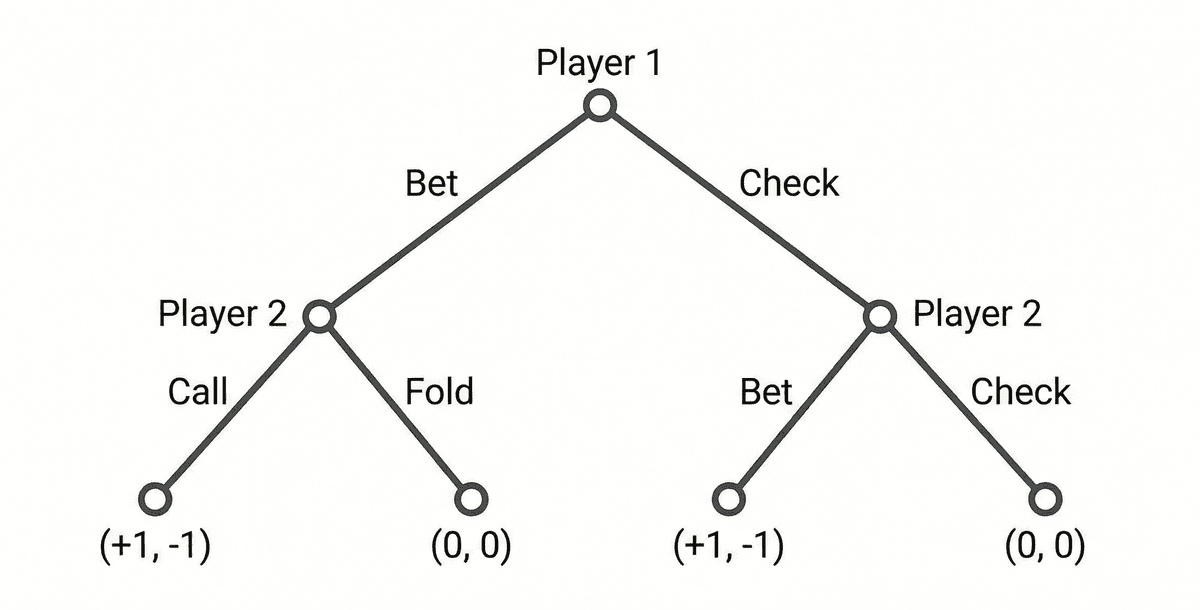
The Decision Tree for the AKQ Game: A Game Theory Analysis
The AKQ game is a simplified poker model that elegantly demonstrates core game theory concepts. Despite its simplicity—just three cards and basic actions—it reveals profound insights into optimal strategy, bluffing frequencies, and Nash equilibrium play. This analysis explores the complete decision tree and mathematical solutions.
Understanding the AKQ Game
Game Structure
Setup:
- Deck: Three cards only (Ace, King, Queen)
- Players: Two (Player 1 and Player 2)
- Ante: $1 from each player (pot starts at $2)
- Each player receives one card (no shared cards)
- Ace > King > Queen
Action Sequence:
- Player 1 acts first: Check or Bet $1
- If Player 1 bets, Player 2: Call or Fold
- If Player 1 checks, Player 2: Check or Bet $1
- If Player 2 bets after check, Player 1: Call or Fold
- Showdown if both check or someone calls
Why Study AKQ?
This simplified game contains all essential poker elements:
- Incomplete information
- Bluffing opportunities
- Value betting
- Pot odds calculations
- Strategic balance
The Complete Decision Tree
Initial Node: Player 1's Decision
Player 1 receives one of three cards:
- Probability of A: 1/3
- Probability of K: 1/3
- Probability of Q: 1/3
Player 1's Options:
- Bet $1 (aggressive action)
- Check (passive action)
Branch 1: Player 1 Bets
Pot after bet: $3 (antes $2 + bet $1)
Player 2's Decision:
- Call $1: Pot becomes $4, go to showdown
- Fold: Player 1 wins $2 immediately
Player 2's Situation:
- Cost to call: $1
- Pot odds: 1:3 (25% equity needed)
- Must win 25% of the time to break even
Branch 2: Player 1 Checks
Pot remains: $2
Player 2's Decision:
- Bet $1: Pot becomes $3
- Check: Go to showdown for free
If Player 2 bets:
- Player 1 must call $1 into pot of $3
- Player 1 gets 3:1 odds (needs 25% equity)
Mathematical Analysis of Strategies
Player 1's Strategy with Each Card
With Ace (Best Hand):
Always bet for value:
- Objective: Build pot with best hand
- Opponent will call with K or A (if they have K, you win)
- EV of betting > EV of checking
With Queen (Worst Hand):
Strategic bluffing opportunity:
- Pure bluff (0% equity when called)
- Success rate needed: 1/(1+3) = 25%
- Fold equity required makes bluffing profitable
With King (Middle Hand):
Most complex decision:
- Beats Q, loses to A
- Some equity but not premium
- Optimal strategy: Mixed strategy (part bet, part check)
Player 2's Strategy by Card
With Ace:
Always call if Player 1 bets:
- Guaranteed win at showdown
- Clear value call
With Queen:
Always fold if Player 1 bets:
- Worst possible hand
- 0% equity when called
- Cannot profitably call getting 3:1
With King:
Critical decision point:
- Beats Q-bluffs
- Loses to A
- Optimal play requires understanding Player 1's strategy
Nash Equilibrium Solution
Finding the Equilibrium
The Nash Equilibrium occurs when both players' strategies are best responses to each other.
Player 1's Optimal Strategy:
| Card | Action | Frequency | Reasoning |
|---|---|---|---|
| Ace | Bet | 100% | Value betting |
| King | Check | 100% | Pot control, position |
| Queen | Bet | 33.3% | Bluffing frequency |
| Queen | Check | 66.7% | Give up |
Player 2's Optimal Strategy:
When Player 1 bets:
| Card | Action | Frequency | Reasoning |
|---|---|---|---|
| Ace | Call | 100% | Best hand |
| King | Call | 33.3% | Bluff catching |
| King | Fold | 66.7% | Against value |
| Queen | Fold | 100% | Worst hand |
Why These Frequencies?
Player 1's Bluff Frequency (33.3%):
Pot odds for Player 2 when calling:
- Risk: $1
- Reward: $3
- Needs to be good: 25% of the time
Player 1 must bluff enough to make calling correct, but not so much that calling becomes profitable.
Optimal bluff frequency: If Player 1 bluffs Q 33.3% of the time, Player 1's betting range is:
- A: 33.3% (value)
- Q: 11.1% (bluff, since Q appears 33.3% × 33.3%)
- Total: 44.4% (75% value, 25% bluff)
This makes Player 2 indifferent when holding K!
Expected Value Calculations
Player 1's EV by Card
With Ace (Always Bet):
Against optimal Player 2 strategy:
- Player 2 has K: 50% × (+$2) = +$1.00
- Player 2 has Q: 50% × (+$2) = +$1.00
- Total EV = +$2.00
With Queen (Bluff 33.3%):
When bluffing:
- Player 2 folds K: 50% × (66.7%) × (+$2) = +$0.67
- Player 2 calls K: 50% × (33.3%) × (-$1) = -$0.17
- Player 2 has A: 50% × (-$1) = -$0.50
- Bluffing EV = $0.00
When checking:
- Check-through EV vs K: -$1
- Check-through EV vs A: -$1
- Checking EV = -$1.00
With King (Always Check):
Check-call strategy:
- Against A: -$1
- Against Q: +$1
- Expected EV = $0.00
Overall Expected Values at Equilibrium
At Nash Equilibrium:
- Player 1 EV: +$0.67 per game
- Player 2 EV: -$0.67 per game
Player 1 has a natural advantage from acting first!
Decision Tree Visualization
                        [Game Start]
                    /                    \
            [P1 has A: 1/3]        [P1 has K: 1/3]        [P1 has Q: 1/3]
                 |                       |                      |
              [Bet 100%]           [Check 100%]         [Bet 33%, Check 67%]
                 |                       |                      |
        [P2: Call/Fold]           [P2: Check/Bet]       [P2: Call/Fold]
            /        \                /      \              /        \
      [A wins]    [A wins]      [Showdown] [P1:C/F]  [Q loses]  [Q wins]
       +$2         +$2                        |         -$1        +$2
                                         [Showdown]
Strategic Insights from AKQ
Lesson 1: Positional Advantage
Player 1's first-to-act position provides inherent value:
- Can bet strong hands for value
- Can bluff weak hands profitably
- Forces Player 2 into reactive decisions
Mathematical advantage: +$0.67 per game = 33.5% ROI on ante
Lesson 2: Bluffing Frequency Matters
Too many bluffs:
- Opponent calls more
- Bluffs become unprofitable
Too few bluffs:
- Opponent folds more
- Value bets win less
Optimal balance: 25% bluffs in betting range
Lesson 3: Mixed Strategies
King requires mixed strategy for both players:
- No pure strategy is optimal
- Randomization prevents exploitation
- Creates uncertainty for opponent
Lesson 4: Indifference Points
At equilibrium, certain decisions have equal EV:
- Player 2's King is indifferent to calling vs folding
- Player 1's Queen is indifferent to bluffing vs checking
This indifference is the hallmark of optimal play!
Applying AKQ to Real Poker
Translating to Texas Hold'em
AKQ Principles in Hold'em:
-
Range Construction:
- Top of range = Ace (value hands)
- Middle of range = King (medium strength)
- Bottom of range = Queen (bluffs)
-
Betting Frequencies:
- Value-to-bluff ratios follow same mathematics
- Adjust based on pot odds offered
-
Position Matters:
- In position = Player 1 advantage
- Out of position = Player 2 disadvantage
Complexity Scaling
Real poker adds:
- Multiple betting streets
- Varying bet sizes
- More card combinations
- Community cards
- Multiple opponents
However, core principles remain identical!
Common Strategy Errors
Error #1: Never Bluffing Queen
Mistake: Always checking Q to "play safe"
Result: Player 1's range becomes too transparent
- Player 2 knows bet = Ace
- Player 2 always folds King
- Player 1 wins smaller pots with Ace
EV Impact: -$0.33 per game
Error #2: Always Betting King
Mistake: Betting King for "thin value"
Result: Player 2 exploits by calling more
- King becomes a bluff when Player 2 has Ace
- Loses extra $1 in these situations
EV Impact: -$0.50 per game
Error #3: Always Calling with King
Mistake: "I need to catch bluffs"
Result: Calls too wide, loses to Ace too often
- Gets correct price vs bluffs
- But loses more to value hands
EV Impact: -$0.25 per game
Conclusion
The AKQ game, despite its simplicity, contains the essence of poker strategy:
- Optimal strategies require mathematical precision
- Position provides inherent advantages
- Bluffing must occur at specific frequencies
- Mixed strategies prevent exploitation
- Opponent indifference characterizes equilibrium play
Understanding the AKQ decision tree provides foundational knowledge for more complex poker situations. The same principles of value betting, bluffing frequency, and pot odds calculation scale to full poker games.
Master these concepts in the AKQ framework, and you'll develop intuition for optimal play in any poker variant. The mathematics remain consistent—only the complexity increases.
Key Takeaway: In poker, as in the AKQ game, success comes from balancing your ranges, understanding pot odds, and making opponents indifferent to their decisions. This is the mathematical heart of unexploitable play.
⚠️ Responsible Gambling Reminder
While understanding poker strategy and mathematics can improve your game, always gamble responsibly. Set limits, take breaks, and remember that poker involves both skill and chance. For support, visit www.problemgambling.ie.
Related Articles

Unexploitable Bluffing: Achieving Perfect Balance in Poker
Learn the mathematical principles of unexploitable bluffing strategies. Master GTO bluffing frequencies, opponent indifference, and balanced range construction.

Only the Tip of the Tree: Advanced Game Theory Applications
Dive deeper into poker game theory beyond basic decision trees. Explore multi-street complexity, information sets, subgame perfect equilibrium, and computational poker solutions.
Bluffing and Exploitation: An Introduction to Poker Mathematics
Master the mathematical foundations of bluffing and exploitation in poker. Learn game theory optimal strategies, bluffing frequencies, and how to exploit opponent weaknesses.