Calculating Expected Value in Poker: Advanced Mathematical Guide
Master expected value calculations in poker. Learn EV formulas, decision trees, multi-street analysis, and advanced concepts for optimal poker strategy.
Calculating Expected Value in Poker: Advanced Mathematical Guide
Expected Value (EV) is the cornerstone of profitable poker decision-making. While basic EV concepts are fundamental, advanced EV calculations involve complex scenarios with multiple variables, future streets, and opponent ranges. This guide covers sophisticated EV analysis for serious poker players.
Advanced EV Fundamentals
Complete EV Formula
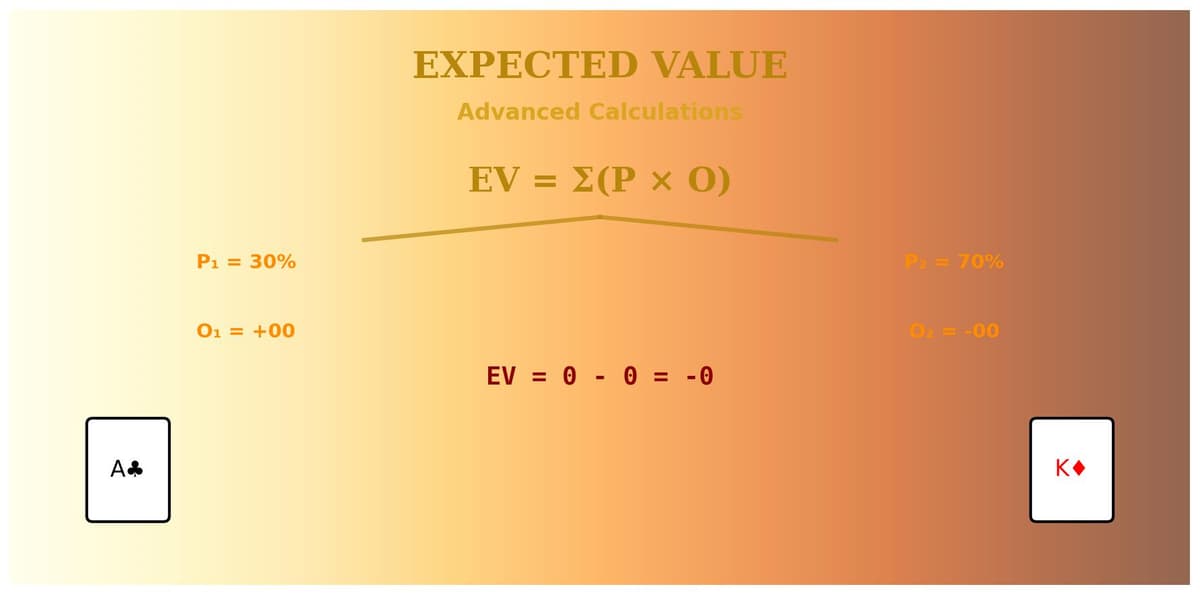
EV = Σ(Probability × Outcome)
Expanded for poker: EV = (P₁ × Outcome₁) + (P₂ × Outcome₂) + ... + (Pₙ × Outcomeₙ)
Where each probability-outcome pair represents a possible scenario.
Multi-Outcome EV Example
Situation: Calling a river bet with a bluff catcher
Possible outcomes:
- Opponent has bluff (30%): Win $200
- Opponent has value hand (70%): Lose $100
EV Calculation: EV = (0.30 × $200) + (0.70 × -$100) EV = $60 - $70 = -$10
Decision: Fold (negative EV)
Hand-by-Hand EV Analysis
Preflop All-In EV
Example: AK vs QQ preflop all-in
Setup:
- Pot before all-in: $50
- All-in amount: $200 each
- Total pot: $450
Equity calculation:
- AK equity: 43.3%
- QQ equity: 56.7%
EV for AK: EV = (0.433 × $450) - $200 EV = $194.85 - $200 = -$5.15
Postflop Decision Trees
Complex scenario: Turn decision with multiple opponent actions
Your hand: A♠ K♠ Board: K♣ 7♠ 2♦ 5♠ Pot: $100
Decision tree:
-
Check (40% opponent checks, 60% opponent bets)
- If opponent checks: Showdown EV
- If opponent bets: Calling decision EV
-
Bet $75 (30% fold, 50% call, 20% raise)
- If opponent folds: Win $100
- If opponent calls: River decision
- If opponent raises: Difficult decision
Expected Value in Different Situations
All-In EV Calculations
Tournament Example:
- Your stack: $10,000
- Opponent stack: $15,000
- Blinds: $200/$400
- Your hand: A♠ A♦
- Opponent shoves with range: 22+, A2s+, A5o+
Calculation steps:
- Calculate equity vs range: ~73%
- Determine pot size: $10,000 + $10,000 + $600 = $20,600
- Calculate EV: (0.73 × $20,600) - $10,000 = $5,038
Calling vs Folding EV
River decision example:
- Pot: $300
- Opponent bets: $200
- Your hand: Second pair
- Opponent's value/bluff ratio: 70/30
Calling EV: EV = (0.30 × $500) + (0.70 × -$200) EV = $150 - $140 = $10
Folding EV: $0
Decision: Call (+$10 EV)
Multi-Street EV Analysis
Turn and River Considerations
Complex example: Turn decision with river implications
Your hand: J♠ T♠ Board: 9♠ 8♥ 2♣ 7♦ Pot: $150 Opponent bets: $100
Analysis branches:
-
Hit straight on river (8 outs = 17.4%)
- Expected river value: $400
- EV contribution: 0.174 × $400 = $69.60
-
Miss straight on river (38 cards = 82.6%)
- Expected river value: -$100 (likely fold)
- EV contribution: 0.826 × (-$100) = -$82.60
Total EV: $69.60 - $82.60 = -$13.00 Decision: Fold
Implied Odds in EV Terms
Formula: EV = (Hit% × Total Winnings) - (Miss% × Current Investment)
Example: Set mining with pocket pairs
Setup:
- Your hand: 7♣ 7♦
- Preflop call: $20
- Pot if you hit set: $300 (average)
- Probability of flopping set: 11.8%
EV Calculation: EV = (0.118 × $300) - (0.882 × $20) EV = $35.40 - $17.64 = $17.76
Decision: Profitable call
Equity Calculations with Multiple Opponents
Multi-Way Pot EV
Scenario: 3-way pot with drawing hand
Your hand: A♠ K♠ Board: 7♠ 5♠ 2♣ Opponents: 2 players with likely strong hands
Equity adjustments:
- Heads-up equity: ~45%
- 3-way equity: ~30% (reduced due to multiple opponents)
- Pot odds needed: 25%
- Decision: Still profitable call
Range vs Range Equity
Advanced calculation: Your range vs opponent's range
Example ranges:
- Your range: Top pair+, flush draws, straight draws
- Opponent's range: Two pair+, strong draws
Weighted equity calculation:
- Calculate equity for each hand combination
- Weight by frequency in range
- Sum for total range equity
Tournament Equity vs Cash Game Equity
ICM Considerations in EV
Tournament example:
- Bubble situation
- Chip EV: +$500
- ICM EV: -$200 (due to survival value)
- Decision: Fold despite positive chip EV
Cash Game EV Purity
Advantages:
- Chips = money directly
- No ICM considerations
- Pure mathematical decisions
Example:
- Pot: $200
- Call: $50
- Equity needed: 20%
- Your equity: 25%
- Decision: Call (+EV)
Risk vs Reward Analysis
Kelly Criterion Application
Formula: f = (bp - q) / b
Poker application:
- Determine optimal bet sizing
- Manage bankroll risk
- Maximize long-term growth
Example:
- Edge: 60% vs 40%
- Pot odds: 2:1
- Optimal bet size: 20% of bankroll
Sharpe Ratio in Poker
Formula: (Return - Risk-free rate) / Standard deviation
Application:
- Compare different games
- Evaluate risk-adjusted returns
- Optimize game selection
Decision Trees and Branching EV
Complex Decision Tree
Scenario: Flop decision with multiple future actions
Your hand: A♠ Q♠ Board: Q♣ 7♠ 2♦ Pot: $80
Decision branches:
-
Bet $60 (70% call, 30% fold)
- If call: Turn decision tree
- If fold: Win $80
-
Check (50% opponent bets, 50% opponent checks)
- If opponent bets: Calling decision
- If opponent checks: Turn decision
EV calculation: Each branch requires separate analysis with probability weighting.
Advanced EV Concepts
Reverse Implied Odds in EV
Formula: EV = (Hit% × Win Amount) - (Hit% × Reverse Loss) - (Miss% × Current Loss)
Example: Low flush draw
- Hit flush: 18%
- Win when hit: 60%
- Lose big when hit: 40%
- Current pot odds: 3:1
Calculation: EV = (0.18 × 0.60 × $400) - (0.18 × 0.40 × $600) - (0.82 × $100) EV = $43.20 - $43.20 - $82.00 = -$82.00
Fold Equity in Betting EV
Formula: Betting EV = (Fold% × Current Pot) + (Call% × Showdown EV)
Example: Semi-bluff bet
- Fold equity: 40%
- Current pot: $100
- Showdown equity if called: 35%
- Pot if called: $300
Calculation: EV = (0.40 × $100) + (0.60 × 0.35 × $300) - $100 EV = $40 + $63 - $100 = $3
Practical EV Scenarios
Scenario 1: River Bluff Decision
Setup:
- Pot: $400
- Your bluff bet: $300
- Opponent folds: 35%
- Opponent calls and you lose: 65%
EV Calculation: EV = (0.35 × $400) - (0.65 × $300) EV = $140 - $195 = -$55
Decision: Don't bluff
Scenario 2: Tournament Push/Fold
Setup:
- Your stack: 8 BB
- Blinds: 1/2 BB
- Your hand: A♠ J♦
- Opponent calling range: 22+, A9+, KQ
Calculation:
- Fold EV: 6 BB (remaining stack)
- Push EV: Calculate based on fold equity and showdown equity
- Compare and choose higher EV option
Scenario 3: Cash Game 3-Bet Bluff
Setup:
- Original raise: $25
- Your 3-bet: $85
- Fold equity: 60%
- Showdown equity if called: 25%
EV Analysis:
- Immediate win: 0.60 × $35 = $21
- Showdown value: 0.40 × 0.25 × $200 = $20
- Cost: $85
- Total EV: $21 + $20 - $85 = -$44
Decision: Don't 3-bet bluff
Software and Calculators for EV
Professional Tools
Solvers:
- PioSolver - GTO solutions
- MonkerSolver - Advanced analysis
- GTO+ - User-friendly interface
Equity Calculators:
- PokerStove - Basic equity
- Flopzilla - Range analysis
- Equilab - Free equity tool
Features to use:
- Range vs range equity
- Board texture analysis
- Betting line comparison
- EV calculations
Manual Calculation Practice
Essential skills:
- Quick equity estimation
- Pot odds calculation
- Probability assessment
- Mental math proficiency
Common EV Calculation Mistakes
1. Ignoring Future Streets
Mistake: Only considering current decision Solution: Factor in implied/reverse implied odds
2. Overestimating Fold Equity
Mistake: Assuming opponents fold too often Solution: Use realistic folding frequencies
3. Underestimating Opponent Ranges
Mistake: Assuming opponent has weak range Solution: Consider full range of possible hands
4. Neglecting Position Value
Mistake: Not adjusting EV for position Solution: Factor in positional advantages
Advanced Mathematical Concepts
Bayesian Analysis in EV
Application: Updating probabilities based on new information
Example: Opponent's betting pattern changes your assessment of their range, affecting EV calculations.
Game Theory and EV
Nash Equilibrium: Optimal strategy where no player can improve by changing strategy alone.
Application: In heads-up situations, GTO play maximizes EV against any opponent strategy.
Monte Carlo Simulation
Purpose: Run thousands of scenarios to calculate complex EV
Example: Tournament ICM situations with multiple variables
EV in Different Game Types
No-Limit Hold'em
Characteristics:
- Variable bet sizes
- Complex decision trees
- High implied odds potential
EV considerations:
- Stack depth effects
- Position importance
- Opponent tendencies
Pot-Limit Omaha
Characteristics:
- Higher variance
- More drawing hands
- Complex equity calculations
EV adjustments:
- Multiway pot frequency
- Drawing hand values
- Nut advantage importance
Tournament Play
Characteristics:
- ICM considerations
- Changing stack depths
- Survival value
EV modifications:
- Chip value fluctuations
- Bubble factors
- Pay jump considerations
Practical Application Guidelines
Quick EV Estimation
Mental shortcuts:
- Round numbers for easier calculation
- Use common equity percentages
- Estimate rather than calculate exactly
Example shortcuts:
- Flush draw ≈ 35%
- Straight draw ≈ 32%
- Overcards ≈ 24%
When to Calculate Precisely
Situations requiring exact calculation:
- Close decisions
- Large pot sizes
- Tournament bubble
- High-stakes games
When Estimation Suffices
Situations where estimation works:
- Clear-cut decisions
- Small pots
- Time pressure
- Obvious spots
Building EV Intuition
Pattern Recognition
Common scenarios:
- Set mining profitability
- Flush draw calling spots
- Bluff sizing optimization
- Value bet sizing
Experience-Based Adjustments
Factors to consider:
- Opponent tendencies
- Table dynamics
- Game flow
- Meta-game considerations
Conclusion
Advanced EV calculation is the foundation of expert poker play. Key principles:
- Consider all possible outcomes and their probabilities
- Factor in future streets and implied odds
- Adjust for opponent ranges and tendencies
- Use appropriate tools for complex calculations
- Develop intuition through practice and experience
Mastering EV calculation allows you to:
- Make optimal decisions in complex spots
- Maximize long-term profitability
- Understand the mathematical foundation of poker
- Develop advanced strategic concepts
- Gain significant edges over opponents
Remember: EV is theoretical - actual results will vary due to variance. Focus on making +EV decisions consistently, and profits will follow over time.
Quick EV Reference
Basic formula: EV = Σ(Probability × Outcome)
Key concepts:
- Positive EV = profitable decision
- Negative EV = unprofitable decision
- Zero EV = break-even decision
Common applications:
- Calling decisions
- Betting decisions
- All-in situations
- Tournament spots
Tools needed:
- Equity calculators
- Range analysis software
- Mental math skills
- Pattern recognition
⚠️ Responsible Gambling Reminder
While understanding poker strategy and mathematics can improve your game, always gamble responsibly. Set limits, take breaks, and remember that poker involves both skill and chance. For support, visit www.problemgambling.ie.
Related Articles
Understanding Expected Value in Poker: A Complete Mathematical Guide
Master the concept of Expected Value (EV) in poker and learn how to make mathematically profitable decisions at the table. Includes detailed calculations, examples, and practical applications.
Poker Math & Probability: Essential Calculations for Winning Players
Master the fundamental mathematics of poker including pot odds, implied odds, combinatorics, and probability calculations. Essential guide for serious players.
Poker and Pot Odds: The Complete Mathematical Guide
Master pot odds calculations in poker. Learn how to compare pot odds to hand odds, make profitable calling decisions, and understand implied odds in Texas Hold'em.