The Independent Chip Model (ICM): Tournament Strategy Mathematics
Master ICM calculations and tournament strategy. Learn how chip values change based on payout structure and make optimal decisions in tournament poker.
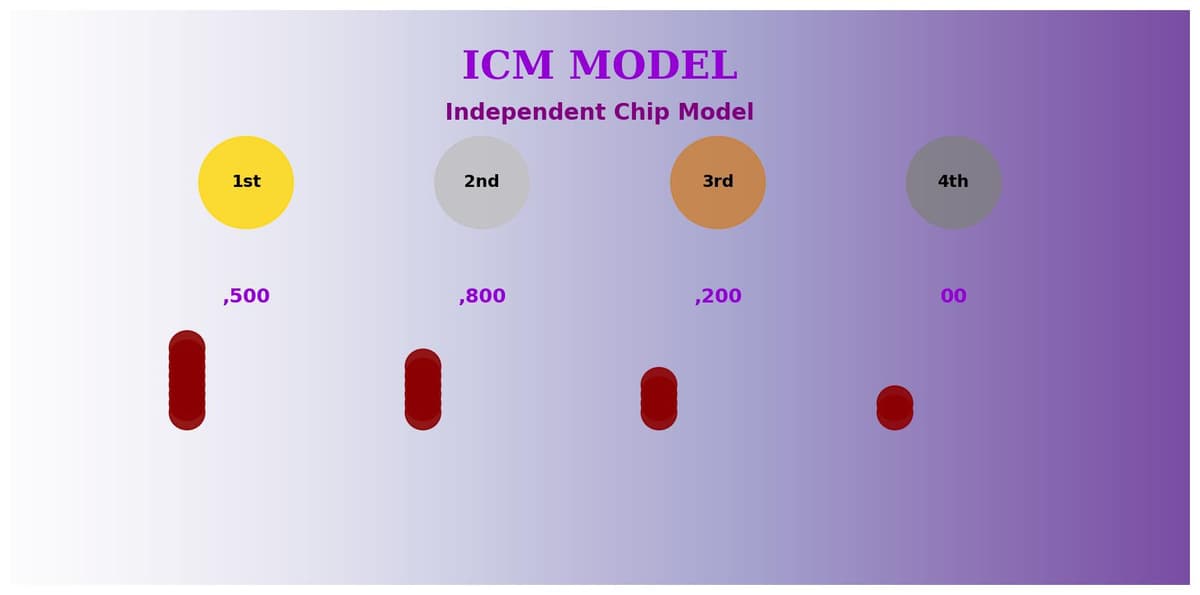
The Independent Chip Model (ICM): Tournament Strategy Mathematics
The Independent Chip Model (ICM) is the mathematical foundation of tournament poker strategy. Unlike cash games where chips equal money, tournament chips have fluctuating values based on the payout structure and remaining players. Understanding ICM is crucial for making optimal decisions in tournaments.
What is ICM?
ICM Definition: A mathematical model that calculates the monetary value of tournament chips based on:
- Current chip stacks
- Number of players remaining
- Prize pool distribution
- Probability of finishing in each position
Key ICM Principles
- Chip values decrease as you accumulate more chips
- Survival becomes more valuable as payouts approach
- Risk premium increases near money bubbles
- Stack sizes matter more than absolute chip counts
Basic ICM Calculation
Simple 3-Player Example
Tournament Setup:
- 3 players remaining
- Prize pool: $1000 (1st: $500, 2nd: $300, 3rd: $200)
- Chip stacks: Player A: 6000, Player B: 3000, Player C: 1000
Step-by-Step ICM Calculation
Step 1: Calculate elimination probabilities
Player C elimination probability:
- C vs A: 1000/(1000+6000) = 14.3%
- C vs B: 1000/(1000+3000) = 25%
- Combined: Approximately 35%
Step 2: Calculate finish probabilities
| Player | 1st Place | 2nd Place | 3rd Place |
|---|---|---|---|
| A | 60% | 30% | 10% |
| B | 30% | 45% | 25% |
| C | 10% | 25% | 65% |
Step 3: Calculate ICM values
| Player | ICM Value | Calculation |
|---|---|---|
| A | $410 | (0.60×$500) + (0.30×$300) + (0.10×$200) |
| B | $315 | (0.30×$500) + (0.45×$300) + (0.25×$200) |
| C | $275 | (0.10×$500) + (0.25×$300) + (0.65×$200) |
ICM vs. Chip EV Comparison
Chip Value Diminishing Returns
| Chips | % of Total | ICM Value | $ per Chip |
|---|---|---|---|
| 1,000 | 10% | $275 | $0.275 |
| 3,000 | 30% | $315 | $0.105 |
| 6,000 | 60% | $410 | $0.068 |
Key Insight: Each additional chip is worth less than the previous one.
ICM in Different Tournament Stages
Early Stage (Far from Money)
Characteristics:
- ICM effects minimal
- Chip accumulation priority
- Play closer to chip EV
Example: 100 players, top 15 paid
- ICM pressure: Low
- Strategy: Aggressive accumulation
Middle Stage (Approaching Bubble)
Characteristics:
- ICM effects increasing
- Survival gains value
- Tighter play optimal
Example: 20 players, top 15 paid
- ICM pressure: High
- Strategy: Avoid marginal spots
Late Stage (In the Money)
Characteristics:
- ICM effects extreme
- Pay jumps significant
- Ultra-conservative play
Example: Final table, big pay jumps
- ICM pressure: Maximum
- Strategy: Ladder when possible
ICM Pressure by Stack Size
Big Stack Strategy
Advantages:
- Can apply ICM pressure
- Fold equity increases
- Can afford to gamble
Optimal Play:
- Aggressive against medium stacks
- Avoid big stack confrontations
- Target short stacks
Medium Stack Strategy
Challenges:
- Most ICM pressure
- Squeezed by big stacks
- Can't afford mistakes
Optimal Play:
- Extremely tight
- Avoid marginal spots
- Wait for premium hands
Short Stack Strategy
Situation:
- Desperate for chips
- ICM considerations reduced
- Must take risks
Optimal Play:
- Push/fold strategy
- Look for fold equity
- Target other short stacks
Detailed ICM Scenarios
Bubble Play Example
Setup: 16 players, 15 paid, min cash $1,000
| Stack Size | Chips | ICM Value | Strategy |
|---|---|---|---|
| Big (40bb) | 80,000 | $3,200 | Aggressive |
| Medium (20bb) | 40,000 | $2,100 | Tight |
| Short (10bb) | 20,000 | $1,400 | Push/fold |
| Micro (5bb) | 10,000 | $800 | Desperate |
Final Table ICM
9-Player Final Table Payouts:
| Position | Payout | % of Prize Pool |
|---|---|---|
| 1st | $50,000 | 25% |
| 2nd | $30,000 | 15% |
| 3rd | $20,000 | 10% |
| 4th | $15,000 | 7.5% |
| 5th | $12,000 | 6% |
| 6th | $10,000 | 5% |
| 7th | $8,000 | 4% |
| 8th | $6,000 | 3% |
| 9th | $4,000 | 2% |
ICM Values by Stack:
| Stack Rank | Chips | ICM Value | Risk Premium |
|---|---|---|---|
| 1st | 150,000 | $28,500 | High |
| 2nd | 120,000 | $24,200 | High |
| 3rd | 100,000 | $21,100 | Medium |
| 4th | 80,000 | $18,300 | Medium |
| 5th | 60,000 | $15,800 | Medium |
| 6th | 50,000 | $13,900 | Low |
| 7th | 40,000 | $11,200 | Low |
| 8th | 30,000 | $8,100 | Very Low |
| 9th | 10,000 | $4,500 | Minimal |
ICM Decision Examples
Example 1: Bubble Fold
Situation:
- 16 players, 15 paid ($1,000 min)
- You: A♠K♠, 25bb stack
- Action: UTG shoves 15bb
- ICM consideration: Folding preserves $1,000+ value
Analysis:
- Chip EV: Profitable call (+EV ~$500)
- ICM EV: Unprofitable call (-EV ~$200)
- Decision: Fold
Example 2: Short Stack Shove
Situation:
- Final table, 6 players
- You: 8bb with A♣J♦
- Big blind: 35bb stack
- ICM consideration: Must accumulate or bust
Analysis:
- ICM value with 8bb: $8,500
- ICM value if double: $14,000
- ICM value if bust: $4,000
- Decision: Shove (risk/reward favorable)
Advanced ICM Concepts
ICM Chop Calculations
When players agree to split prize money based on ICM:
4-Player Chop Example:
| Player | Chips | ICM % | Chop Amount |
|---|---|---|---|
| A | 60,000 | 45% | $22,500 |
| B | 40,000 | 32% | $16,000 |
| C | 30,000 | 15% | $7,500 |
| D | 20,000 | 8% | $4,000 |
Future Game Simulation (FGS)
More advanced than basic ICM, FGS considers:
- Skill differences between players
- Position advantages
- Blind structure
- Future decision points
ICM Software and Tools
Popular ICM Calculators
- ICMIZER - Professional tournament tool
- HoldemResources Calculator - Advanced GTO solver
- PokerStove - Basic ICM calculations
- Tournament Shark - Real-time ICM
Key Features to Look For
- Real-time calculations
- Hand range analysis
- Push/fold charts
- Multi-table support
Common ICM Mistakes
1. Ignoring ICM Completely
Mistake: Playing tournament like cash game Cost: Massive EV loss near money
2. Over-applying ICM
Mistake: Playing too tight early Cost: Missing accumulation opportunities
3. Wrong Stack Size Strategy
Mistake: Big stack playing too tight Cost: Not leveraging ICM pressure
4. Bubble Mistakes
Mistake: Calling light on bubble Cost: Busting before money
ICM Training Exercises
Exercise 1: Bubble Decisions
Setup: 16 players, 15 paid Your stack: 20bb Hand: A♠Q♦ Action: UTG+1 shoves 12bb
Questions:
- What's your ICM value if you fold?
- What's your ICM value if you call and win?
- What's your ICM value if you call and lose?
- What's the break-even calling percentage?
Exercise 2: Final Table Ladder
Setup: 4 players, pay jumps $5K → $8K → $12K → $20K Your stack: 2nd in chips Situation: Short stack all-in
Questions:
- Should you call with AK?
- How does the big stack's decision affect you?
- What's the value of letting short stack bust?
Mathematical Formulas
Basic ICM Formula
P(finish position i) = (Stack_player / Total_chips) × Adjustment_factor
Where adjustment factor accounts for:
- Number of players
- Relative stack sizes
- Elimination probabilities
Risk Premium Calculation
Risk Premium = Chip EV - ICM EV
Example:
- Chip EV of call: +$500
- ICM EV of call: -$200
- Risk Premium: $700
Practical ICM Guidelines
Early Tournament (>50bb average)
- ICM factor: Minimal
- Strategy: Chip accumulation focus
- Adjustments: Play close to cash game
Middle Tournament (20-50bb average)
- ICM factor: Moderate
- Strategy: Balanced approach
- Adjustments: Tighten up slightly
Late Tournament (<20bb average)
- ICM factor: High
- Strategy: Survival focus
- Adjustments: Significant tightening
Bubble/Final Table
- ICM factor: Extreme
- Strategy: Stack-size dependent
- Adjustments: Major strategy shifts
ICM and Satellite Strategy
Satellite Tournaments
Goal: Win seat, not chips ICM implications: Extreme
Strategy adjustments:
- Ultra-tight play
- Avoid all marginal spots
- Let others eliminate each other
Example: 100-player satellite, 10 seats
- Fold AA if it risks elimination
- Survival > chip accumulation
Conclusion
ICM is fundamental to tournament success. Key principles:
- Chip values fluctuate based on tournament situation
- Stack preservation often trumps chip accumulation
- Position in payout structure affects optimal strategy
- Risk premiums increase as money approaches
- Software tools are essential for precise calculations
Master ICM, and you'll have a significant edge in tournament poker. The mathematics may seem complex, but the strategic insights are invaluable for long-term tournament success.
Quick ICM Reference
High ICM Pressure Situations:
- Bubble play
- Final table
- Big pay jumps
- Satellite tournaments
Low ICM Pressure Situations:
- Early tournament
- Deep stacks
- Flat payout structure
- Far from money
Remember: ICM is a tool, not a rule. Use it to inform decisions, but consider all factors including opponent tendencies, table dynamics, and future opportunities.
⚠️ Responsible Gambling Reminder
While understanding poker strategy and mathematics can improve your game, always gamble responsibly. Set limits, take breaks, and remember that poker involves both skill and chance. For support, visit www.problemgambling.ie.
Related Articles
Understanding Expected Value in Poker: A Complete Mathematical Guide
Master the concept of Expected Value (EV) in poker and learn how to make mathematically profitable decisions at the table. Includes detailed calculations, examples, and practical applications.
Variance in Poker: Understanding and Managing the Swings
Master poker variance and bankroll management. Learn how to calculate standard deviation, understand downswings, and maintain mental stability through variance.
Poker Math & Probability: Essential Calculations for Winning Players
Master the fundamental mathematics of poker including pot odds, implied odds, combinatorics, and probability calculations. Essential guide for serious players.