Variance in Poker: Understanding and Managing the Swings
Master poker variance and bankroll management. Learn how to calculate standard deviation, understand downswings, and maintain mental stability through variance.
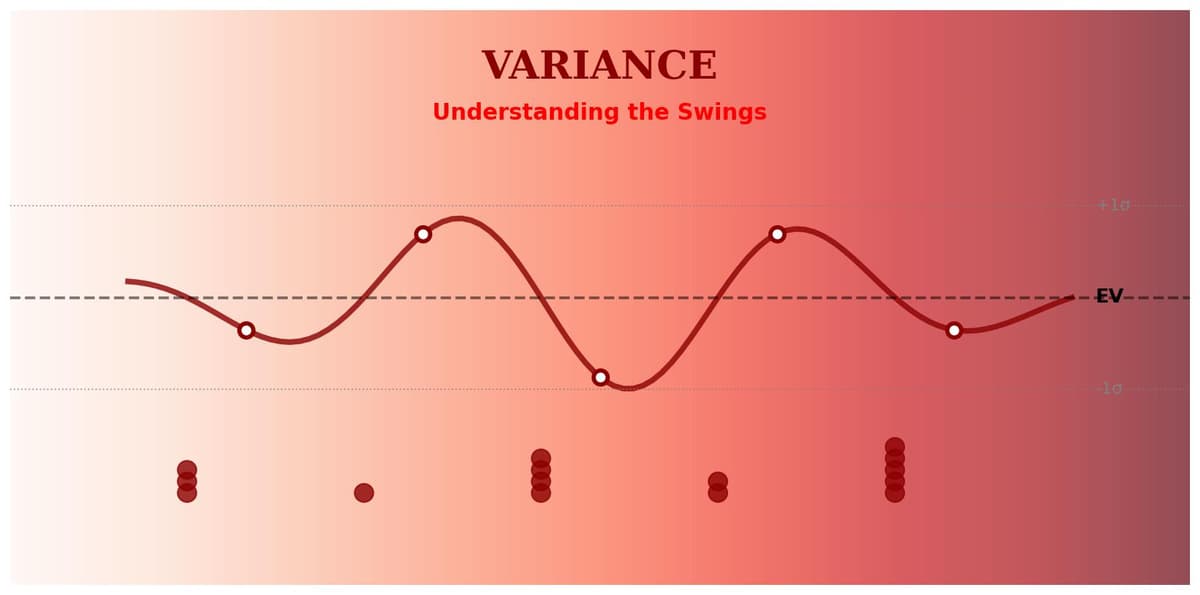
Variance in Poker: Understanding and Managing the Swings
Variance is the mathematical measure of how much your results deviate from expected value. In poker, variance creates the swings that can make or break players psychologically and financially. Understanding variance is crucial for proper bankroll management and mental game stability.
What is Variance?
Variance Definition: The statistical measure of how spread out results are from the expected average.
In Poker Terms: How much your actual results differ from your expected winnings over time.
Key Variance Concepts
- Standard Deviation (σ) - Square root of variance
- Expected Value (EV) - Your theoretical average result
- Actual Results - What actually happened
- Sample Size - Number of hands/sessions played
Mathematical Foundation
Basic Variance Formula
Variance (σ²) = E[(X - μ)²]
Where:
- X = Individual result
- μ = Expected value (mean)
- E = Expected value function
Standard Deviation in Poker
Standard Deviation = √Variance
Practical Application:
- 68% of results fall within 1 standard deviation
- 95% of results fall within 2 standard deviations
- 99.7% of results fall within 3 standard deviations
Variance in Different Poker Formats
Cash Game Variance
Typical Standard Deviations:
| Game Type | BB/100 SD | Hourly SD (25 hands/hr) |
|---|---|---|
| 6-Max NLHE | 80-120 | 20-30 BB |
| Full Ring NLHE | 60-90 | 15-22 BB |
| PLO | 120-180 | 30-45 BB |
| Limit Hold'em | 12-18 | 3-4.5 BB |
Tournament Variance
ROI Standard Deviations:
| Tournament Type | ROI SD | Explanation |
|---|---|---|
| STTs | 50-70% | Lower variance, frequent cashes |
| MTTs | 100-150% | High variance, rare big scores |
| Satellites | 80-120% | Binary outcomes increase variance |
| Turbos | 120-180% | Faster structure = more variance |
Calculating Your Variance
Cash Game Example
Your Stats:
- Winrate: 5 BB/100
- Standard deviation: 90 BB/100
- Hands played: 10,000
Expected Results:
- Expected winnings: 500 BB
- Standard deviation: 900 BB
- 68% confidence interval: -400 BB to +1,400 BB
- 95% confidence interval: -1,300 BB to +2,300 BB
Sample Size Requirements
Hands Needed for Statistical Significance:
| Confidence Level | Hands Required | Months (25k hands/month) |
|---|---|---|
| 68% (1 SD) | 25,000 | 1 month |
| 95% (2 SD) | 100,000 | 4 months |
| 99% (3 SD) | 225,000 | 9 months |
Variance and Bankroll Management
Kelly Criterion Application
Formula: f = (bp - q) / b
Where:
- f = Fraction of bankroll to risk
- b = Odds received
- p = Probability of winning
- q = Probability of losing
Conservative Bankroll Guidelines
Cash Games:
| Game Type | Buy-ins Required | Risk of Ruin |
|---|---|---|
| 6-Max NLHE | 30-40 | <5% |
| Full Ring NLHE | 25-35 | <5% |
| PLO | 40-60 | <5% |
| Limit Hold'em | 300-500 | <5% |
Tournaments:
| Tournament Type | Buy-ins Required | Risk of Ruin |
|---|---|---|
| STTs | 50-100 | <5% |
| MTTs | 100-200 | <5% |
| High Variance MTTs | 200-300 | <5% |
Understanding Downswings
Probability of Downswings
For a 5 BB/100 winner with 90 BB/100 SD:
| Downswing Size | Probability | Expected Frequency |
|---|---|---|
| 10 buy-ins | 35% | Every 3 months |
| 20 buy-ins | 15% | Every 8 months |
| 30 buy-ins | 6% | Every 2 years |
| 40 buy-ins | 2% | Every 5 years |
| 50 buy-ins | 1% | Every 10 years |
Longest Expected Downswings
Mathematical Expectations:
| Winrate (BB/100) | SD (BB/100) | Worst 1% Downswing |
|---|---|---|
| 2 | 80 | 35 buy-ins |
| 3 | 85 | 32 buy-ins |
| 5 | 90 | 28 buy-ins |
| 7 | 95 | 25 buy-ins |
| 10 | 100 | 22 buy-ins |
Factors Affecting Variance
Playing Style Impact
Tight-Aggressive (TAG):
- Lower variance
- Steady winnings
- Fewer big pots
Loose-Aggressive (LAG):
- Higher variance
- Bigger swings
- More big pots
Game Selection Impact
Low Variance Games:
- Tight opponents
- Small pots
- Predictable play
High Variance Games:
- Loose opponents
- Large pots
- Unpredictable play
Position and Variance
In Position:
- Better control
- Lower variance
- More information
Out of Position:
- Less control
- Higher variance
- Difficult decisions
Variance Reduction Strategies
1. Game Selection
Choose games with:
- Weaker opponents
- Deeper stacks
- Better position frequency
2. Playing Style Adjustments
Reduce variance by:
- Playing tighter ranges
- Avoiding marginal spots
- Focusing on value betting
3. Bankroll Management
Conservative approach:
- Larger bankroll requirements
- Move down during downswings
- Never play scared money
4. Volume Management
Optimal volume:
- Play when mentally fresh
- Avoid tilt-inducing sessions
- Quality over quantity
Psychological Aspects of Variance
Cognitive Biases
Recency Bias:
- Overweighting recent results
- Ignoring long-term data
Confirmation Bias:
- Seeing patterns that don't exist
- Attributing results to skill/luck incorrectly
Mental Game Strategies
Variance Acceptance:
- Understand it's inevitable
- Focus on decision quality
- Separate results from process
- Maintain long-term perspective
Tilt Prevention:
- Set stop-loss limits
- Take breaks during downswings
- Review hands objectively
- Seek support from poker community
Variance in Different Scenarios
Scenario 1: Tournament Final Table
Situation: 9 players, equal stacks Variance factors:
- ICM pressure
- Short-term luck
- Pay jump significance
Variance impact:
- Single elimination = high variance
- Skill edge reduced
- Luck factor increased
Scenario 2: Cash Game Session
Situation: 6-max $1/$2, 200 hands Variance factors:
- Coolers and bad beats
- Card distribution
- Opponent adjustments
Expected range:
- +/- 4 buy-ins (2 SD)
- Skill edge: 1-2 buy-ins
- Luck factor: 6-8 buy-ins
Advanced Variance Concepts
Skewness in Poker
Definition: Asymmetry in result distribution
Tournament skewness:
- Positive skew (rare big wins)
- Many small losses
- Few large profits
Cash game skewness:
- More symmetric distribution
- Occasional big pots
- Generally balanced
Kurtosis and Fat Tails
Definition: Extreme outcomes frequency
Poker implications:
- More extreme results than normal distribution
- "Black swan" events
- Importance of bankroll management
Variance Tracking and Analysis
Essential Metrics
Cash Games:
- BB/100 winrate
- Standard deviation
- Hands played
- Hourly rate
Tournaments:
- ROI percentage
- ITM percentage
- Average buy-in
- Total tournaments
Software Tools
Tracking Software:
- PokerTracker 4
- Hold'em Manager 3
- DriveHUD
- Hand2Note
Analysis Features:
- Variance graphs
- Confidence intervals
- Downswing analysis
- Bankroll simulation
Variance Simulation
Monte Carlo Analysis
Purpose: Simulate thousands of possible outcomes
Example Simulation:
- 100,000 hands
- 5 BB/100 winrate
- 90 BB/100 SD
Results:
- 68% finish between -400 and +1,400 BB
- 5% chance of losing 20+ buy-ins
- 1% chance of losing 35+ buy-ins
Practical Applications
Bankroll planning:
- Determine required bankroll
- Set move-up/move-down limits
- Plan for worst-case scenarios
Goal setting:
- Realistic expectations
- Timeline adjustments
- Risk tolerance assessment
Managing Variance Professionally
Professional Considerations
Income stability:
- Larger bankroll requirements
- Multiple income streams
- Conservative withdrawal rates
Tax implications:
- Variance affects annual income
- Quarterly payment planning
- Record keeping importance
Staking and Backing
Variance sharing:
- Reduce personal variance
- Share profits with backer
- Professional development
Markup considerations:
- Variance affects markup
- Track record importance
- Long-term relationships
Common Variance Mistakes
1. Underestimating Variance
Mistake: Expecting steady profits Reality: Significant swings are normal Solution: Proper bankroll management
2. Overreacting to Short-Term Results
Mistake: Changing strategy after bad session Reality: Small samples are meaningless Solution: Focus on long-term data
3. Playing Above Bankroll
Mistake: Moving up during heater Reality: Variance can destroy bankroll Solution: Conservative move-up strategy
4. Ignoring Variance in Game Selection
Mistake: Playing highest variance games Reality: Lower variance = more stable income Solution: Balance profit and variance
Variance and Different Player Types
Recreational Players
Characteristics:
- Limited bankroll
- Emotional attachment to results
- Short-term focus
Recommendations:
- Lower variance games
- Smaller stakes
- Focus on fun and learning
Semi-Professional Players
Characteristics:
- Supplemental income
- Moderate bankroll
- Improving skills
Recommendations:
- Balanced approach
- Proper bankroll management
- Variance tracking
Professional Players
Characteristics:
- Primary income source
- Large bankroll
- Advanced skills
Recommendations:
- Conservative bankroll management
- Multiple game types
- Variance minimization strategies
Conclusion
Variance is an inescapable part of poker that every player must understand and manage. Key principles:
- Variance is inevitable - even the best players experience significant swings
- Sample size matters - short-term results are largely meaningless
- Bankroll management is crucial - protect yourself from ruin
- Mental game is vital - maintain perspective during swings
- Track and analyze - use data to understand your variance
Understanding variance helps you:
- Set realistic expectations
- Manage your bankroll properly
- Maintain mental stability
- Make better strategic decisions
- Achieve long-term success
Remember: in poker, you're paid for making good decisions, not for winning every hand. Focus on the process, and let the results take care of themselves over time.
Quick Variance Reference
Key Numbers:
- 68% of results within 1 SD
- 95% of results within 2 SD
- 99.7% of results within 3 SD
Bankroll Guidelines:
- Cash games: 30-40 buy-ins
- Tournaments: 100-200 buy-ins
- High variance: Add 50-100% buffer
Mental Game:
- Focus on decisions, not results
- Understand downswings are normal
- Maintain long-term perspective
- Seek support during tough times
⚠️ Responsible Gambling Reminder
While understanding poker strategy and mathematics can improve your game, always gamble responsibly. Set limits, take breaks, and remember that poker involves both skill and chance. For support, visit www.problemgambling.ie.
Related Articles
Understanding Expected Value in Poker: A Complete Mathematical Guide
Master the concept of Expected Value (EV) in poker and learn how to make mathematically profitable decisions at the table. Includes detailed calculations, examples, and practical applications.
The Independent Chip Model (ICM): Tournament Strategy Mathematics
Master ICM calculations and tournament strategy. Learn how chip values change based on payout structure and make optimal decisions in tournament poker.
Poker Math & Probability: Essential Calculations for Winning Players
Master the fundamental mathematics of poker including pot odds, implied odds, combinatorics, and probability calculations. Essential guide for serious players.