Mathematics in Texas Hold'em Poker: Complete Odds and Probability Guide
Comprehensive guide to poker mathematics including starting hands, pot odds, hand odds, outs, and implied value calculations. Master the mathematical foundations of winning Texas Hold'em.
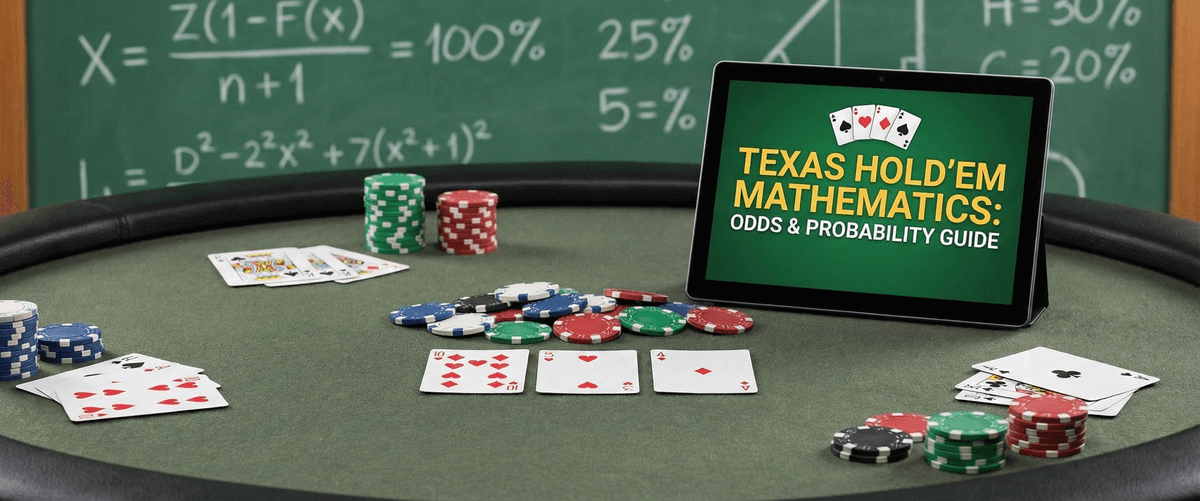
Mathematics in Texas Hold'em Poker: Complete Odds and Probability Guide
Mathematics is the foundation of successful Texas Hold'em strategy. Understanding probability, odds, and expected value transforms poker from gambling into a game of skill. This comprehensive guide covers everything from basic hand combinations to advanced pot odds calculations, providing you with the mathematical tools to make profitable decisions.
Number of Possible Starting Hands
The Combinatorics of Starting Hands
In Texas Hold'em, each player receives two cards from a 52-card deck. The mathematics of combinations determines how many possible starting hands exist.
Total Two-Card Combinations:
Using the combination formula: C(52,2) = 52! / (2! × 50!) = 1,326 possible starting hands
Breaking Down Hand Categories
Pocket Pairs:
- Number of ranks: 13 (from 22 to AA)
- Ways to make each pair: C(4,2) = 6
- Total pocket pairs: 13 × 6 = 78 combinations
- Probability of any pocket pair: 78/1,326 = 5.88%
Suited Hands:
- Number of rank combinations: C(13,2) = 78
- Number of suits: 4
- Total suited hands: 78 × 4 = 312 combinations
- Probability of any suited hand: 312/1,326 = 23.5%
Offsuit Hands:
- Number of rank combinations: C(13,2) = 78
- Ways to make offsuit: 12 (4×4 minus 4 suited)
- Total offsuit hands: 78 × 12 = 936 combinations
- Probability of any offsuit hand: 936/1,326 = 70.6%
Verification: 78 + 312 + 936 = 1,326 ✓
Specific Hand Probabilities
Probability of Specific Hands:
| Hand Type | Combinations | Probability | Odds Against |
|---|---|---|---|
| Specific pair (e.g., AA) | 6 | 0.45% | 220:1 |
| Any pair | 78 | 5.88% | 16:1 |
| Specific suited (e.g., AKs) | 4 | 0.30% | 331:1 |
| Specific offsuit (e.g., AKo) | 12 | 0.90% | 110:1 |
| Any specific hand | 16 | 1.21% | 82:1 |
| Ace-King (any) | 16 | 1.21% | 82:1 |
| Any two Broadway cards | 81 | 6.11% | 15.4:1 |
| Suited connectors | 52 | 3.92% | 24.5:1 |
The Importance of Odds in Poker
Understanding Odds vs. Probability
Probability: The likelihood of an event occurring (expressed as percentage or decimal)
Odds: The ratio of failure to success
Conversion Formula:
- Odds = (1 - Probability) / Probability
- Probability = 1 / (Odds + 1)
Example:
- Probability: 25% = 0.25
- Odds: (1 - 0.25) / 0.25 = 3:1 or "3-to-1"
Why Odds Matter in Poker
Odds allow direct comparison between:
- Pot Odds: Price you're getting to call
- Hand Odds (Card Odds): Probability of making your hand
- Implied Odds: Future betting potential
- Expected Value: Long-term profitability
Fundamental Decision Rule:
If Hand Odds < Pot Odds → Call is profitable If Hand Odds > Pot Odds → Fold is correct
Hand Odds and Poker Odds
Complete Outs Table
This comprehensive table shows your chances of improving based on the number of outs you have:
| Outs | One Card % | Two Card % | One Card Odds | Two Card Odds | Draw Type |
|---|---|---|---|---|---|
| 1 | 2% | 4% | 46:1 | 23:1 | Backdoor Straight or Flush (Requires two cards) |
| 2 | 4% | 8% | 22:1 | 12:1 | Pocket Pair to Set |
| 3 | 7% | 13% | 14:1 | 7:1 | One Overcard |
| 4 | 9% | 17% | 10:1 | 5:1 | Inside Straight / Two Pair to Full House |
| 5 | 11% | 20% | 8:1 | 4:1 | One Pair to Two Pair or Set |
| 6 | 13% | 24% | 6.7:1 | 3.2:1 | No Pair to Pair / Two Overcards |
| 7 | 15% | 28% | 5.6:1 | 2.6:1 | Set to Full House or Quads |
| 8 | 17% | 32% | 4.7:1 | 2.2:1 | Open Straight |
| 9 | 19% | 35% | 4.1:1 | 1.9:1 | Flush |
| 10 | 22% | 38% | 3.6:1 | 1.6:1 | Inside Straight & Two Overcards |
| 11 | 24% | 42% | 3.2:1 | 1.4:1 | Open Straight & One Overcard |
| 12 | 26% | 45% | 2.8:1 | 1.2:1 | Flush & Inside Straight / Flush & One Overcard |
| 13 | 28% | 48% | 2.5:1 | 1.1:1 | - |
| 14 | 30% | 51% | 2.3:1 | 0.95:1 | - |
| 15 | 33% | 54% | 2.1:1 | 0.85:1 | Flush & Open Straight / Flush & Two Overcards |
| 16 | 34% | 57% | 1.9:1 | 0.75:1 | - |
| 17 | 37% | 60% | 1.7:1 | 0.66:1 | - |
Common Drawing Hands with Specific Examples
| Draw Hand | Flop | Specific Outs | # Outs |
|---|---|---|---|
| Pocket Pair to Set | [4♠ 4♥] [6♣ 7♦ T♠] | 4♦, 4♣ | 2 |
| One Overcard | [A♠ 4♥] [6♥ 2♦ J♣] | A♦, A♥, A♣ | 3 |
| Inside Straight | [6♣ 7♦] [5♠ 9♥ A♦] | 8♣, 8♦, 8♥, 8♠ | 4 |
| Two Pair to Full House | [A♦ J♥] [5♠ A♠ J♦] | A♥, A♣, J♠, J♣ | 4 |
| One Pair to Two Pair or Set | [J♣ Q♦] [J♦ 3♣ 4♠] | J♥, J♠, Q♠, Q♥, Q♣ | 5 |
| No Pair to Pair | [3♦ 6♣] [8♥ J♦ A♣] | 3♣, 3♠, 3♥, 6♥, 6♠, 6♦ | 6 |
| Two Overcards to Over Pair | [A♣ K♦] [3♦ 2♥ 8♥] | A♥, A♠, A♦, K♥, K♣, K♠ | 6 |
| Set to Full House or Quads | [5♥ 5♦] [5♣ Q♥ 2♠] | 5♠, Q♠, Q♦, Q♣, 2♥, 2♦, 2♣ | 7 |
| Open Straight | [9♥ T♣] [3♣ 8♦ J♥] | Any 7, Any Q | 8 |
| Flush | [A♥ K♥] [3♥ 5♠ 7♥] | Any heart (2♥ to Q♥) | 9 |
| Inside Straight & Two Overcards | [A♥ K♣] [Q♠ J♣ 6♦] | Any Ten, A♠, A♦, A♣, K♠, K♥, K♦ | 10 |
| Flush & Inside Straight | [K♣ J♣] [A♣ 2♣ T♥] | Any Q, Any club | 12 |
| Flush and Open Straight | [J♥ T♥] [9♣ Q♥ 3♥] | Any heart, 8♦, 8♠, 8♣, K♦, K♠, K♣ | 15 |
How to Calculate Hand Odds (The Longer Way)
Step-by-Step Calculation Method
Formula:
Hand Odds = (Cards That Don't Help) : (Cards That Help)
Example: Flush Draw on the Flop
Situation:
- You have: A♥ K♥
- Flop: 7♥ 3♥ 2♠
- Outs: 9 hearts remaining
Step 1: Count Total Unknown Cards
- Started with 52 cards
- You see 5 cards (2 yours + 3 flop)
- Unknown cards: 52 - 5 = 47 cards
Step 2: Count Outs
- Hearts in deck: 13
- Hearts seen: 4 (two in hand, two on flop)
- Outs: 13 - 4 = 9 hearts
Step 3: Calculate Cards That Don't Help
- Non-outs: 47 - 9 = 38 cards
Step 4: Express as Odds
- Hand odds: 38:9 ≈ 4.2:1
Step 5: Convert to Percentage (if desired)
- Probability = 9 / 47 = 19.1%
Two-Card Odds (Flop to River)
When considering both turn and river:
Formula:
P(make hand) = 1 - P(miss on turn) × P(miss on river)
Example: Flush Draw (9 outs)
Turn:
- Probability of missing: 38/47 = 80.9%
River (if miss turn):
- Cards remaining: 46
- Probability of missing: 37/46 = 80.4%
Both Streets:
- P(miss both) = 0.809 × 0.804 = 0.650
- P(make hand) = 1 - 0.650 = 0.350 = 35%
Odds: 1.86:1 (approximately 2:1)
How to Calculate Hand Odds (The Shorter Way)
The Rule of 2 and 4
Quick approximation method used by professional players:
Rule:
- On the Flop (2 cards to come): Outs × 4 = Approximate %
- On the Turn (1 card to come): Outs × 2 = Approximate %
Example: Flush Draw (9 outs)
On the Flop:
- Quick calculation: 9 × 4 = 36%
- Actual probability: 35%
- Error: Only 1% difference!
On the Turn:
- Quick calculation: 9 × 2 = 18%
- Actual probability: 19.6%
- Error: About 1.6% difference
Accuracy Adjustment for High Out Counts
For 10+ outs, the Rule of 4 slightly overestimates:
Adjusted Rule:
- Flop (10+ outs): (Outs × 4) - (Outs - 8) = More accurate %
Example: 15-Out Draw
- Simple rule: 15 × 4 = 60%
- Adjusted: 60 - (15 - 8) = 60 - 7 = 53%
- Actual: 54.1%
Much more accurate!
Mental Math Shortcuts
Common Draws (Memorize These):
| Draw | Outs | Flop to River | Turn to River |
|---|---|---|---|
| Gutshot | 4 | ~17% (5:1) | ~9% (11:1) |
| Two Overcards | 6 | ~24% (3:1) | ~13% (7:1) |
| Open-Ended Straight | 8 | ~32% (2:1) | ~17% (5:1) |
| Flush Draw | 9 | ~35% (2:1) | ~19% (4:1) |
| Flush + Gutshot | 12 | ~45% (1.2:1) | ~26% (3:1) |
| Flush + OESD | 15 | ~54% (0.85:1) | ~33% (2:1) |
Pot Odds and Poker Odds
Defining Pot Odds
Pot Odds: The ratio of the current pot size to the cost of a contemplated call.
Formula:
Pot Odds = Amount to Call : Pot Size
Example:
- Pot: $100
- Bet you must call: $25
- Pot odds: $25 : $100 = 1:4 (or 4-to-1)
Converting Pot Odds to Percentage
Formula:
Required Equity % = Cost to Call / (Pot + Cost to Call)
Example:
- Pot: $100
- Call: $25
- Required equity = 25 / (100 + 25) = 25/125 = 20%
Interpretation: You need to win more than 20% of the time for calling to be profitable.
Comparing Pot Odds to Hand Odds
Decision Framework:
- Calculate pot odds (price you're getting)
- Calculate hand odds (chance of winning)
- Compare:
- If Hand Odds < Pot Odds → Call
- If Hand Odds > Pot Odds → Fold
Practical Example:
Situation:
- You: A♠ K♠
- Board: 7♥ 3♥ 2♠ 8♣
- Pot: $200
- Opponent bets: $100
- You estimate 9 outs (flush)
Analysis:
Pot Odds:
- Must call: $100
- Total pot if you call: $300
- Pot odds: 100:300 = 1:3
- Required equity: 25%
Hand Odds:
- Outs: 9
- Cards remaining: 46
- Probability: 9/46 = 19.6%
- Hand odds: 4.1:1
Decision:
- Required: 25%
- Actual: 19.6%
- 19.6% < 25% → FOLD
But wait! This doesn't account for implied odds...
Poker Odds from the Flop to Turn and Turn to River
Single-Street Odds
Flop to Turn (One Card):
Probability = Outs / 47
Turn to River (One Card):
Probability = Outs / 46
Two-Street Odds
Flop to River (Two Cards):
Approximate (Rule of 4): Probability ≈ Outs × 4
Exact Formula: P = 1 - [(47 - Outs) / 47] × [(46 - Outs) / 46]
Odds Comparison Table
9-Out Flush Draw:
| Street | Cards Left | Probability | Odds | Rule of 2/4 |
|---|---|---|---|---|
| Flop to Turn | 47 | 19.1% | 4.2:1 | 18% (9×2) |
| Turn to River | 46 | 19.6% | 4.1:1 | 18% (9×2) |
| Flop to River | - | 35.0% | 1.9:1 | 36% (9×4) |
8-Out Straight Draw:
| Street | Cards Left | Probability | Odds | Rule of 2/4 |
|---|---|---|---|---|
| Flop to Turn | 47 | 17.0% | 4.9:1 | 16% (8×2) |
| Turn to River | 46 | 17.4% | 4.75:1 | 16% (8×2) |
| Flop to River | - | 31.5% | 2.2:1 | 32% (8×4) |
When the Odds Change
Important Note: Odds improve as streets progress because fewer unknown cards remain.
Turn Card Effect:
- If turn is a brick (doesn't help): Odds slightly improve for river
- If turn gives more outs: Odds improve significantly
- If turn counterfeits outs: Odds worsen
Implied Value (Implied Odds)
Beyond Immediate Pot Odds
Implied Odds: Consideration of money you can win on future streets if you make your hand.
Formula:
Implied Odds = (Current Pot + Future Bets) / Cost to Call
Calculating Implied Odds
Example:
Situation:
- Pot: $100
- Bet to call: $50
- Your stack: $500
- Opponent's stack: $500
- You have flush draw (9 outs = 19% to hit on turn)
Immediate Pot Odds:
- Pot odds: 50:150 = 1:3 (25% required)
- Hand equity: 19%
- Direct pot odds say FOLD
With Implied Odds:
If you hit flush on turn:
- Likely opponent will bet/call: ~$150 more
- Implied pot: $100 + $50 + $150 = $300
- Implied odds: 50:300 = 1:6 (14.3% required)
- Hand equity: 19%
- 19% > 14.3% → CALL is profitable!
Factors Affecting Implied Odds
Good Implied Odds Situations:
- Deep stacks relative to pot
- Hidden hand strength (straight draws better than flush draws)
- Aggressive opponents likely to pay off
- Weak opponent holdings that will call big bets
- Late position with initiative
Poor Implied Odds Situations:
- Short stacks
- Obvious draws (four to a flush on board)
- Passive opponents
- Scary board textures that freeze action
- Multi-way pots where drawing hand might not be best
Reverse Implied Odds
Reverse Implied Odds: The money you can LOSE on future streets even when you make your hand.
Example:
You have: Q♠ J♠ Board: K♠ T♦ 2♠
You're drawing to flush, but:
- If A♠ comes, you have flush but lose to higher flush
- If 9 comes, you have straight but could face higher straight
- Reverse implied odds reduce value of drawing
Adjustment:
When considering implied odds, subtract potential reverse implied odds:
Net Implied Odds = Implied Odds - Reverse Implied Odds
Practical Application: Complete Hand Example
Full Hand Analysis:
Preflop:
- You: A♠ K♠ (probability of this hand: 0.3%)
- Position: Button
- Action: Raise (standard play with AKs)
Flop: Q♠ J♠ 5♦
Pot: $50 Opponent bets: $25
Your Hand:
- Outs: 9 (flush) + 3 (tens for straight) = 12 outs
- Some overlap if T♠ comes
- Effective outs: ~11.5
Hand Odds:
- 11.5 × 4 = 46% by river
- 11.5 × 2 = 23% on turn
Pot Odds:
- Call: $25 into $75 total = 25/75 = 33% required
- 46% > 33% → Clear call
Turn: 5♣
Pot: $100 Opponent bets: $75
Updated Hand Odds:
- Still 11.5 outs
- 11.5 × 2 = 23% to hit river
Pot Odds:
- Call: $75 into $175 total = 75/175 = 43% required
- 23% < 43% → Direct odds say Fold
Implied Odds:
- Opponent has $200 behind
- If you hit, likely can win another $100-150
- Implied pot: $275 (current) + $125 (estimated) = $400
- Implied odds: 75/400 = 18.75% required
- 23% > 18.75% → Call is correct with implied odds
Conclusion
Mathematics is not optional in Texas Hold'em—it's fundamental. Understanding these concepts allows you to:
- Calculate accurate probabilities of making hands
- Determine correct pot odds for calling bets
- Compare hand odds to pot odds for optimal decisions
- Factor in implied odds for strategic depth
- Make profitable long-term decisions regardless of short-term results
Key Takeaways:
- Memorize common out percentages (4, 8, 9, 12, 15 outs)
- Use Rule of 2 and 4 for quick calculations
- Always compare hand odds to pot odds
- Consider implied odds with deep stacks
- Be aware of reverse implied odds
- Think in terms of long-term expected value
Master these mathematical concepts, and you'll transform from a recreational player into a consistently profitable one. The numbers don't lie—they reveal the path to winning poker.
Practice Exercise: Review your recent hands and calculate the pot odds and hand odds for each significant decision. Were your calls mathematically justified? This analysis will rapidly improve your game!
⚠️ Responsible Gambling Reminder
While understanding poker strategy and mathematics can improve your game, always gamble responsibly. Set limits, take breaks, and remember that poker involves both skill and chance. For support, visit www.problemgambling.ie.
Related Articles
Poker and Pot Odds: The Complete Mathematical Guide
Master pot odds calculations in poker. Learn how to compare pot odds to hand odds, make profitable calling decisions, and understand implied odds in Texas Hold'em.
Poker Odds & Outs Explained: Master the Mathematics of Drawing Hands
Complete guide to poker odds and outs calculation. Learn how to count outs, calculate odds, and make profitable decisions with drawing hands in Texas Hold'em.
Calculating Expected Value in Poker: Advanced Mathematical Guide
Master expected value calculations in poker. Learn EV formulas, decision trees, multi-street analysis, and advanced concepts for optimal poker strategy.