Sklansky Dollars: Understanding True Poker Profitability
Master the concept of Sklansky dollars in poker. Learn what they are, how to calculate them, and how this fundamental theorem measures your true long-term profitability.
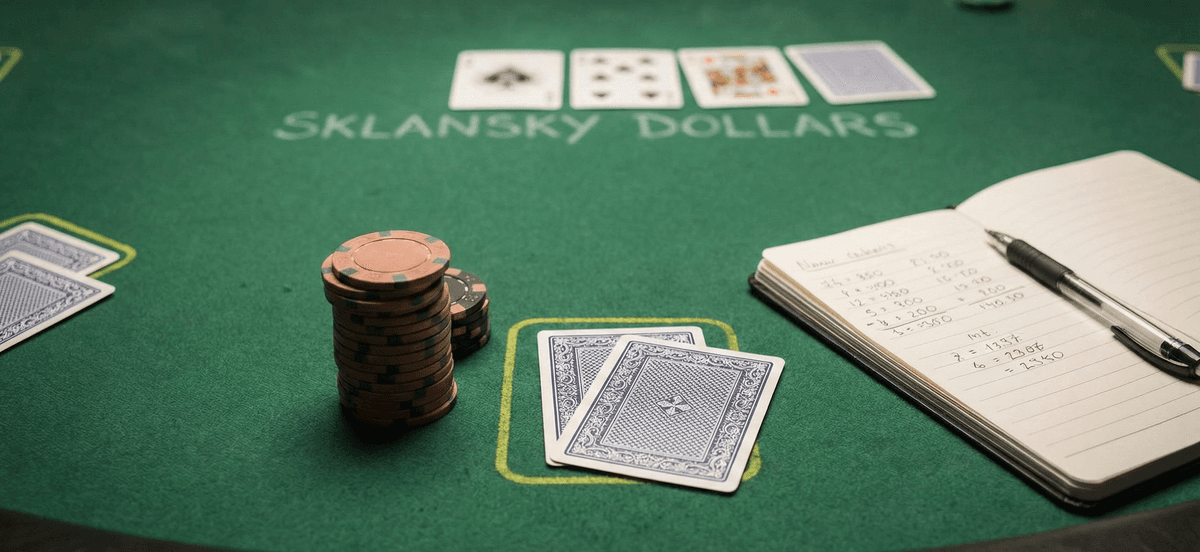
Sklansky Dollars: Understanding True Poker Profitability
In the world of poker, your actual winnings don't always reflect the quality of your decisions. You might make a mathematically perfect play and still lose the pot, or make a terrible decision and get lucky. This is where Sklansky dollars come in—a revolutionary concept that measures your true poker profitability based on the quality of your decisions rather than short-term results.
What are "Sklansky Dollars"?
Sklansky dollars are a theoretical currency named after poker theorist David Sklansky, introduced in his seminal work "The Theory of Poker." They represent the money you would win or lose if every hand was played to completion an infinite number of times. In essence, they measure your expected value independent of variance and luck.
The core principle is simple: Whenever you play a hand exactly as you would if you could see your opponent's cards, you earn your fair share of the pot in Sklansky dollars. When you make a mistake that deviates from perfect play, you lose Sklansky dollars, even if you happen to win the actual pot.
The Fundamental Theorem of Poker
Sklansky's Fundamental Theorem of Poker states:
"Every time you play a hand differently from the way you would have played it if you could see all your opponents' cards, they gain; and every time you play your hand the same way you would have played it if you could see all their cards, they lose. Conversely, every time opponents play their hands differently from the way they would have if they could see all your cards, you gain; and every time they play their hands the same way they would have played if they could see all your cards, you lose."
This theorem is the foundation of Sklansky dollars. Your actual chip stack might fluctuate wildly due to variance, but your Sklansky dollar balance reflects your true skill level.
Sklansky Dollars Example
Let's examine a clear example to understand how Sklansky dollars work:
Scenario:
- You're playing $1/$2 No-Limit Hold'em
- The pot is $100
- You have K♠ Q♠
- The board shows A♠ 10♠ 2♥ 7♣
- Your opponent bets $50 into the $100 pot
- You have a flush draw (9 outs)
Calculating Your Equity
With 9 outs and one card to come:
- Your winning probability: approximately 18% (9 outs × 2)
- Opponent's winning probability: approximately 82%
Pot odds calculation:
- You need to call $50 to win $150 (pot + opponent's bet)
- Pot odds: 150:50 or 3:1 (25% equity needed)
- Your equity: 18%
Since you need 25% equity to call profitably but only have 18%, calling is mathematically incorrect.
Real Money vs. Sklansky Dollars
If you call and hit your flush:
- Real money result: +$150 (you win the $150 pot)
- Sklansky dollars: -$23
Here's why: Even though you won the pot, you made a mathematically -EV decision. Let's calculate the Sklansky dollar loss:
Expected Value of Calling:
- EV = (0.18 × $150) - (0.82 × $50)
- EV = $27 - $41
- EV = -$14
By calling, you lost $14 in Sklansky dollars because you made a decision that, in the long run, loses money. The fact that you got lucky and hit your flush doesn't change the quality of the decision.
If you fold:
- Real money result: $0 (you lose nothing more)
- Sklansky dollars: $0 (correct decision preserves your theoretical equity)
Working Out Sklansky Dollars
Calculating Sklansky dollars requires understanding pot equity. Here's the step-by-step process:
Step 1: Determine Your Equity Percentage
Your equity is your probability of winning the pot if all cards were dealt out. This can be calculated using:
- Counting outs
- Equity calculators
- Experience with common poker probabilities
Step 2: Calculate Your Sklansky Dollar Share
Your Sklansky dollar share = Total Pot × Your Equity Percentage
Example:
- Pot size: $200
- Your equity: 35%
- Your Sklansky dollar share: $200 × 0.35 = $70
Step 3: Compare Action Costs
Compare the cost of various actions to your equity share:
| Action | Cost | Sklansky Dollar Change |
|---|---|---|
| Fold | $0 | -$70 (you lose your equity) |
| Call $50 | $50 | +$20 ($70 equity - $50 cost) |
| Raise to $100 | $100 | -$30 ($70 equity - $100 cost) |
Comprehensive Example
Situation:
- You hold A♥ K♥
- Board: Q♥ J♥ 5♣ 2♠
- Pot: $300
- Opponent bets $150
- Opponent likely has: Top pair (Q-x)
Your hand equity analysis:
- Nut flush draw: 9 outs
- Straight draw: 8 outs (any 10, minus 10♥ counted in flush)
- Overcard outs: 6 outs (3 Aces + 3 Kings, discounted)
- Approximate total: 15 clean outs
- Equity: ~30% (being conservative)
Sklansky dollar calculation:
Current pot equity: $300 × 0.30 = $90
Option A: Fold
- Real money cost: $0
- Sklansky dollars: -$90 (you abandon your equity)
Option B: Call $150
- Real money cost: $150
- New pot: $600
- Your equity in new pot: $600 × 0.30 = $180
- Sklansky dollar gain: $180 - $150 = +$30
Option C: Raise to $400 (adding $400)
- If opponent folds 40% of the time:
- 40% × $450 (current pot) = $180 (immediate win)
- 60% × (equity calculation if called)
- This gets complex but often -EV with just a draw
In this case, calling gains $30 in Sklansky dollars, making it the profitable decision even though there's still a 70% chance you'll lose the pot.
Real Money and Sklansky Dollars
The relationship between real money and Sklansky dollars is crucial to understand:
Short-Term Divergence
In the short term, real money results and Sklansky dollars can diverge dramatically:
Example scenario over 10 hands:
| Hand | Real Money Result | Sklansky Dollar Result |
|---|---|---|
| 1 | +$200 (hit flush) | -$30 (bad call) |
| 2 | -$100 (fold) | +$0 (correct fold) |
| 3 | +$500 (won race) | +$250 (50% equity) |
| 4 | -$300 (lost flip) | -$0 (50% equity) |
| 5 | +$150 (bluff worked) | +$150 (good play) |
| Total | +$450 | +$370 |
Notice that you won $450 in real money but only $370 in Sklansky dollars. This means you got lucky—you won $80 more than you "deserved" based on your decisions.
Long-Term Convergence
Over thousands of hands, your real money results will converge toward your Sklansky dollar expectation. This is why:
- Variance evens out: Lucky breaks and unlucky beats balance over time
- Skill reveals itself: Good decision-making consistently earns Sklansky dollars
- Results reflect quality: Long-term winners earn Sklansky dollars consistently
Long-term example (1,000 hands):
| Time Period | Real Money | Sklansky Dollars | Difference |
|---|---|---|---|
| First 100 hands | +$5,200 | +$3,100 | +$2,100 (lucky) |
| Hands 101-500 | +$8,900 | +$12,400 | -$3,500 (unlucky) |
| Hands 501-1000 | +$18,200 | +$17,800 | +$400 (even) |
| Total | +$32,300 | +$33,300 | -$1,000 |
After 1,000 hands, the real money and Sklansky dollars are within 3% of each other, demonstrating convergence.
What's the Use of Sklansky Dollars?
Understanding Sklansky dollars provides several practical benefits:
1. Evaluating True Performance
Sklansky dollars help you assess your play quality independent of results. This is crucial for:
- Avoiding results-oriented thinking: Just because you won doesn't mean you played well
- Staying disciplined during downswings: Losing money doesn't always mean you're playing badly
- Identifying leaks: You might be winning but leaving Sklansky dollars on the table
2. Decision-Making Under Uncertainty
When facing difficult decisions, thinking in Sklansky dollars helps you:
- Focus on equity: What's my fair share of this pot?
- Ignore sunk costs: Money already in the pot isn't yours unless you have equity
- Calculate precise pot odds: Am I getting the right price?
3. Handling Variance
Understanding Sklansky dollars makes it easier to handle the mental game:
When you're running bad:
- You can analyze if you're truly playing badly or just unlucky
- Track Sklansky dollar performance to confirm good play
- Maintain confidence during downswings
When you're running hot:
- Don't overestimate your skill if you're out-earning Sklansky dollars
- Stay humble and avoid moving up in stakes prematurely
- Keep making +EV decisions regardless of short-term success
4. Learning and Improvement
Sklansky dollars provide a framework for improvement:
| Traditional Analysis | Sklansky Dollar Analysis |
|---|---|
| "I lost that pot" | "Did I play to maximize my equity?" |
| "I'm down $500 today" | "Did I earn or lose Sklansky dollars?" |
| "That call was terrible because I lost" | "That call was correct given the equity" |
5. Software and Tracking
Modern poker tracking software can estimate Sklansky dollars by:
- Analyzing hand histories
- Calculating equity at decision points
- Comparing your actual actions to optimal play
- Showing graphs of real money vs. expected value
This allows you to see patterns:
- Are you consistently losing Sklansky dollars in certain situations?
- Are you running above or below expectation?
- Which parts of your game need improvement?
Sklansky Dollars and the Fundamental Theorem
The connection between Sklansky dollars and the Fundamental Theorem of Poker is direct: every correct decision earns Sklansky dollars, and every mistake costs them.
Applying the Theorem
Scenario: Bluff Catching
You're on the river with a medium-strength hand:
- Pot: $500
- Opponent bets $300
- You have: Second pair
- Opponent's range: 60% bluffs, 40% value hands
Perfect information play: If you could see opponent's cards:
- You'd call when they're bluffing (60% of the time)
- You'd fold when they have value (40% of the time)
Your actual decision (calling):
- You win: 60% × $800 = $480
- You lose: 40% × $300 = -$120
- Net EV: +$360 in Sklansky dollars
By calling, you earn Sklansky dollars because:
- You win your share of the pot when ahead (60%)
- You pay the minimum when behind (40%)
- This matches the "perfect information" scenario
When Opponents Make Mistakes
The Fundamental Theorem states that when opponents deviate from perfect play, you gain. This manifests in Sklansky dollars:
Example: Opponent bluffs $200 into a $300 pot with only 10% equity:
- Their Sklansky dollar share: $300 × 0.10 = $30
- Their cost to bluff: $200
- Their Sklansky dollar loss: $30 - $200 = -$170
You benefit:
- Your equity rises from ~50% to 90%
- Your Sklansky dollars: $500 × 0.90 = $450
- You gained $170 in Sklansky dollars (what they lost)
This is zero-sum: every Sklansky dollar lost by your opponent is gained by someone at the table, usually you.
Limitations of the Theorem
The Fundamental Theorem has limitations:
- Multiple opponents: With multiple players, mistakes don't always benefit you directly
- Future betting rounds: Some "mistakes" on early streets enable profitable plays later
- Psychology: Sometimes "incorrect" plays have exploitative value
- Bluffing: Optimal bluffing strategy requires deliberately losing Sklansky dollars sometimes
Practical Applications and Tools
Hand Analysis Workflow
When reviewing hands, use this Sklansky dollar framework:
-
Calculate equity at decision point
- Use equity calculators or software
- Estimate based on outs and experience
-
Determine pot size and action cost
- Total pot available
- Cost to call, bet, or raise
-
Compute Sklansky dollar EV
- (Pot × Equity) - Action Cost
-
Compare to actual result
- Did you earn or lose Sklansky dollars?
- What's the gap between real money and Sklansky dollars?
Using Tracking Software
Programs like PokerTracker and Hold'em Manager approximate Sklansky dollars through:
- EV adjusted results: Shows what you "should have" won
- All-in EV: Your equity when money goes in
- Expected value lines: Graph showing EV vs. actual results
Sample output:
| Metric | Value |
|---|---|
| Real money won | +$3,450 |
| EV adjusted | +$2,890 |
| Difference | +$560 (running hot) |
| All-in EV | +$3,100 |
This tells you that you're winning slightly more than you "deserve" (+$560) but running below expectation in all-in pots (-$210).
Conclusion
Sklansky dollars represent a powerful mental model for thinking about poker. They separate luck from skill, short-term results from long-term expectation, and good decisions from poor ones. While you can't spend Sklansky dollars at the casino cashier, consistently earning them is the surest path to becoming a profitable poker player.
By focusing on making decisions that earn Sklansky dollars—maximizing your pot equity through sound mathematical play—you ensure that over time, your real money results will reflect your true skill level. When the cards aren't falling your way, you can take comfort in knowing you're still earning your theoretical fair share of every pot.
Remember: poker is a game of decisions, not results. Make enough +EV decisions, earn enough Sklansky dollars, and the real money will follow. As the saying goes, "Play well, and the money will come."
For deeper mathematical understanding, explore our guides on calculating expected value, poker probability, and handling variance. Master these concepts, and you'll be thinking in Sklansky dollars in no time.
⚠️ Responsible Gambling Reminder
While understanding poker strategy and mathematics can improve your game, always gamble responsibly. Set limits, take breaks, and remember that poker involves both skill and chance. For support, visit www.problemgambling.ie.
Related Articles
Understanding Expected Value in Poker: A Complete Mathematical Guide
Master the concept of Expected Value (EV) in poker and learn how to make mathematically profitable decisions at the table. Includes detailed calculations, examples, and practical applications.
Poker Math & Probability: Essential Calculations for Winning Players
Master the fundamental mathematics of poker including pot odds, implied odds, combinatorics, and probability calculations. Essential guide for serious players.
Calculating Expected Value in Poker: Advanced Mathematical Guide
Master expected value calculations in poker. Learn EV formulas, decision trees, multi-street analysis, and advanced concepts for optimal poker strategy.