Unexploitable Bluffing: Achieving Perfect Balance in Poker
Learn the mathematical principles of unexploitable bluffing strategies. Master GTO bluffing frequencies, opponent indifference, and balanced range construction.
Unexploitable Bluffing: Achieving Perfect Balance in Poker
In the evolving landscape of modern poker, unexploitable strategy has become the foundation of high-level play. Understanding how to construct perfectly balanced ranges that cannot be exploited is essential for competing against strong opponents. This guide explores the mathematical principles behind unexploitable bluffing.
The Concept of Unexploitability
What Does Unexploitable Mean?
An unexploitable strategy is one where your opponent cannot gain any advantage regardless of their counter-strategy. In game theory terms, this is known as a Nash Equilibrium strategy.
Key Principle:
When you play unexploitably, your opponent's best response yields them zero additional expected value beyond what you're already giving them.
The Mathematics of Indifference
The core of unexploitable play is making your opponent indifferent between their available options.
Indifference Equation:
EV(Call) = EV(Fold)
When this equation holds true, your opponent gains nothing by deviating from any strategy. This is the essence of unexploitability.
Mathematical Foundations of GTO Bluffing
The Optimal Bluffing Ratio
The mathematical formula for optimal bluffing frequency derives from pot odds and bet sizing.
Alpha (α) - The Bluffing Frequency:
α = Bet Size / (Pot + Bet Size)
Example Calculations:
| Pot Size | Bet Size | α (Bluff Frequency) | Value Frequency |
|---|---|---|---|
| $100 | $50 | 33.3% | 66.7% |
| $100 | $75 | 42.9% | 57.1% |
| $100 | $100 | 50.0% | 50.0% |
| $100 | $150 | 60.0% | 40.0% |
| $100 | $200 | 66.7% | 33.3% |
Why This Formula Works
The formula ensures your opponent breaks even when calling:
From Opponent's Perspective:
When calling bet B into pot P:
- Cost to call: B
- Win when you bluff: P + B
- Lose when you have value: B
Breakeven Equation:
α × (P + B) - (1 - α) × B = 0
Solving for α gives us: α = B / (P + B)
Constructing Unexploitable Ranges
The Range Building Process
Creating unexploitable ranges involves mathematical precision in hand selection.
Step 1: Determine Total Combos Available
Example river situation:
- Total hands you could have: 100 combinations
- Hands that can value bet: 40 combinations
- Potential bluff candidates: 60 combinations
Step 2: Calculate Required Frequencies
Pot = $200, Bet = $150
- Required bluff frequency: 150 / (200 + 150) = 42.9%
- Required value frequency: 57.1%
Step 3: Select Specific Hands
From 100 total combos:
- Value hands: 57 combos (use all 40 available + some marginal)
- Bluffs: 43 combos (selected from 60 available)
Bluff Selection Criteria
Not all bluffs are created equal. Optimal bluff selection considers:
-
Blocker Effects
- Hands that block opponent's calling range
- Hands that unblock opponent's folding range
-
Backdoor Equity
- Hands with some chance to improve
- Straight draws, flush draws, overcards
-
Removal Effects
- Reducing combinations of hands opponent would call with
Multi-Street Unexploitable Play
Sequential Decision Trees
Unexploitable play across multiple streets requires planning your entire strategy tree.
Three-Street Bluffing Frequencies:
When betting $X into pot $P on each street:
Street 1 (Flop):
- Bluff frequency: X / (P + X)
Street 2 (Turn):
- Continuing bluff frequency: X / (P₂ + X)
- Where P₂ = previous pot + previous bets
Street 3 (River):
- Final bluff frequency: X / (P₃ + X)
Geometric Bet Sizing
Using geometric sizing (same % of pot each street) simplifies unexploitable play.
Benefits of Geometric Sizing:
- Consistent bluffing frequencies across streets
- Easier range construction
- Maintains unexploitable balance throughout hand
Example Geometric Sequence:
| Street | Pot | 75% Pot Bet | New Pot | Bluff Frequency |
|---|---|---|---|---|
| Flop | $100 | $75 | $250 | 42.9% |
| Turn | $250 | $188 | $626 | 42.9% |
| River | $626 | $470 | $1,566 | 42.9% |
Notice: Bluff frequency remains constant!
Opponent Indifference and Defense Frequency
The Minimum Defense Frequency
For your bluffs to be unexploitable, opponents must defend enough to make you indifferent to bluffing.
Minimum Defense Frequency (MDF):
MDF = Pot / (Pot + Bet)
MDF Table by Bet Size:
| Bet Size (% of Pot) | MDF Required | Fold Frequency |
|---|---|---|
| 33% | 75% | 25% |
| 50% | 67% | 33% |
| 75% | 57% | 43% |
| 100% | 50% | 50% |
| 150% | 40% | 60% |
| 200% | 33% | 67% |
Making Your Opponent Indifferent
When you construct ranges with optimal bluff frequency, your opponent's EV is identical whether they call or fold perfectly.
Mathematical Proof:
Given: Pot = P, Bet = B, Optimal α = B / (P + B)
If opponent folds perfectly: EV_fold = 0 (gives up pot when you bluff, saves money vs value)
If opponent calls perfectly: EV_call = α × (P + B) - (1 - α) × B = 0
Both strategies yield same EV → Opponent is indifferent!
Practical Implementation
The 4-Step GTO Bluffing Process
1. Calculate Optimal Frequency
α = Bet / (Pot + Bet)
2. Count Available Combinations
- Value hands you want to bet
- Potential bluff candidates
3. Select Bluff Combos Based on α
Bluff Combos = Total Betting Combos × α
4. Choose Best Bluffs
- Maximum blockers to calling range
- Best backdoor equity
- Strategic board coverage
Real-World Application
River Scenario:
Board: K♠ Q♦ 8♣ 3♥ 2♠ Pot: $300 Effective stack: $450 You bet: $300
Step 1: Calculate Frequency α = 300 / (300 + 300) = 50%
Step 2: Count Combinations
- Strong hands to value bet: 35 combos
- Sets, two pairs, straights
- Need total: 70 combos
- Therefore need: 35 bluff combos
Step 3: Select Bluffs Best bluff candidates:
- A♥ J♥ (blocks AK, AQ)
- J♠ T♠ (straight blocker)
- A♦ 9♦ (overcard + blocker)
- 9♠ 7♠ (missed straight draws)
Exploitative Adjustments to GTO Baseline
When to Deviate
While unexploitable play is theoretically optimal, real opponents make mistakes. Recognize when deviation is profitable.
Deviation Value Formula:
EV_deviation = (Opponent Error Rate) × (Average Mistake Size)
Example:
If opponent folds 60% instead of optimal 50%:
- Error rate: 10%
- Average pot: $300
- Value of over-bluffing: $30 per spot
However, this opens you to counter-exploitation!
The Risk-Reward of Exploitation
Considerations:
- Opponent Awareness: How likely are they to adjust?
- Sample Size: Have you observed enough to be confident?
- Game Type: Is this a one-time game or repeated play?
- Stack Depths: How much can exploitation cost you?
Unexploitable Bet Sizing Strategy
Why Bet Size Matters
Different bet sizes require different bluffing frequencies. Unexploitable players use bet sizing strategically.
Polarized Betting Strategy:
Large bets (150%+ pot):
- High bluff frequency required (60%+)
- Naturally more polarized
- Harder for opponent to call
Small bets (33% pot):
- Low bluff frequency (25%)
- More merged ranges
- Easier for opponent to call
Dynamic Bet Sizing
Using multiple bet sizes adds complexity to your unexploitable strategy:
Range-Based Sizing:
- Small bets: 33% pot → 25% bluffs, 75% value (mixed/merged)
- Medium bets: 75% pot → 43% bluffs, 57% value (polarized)
- Large bets: 150% pot → 60% bluffs, 40% value (highly polarized)
Common Mistakes in Unexploitable Play
Error #1: Rigid Frequency Application
Mistake: Always bluffing exactly at calculated frequency
Reality: Frequencies should vary by:
- Board texture
- Position
- Stack depth
- Opponent type (in live play)
Error #2: Ignoring Blocker Effects
Mistake: Random bluff selection
Correction: Choose bluffs that:
- Block strong hands opponent would call with
- Unblock weak hands opponent would fold
Error #3: Over-Bluffing at Equilibrium
Mistake: Thinking more bluffs = more unexploitable
Reality: Exact optimal frequency is crucial. Both over and under-bluffing create exploitable leaks.
Conclusion
Unexploitable bluffing is the foundation of modern poker strategy. By understanding and implementing these mathematical principles, you create a baseline strategy that:
- Cannot be exploited by observant opponents
- Provides optimal EV against any opponent strategy
- Serves as launching point for profitable exploitative adjustments
The formula α = B / (P + B) is your guide to perfect balance. Master this, and you'll play poker that's mathematically sound and strategically unbeatable.
Remember: Unexploitability doesn't mean maximally profitable—it means maximally protected. Use it as your foundation, then adjust based on opponent tendencies for maximum EV.
⚠️ Responsible Gambling Reminder
While understanding poker strategy and mathematics can improve your game, always gamble responsibly. Set limits, take breaks, and remember that poker involves both skill and chance. For support, visit www.problemgambling.ie.
Related Articles
Bluffing and Exploitation: An Introduction to Poker Mathematics
Master the mathematical foundations of bluffing and exploitation in poker. Learn game theory optimal strategies, bluffing frequencies, and how to exploit opponent weaknesses.
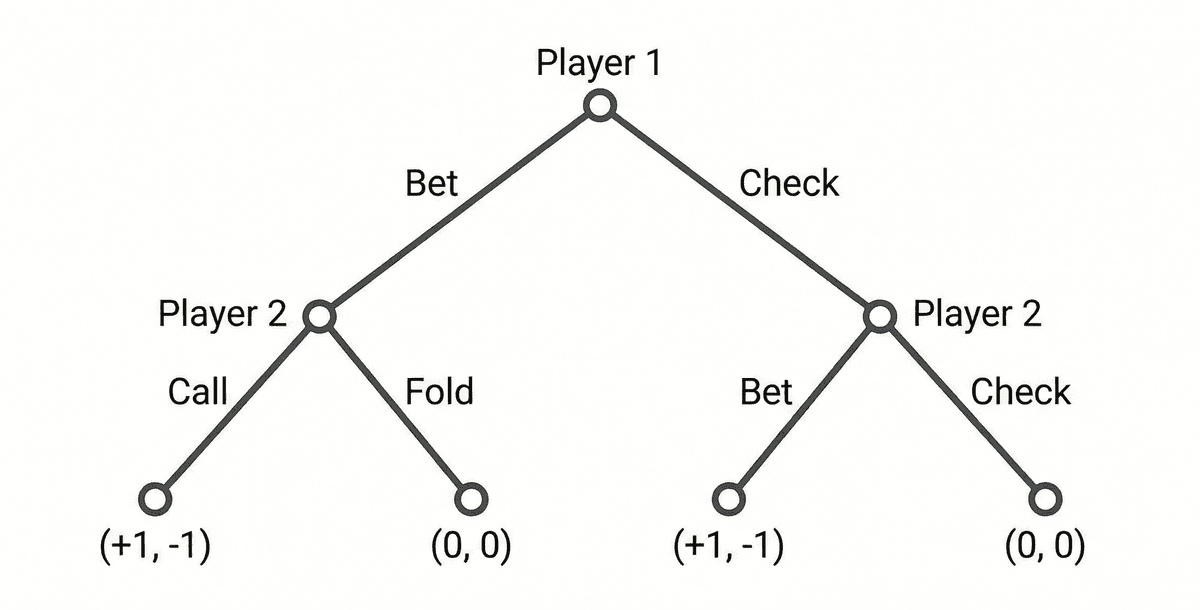
The Decision Tree for the AKQ Game: A Game Theory Analysis
Explore the classic AKQ poker game through decision tree analysis. Learn Nash equilibrium strategies, optimal betting frequencies, and the mathematical foundations of poker game theory.
Poker Equity (Pot Equity): Complete Guide to Understanding Your Share
Master poker equity concepts with detailed examples, calculations, and practical applications. Learn how pot equity determines profitable decisions and maximizes your win rate.