The Texas Sharpshooter Fallacy: How Poker Players Fool Themselves with False Patterns
Understand the Texas Sharpshooter Fallacy and its impact on poker decision-making. Learn to distinguish genuine patterns from random clustering and avoid costly cognitive biases.
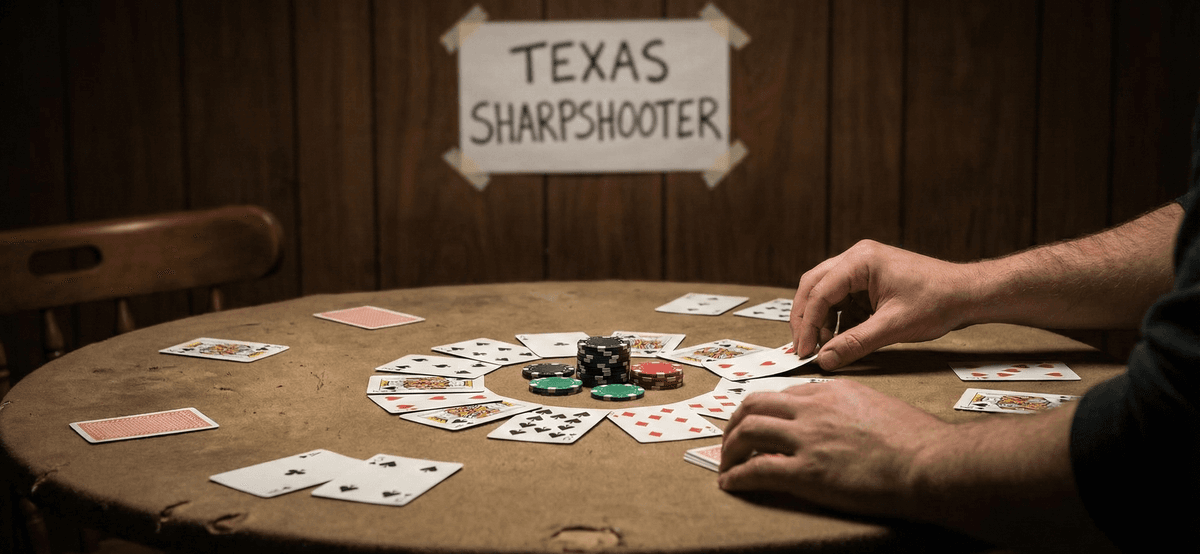
The Texas Sharpshooter Fallacy: How Poker Players Fool Themselves with False Patterns
Picture a cowboy who fires randomly at the side of a barn, then walks up and paints a bullseye around the tightest cluster of bullet holes. "Look at my marksmanship!" he exclaims, pointing to his "perfect" shooting. This is the Texas Sharpshooter Fallacy—drawing conclusions from random data by focusing on clusters after the fact, while ignoring the larger context.
In poker, this cognitive bias is everywhere, and it costs players money every single day. Understanding it can be the difference between strategic improvement and perpetual self-deception.
Understanding the Texas Sharpshooter Fallacy
The Core Concept
The Texas Sharpshooter Fallacy occurs when someone:
- Collects or observes random data
- Notices a cluster or pattern in that data
- Focuses exclusively on that cluster
- Draws conclusions as if the pattern was predicted beforehand
- Ignores all contradictory data points
Mathematical Reality:
Given enough random data, clusters WILL appear by pure chance.

Example: Flip a coin 1,000 times
- Expected outcome: ~500 heads, 500 tails
- Longest expected streak of same result: 8-10 flips
- Probability of 10 heads in a row appearing somewhere: >99%

If you focus on that streak and conclude "the coin is rigged,"
you've committed the Texas Sharpshooter Fallacy.
Why Our Brains Are Vulnerable
Evolution programmed humans to recognize patterns—it was survival-critical. A rustling bush might be wind (harmless) or a predator (deadly). Those who assumed pattern (predator) and erred on the side of caution survived to pass on their genes.
The Evolutionary Trade-off:
| Type of Error | Cost in Evolution | Cost in Poker |
|---|---|---|
| False Positive (See pattern that isn't there) | Small (unnecessary caution) | Medium (bad adjustments) |
| False Negative (Miss pattern that exists) | Large (death) | Large (missed opportunities) |
Result: Our brains default to seeing patterns, even in randomness. In poker, where variance is high and sample sizes are often small, this bias thrives.
Common Texas Sharpshooter Fallacies in Poker
Fallacy #1: The "He Always Has It" Error
The Scenario: You've been playing with an opponent for 2 hours. Three times he's bet the river with a strong hand. You conclude: "This player only bets river when he has the nuts."
The Reality Check:
Sample Data:
- 120 minutes of play
- 30 hands seen
- Opponent went to river 3 times
- All 3 times he bet and showed strong hands

Your Brain: "100% of river bets = strong hands!"

Statistical Reality:
- Sample size: n=3 (laughably small)
- Confirmation bias: You didn't count the 15 times he showed weak hands on earlier streets
- Selective memory: You forgot the river bet he made last session that was a bluff

True Frequency: Unknown, but certainly not 100%
Cost of Error: The 4th time he bets the river, you fold top pair. He shows a missed draw. Your fallacy-driven fold cost you a $200 pot.
Fallacy #2: Card Distribution Patterns
The Scenario: "I've been dealt pocket aces 5 times today, and I've lost with them 4 times. Aces are cursed!"
The Statistical Truth:
Probability of Being Dealt AA: 1/221 hands (0.45%)

Probability AA Wins Heads-Up: ~85%
Probability AA Wins 6-Handed: ~50%
Probability AA Wins 9-Handed: ~35%

Expected AA Outcome in 1,000 Hands:
- Times dealt AA: ~4.5
- Times AA wins: ~1.6 (6-handed)
- Times AA loses: ~2.9

Your Experience (5 dealt, 4 losses):
- Within 1 standard deviation of expected
- Perfectly normal variance
- No curse, just randomness
Real Impact: Players who believe this fallacy start:
- Playing AA too cautiously
- Getting paranoid when action builds
- Making -EV folds in big pots
- Missing value from premium hands
Annual Cost: Studies suggest this bias costs players 1-2bb/100 hands in reduced AA value.
Fallacy #3: Time-Based Superstitions
The Scenario: "I always lose on Tuesday afternoons. The player pool is different."
The Investigation:
Your Tuesday Afternoon Data:
- Sessions played: 8
- Losing sessions: 6
- Total loss: $1,200

Your Conclusion: "Tuesday afternoons are bad for me."

Actual Analysis:
Total afternoon sessions played: 45
- Tuesday: 8 sessions, -$1,200
- Wednesday: 9 sessions, -$400
- Thursday: 7 sessions, +$600
- Friday: 12 sessions, +$2,100
- Saturday: 9 sessions, -$800

Overall afternoon win rate: +$300/session
Tuesday afternoon sample: Too small + recency bias
Statistical significance: None (p > 0.4)

Reality: Random clustering in small sample
The Danger: You now avoid Tuesday afternoons, potentially missing soft games and convenient session times. Your superstition reduced your volume and therefore your profits.
Fallacy #4: "Predictive" Bet Sizing Tells
The Scenario: You notice that twice when a certain opponent bet 60% pot on the river, he had a bluff. You conclude: "When Villain bets 60% pot on river, it's always a bluff."
Sample Size Reality:
Observed: n=2 (60% pot river bets seen)
Result: Both were bluffs

Actual Pattern (from larger database):
Villain's river betting:
- 60% pot bets: 23 total (you saw 2)
  → Bluffs: 9 (39%)
  → Value: 14 (61%)

Your two observations: Cherry-picked by random chance
True pattern: Actually value-heavy at this size

Cost of Belief:
You call next time with weak showdown value
Villain has the nuts
-$300
Distinguishing Real Patterns from False Patterns
The Sample Size Principle
Minimum Sample Sizes for Confidence:
| Metric | Minimum Reliable Sample |
|---|---|
| Overall win rate | 30,000 hands |
| Specific opponent tendency | 300+ observations of that player |
| Situational pattern | 100+ occurrences of exact situation |
| Card distribution | 10,000+ hands per card combination |
| Session timing patterns | 50+ sessions in that time slot |
Quick Math Test:
Formula: Confidence Level = √(Sample Size)

Your Observation: Opponent 3-bets pre-flop 3 out of 4 times
Confidence: √4 = 2 (very low)

Required Sample for 90% Confidence: 81 observations
Required Sample for 95% Confidence: 384 observations

You're making a read based on 1% of the data you need.
Statistical Significance Testing
Before adjusting your strategy based on a pattern, test it:
The Chi-Square Test (Simplified):
Hypothesis: "Opponent bluffs more on flush-completing rivers"

Your Data:
Flush completes: 15 rivers
Opponent bluffed: 8 times (53%)

All other rivers: 40 rivers
Opponent bluffed: 15 times (38%)

Chi-Square Calculation:
Expected bluff frequency: 41.8%
Observed deviation: +11.2 percentage points

Result: χ² = 1.24, p = 0.27

Interpretation:
27% chance this pattern occurred randomly
NOT statistically significant (need p < 0.05)
INSUFFICIENT EVIDENCE to adjust strategy
The Control Group Method
Like a scientist, compare your "pattern" to a control:
Structured Comparison:
Pattern Claim: "I lose every time I play after work"

Test:
Group A (After Work):
- 20 sessions
- Total: -$800
- Avg: -$40/session

Group B (Control - All Other Times):
- 80 sessions
- Total: +$1,200
- Avg: +$15/session

Difference: $55/session

But wait—check for confounding variables:
- After work: Average fatigue score 7/10
- Other times: Average fatigue score 3/10

Possible explanations:
1. Time of day matters (Texas Sharpshooter)
2. Fatigue matters (actual causation)
3. Player pool is tougher after work (actual)
4. Random variance in small sample (likely)

Need: More data + control for fatigue + player pool analysis
Avoiding the Fallacy: Practical Strategies
Strategy 1: Pre-Register Your Hypotheses
Before you start looking for patterns, write down what you expect to find:
Pre-Registration Template:
Date: December 29, 2024

Hypothesis: "Opponent X is extremely tight pre-flop"

Prediction: VPIP < 12%, PFR < 8%

Sample Required: 300 hands

Criteria for Confirmation:
- VPIP must be <12% with 95% confidence
- Will adjust strategy if confirmed

Review Date: [After 300 hands collected]

Result: [To be filled in]

Conclusion: [To be filled in]
This prevents you from cherry-picking data after the fact.
Strategy 2: Devil's Advocate Analysis
For every pattern you think you see, actively look for counter-evidence:
Counter-Evidence Checklist:
Pattern Observed: "Villain is passive on ace-high boards"

Devil's Advocate Questions:
□ How many ace-high boards have I seen? (Sample size)
□ How many times was he aggressive on ace-high boards? (Counter-examples)
□ Was I in position or out of position? (Confounding variable)
□ What was the pre-flop action? (Context matters)
□ How does this compare to his play on king-high boards? (Control)
□ Am I remembering recent hands disproportionately? (Recency bias)

If you can't answer these, you don't have a reliable read.
Strategy 3: Use Database Filters Correctly
Poker tracking software can reveal patterns—or create false ones:
Correct Database Usage:
WRONG: "Let me filter for times I lost with AA and figure out why."
→ This guarantees you'll find patterns in losing hands
→ Texas Sharpshooter Fallacy in action

RIGHT: "Let me look at ALL my AA hands and see if there's a pattern
        in how I play them that correlates with win rate."
→ This examines the full dataset
→ Patterns are meaningful, not cherry-picked
Sample Investigation:
Query: All pocket aces hands (n=234)

Group Analysis:
- AA when I 3-bet pre-flop: 178 hands, +$8,456 (+$47.50/hand)
- AA when I just called pre-flop: 56 hands, -$1,234 (-$22.04/hand)

Difference: $69.54/hand

Sample Size: Adequate for pattern identification
Statistical Significance: p < 0.01 (highly significant)

Conclusion: Real pattern found—I need to 3-bet AA more often
Action Item: Review calling strategy with AA
Strategy 4: The "What If I'm Wrong?" Analysis
Before making a strategic change based on a pattern:
Risk Assessment Framework:
Pattern: "Opponent folds to 3-bets 80% of the time"
Sample: 10 observations (8 folds, 2 calls)

Plan: 3-bet light against this opponent

What if I'm wrong?
- True fold rate might be 50%
- I'd 3-bet with worse hands
- He'd call more, playing OOP with bad range
- Expected loss per instance: ~$25
- Frequency of mistake: High
- Total expected cost: Large

What if I'm right?
- I'll win blinds and antes profitably
- Expected gain per instance: ~$8
- Frequency of success: High
- Total expected gain: Medium

Risk/Reward: Poor until sample size increases

Decision: Wait for 30+ observations before adjusting
Real-World Applications
Application 1: Tournament Variance
Common Fallacy: "I never cash in tournaments. I'm terrible at tournaments."
Reality Check:
Your Tournament Record:
- Tournaments played: 40
- Cashes: 4 (10%)
- Expected cash rate: 15% (typical)

Variance Analysis:
Standard deviation for 40 tournaments: ±8%
Your result (10%): Within 1 SD of expected

Binomial Probability:
P(4 or fewer cashes in 40 tournaments with 15% cash rate) = 18%

Conclusion: Your results are totally normal variance
           You need 300+ tournaments for reliable pattern
Lesson: Don't abandon tournament poker based on small samples. According to Pocketfives, most tournament pros need 500+ MTTs to establish reliable ROI baselines.
Application 2: Card Run Patterns
Common Fallacy: "I've been card dead for 3 hours. I'm due for premium hands."
The Gambler's Fallacy + Texas Sharpshooter:
Your Last 3 Hours:
- Hands played: 180
- Premium pairs (JJ+): 2
- Expected: 180 × (6/221) = 4.9

Analysis:
- Deviation: -2.9 premium pairs
- Standard deviation: ±2.1
- Z-score: -1.38 (not unusual)

Statistical Reality:
Your "card dead" streak is actually within normal variance.
You've cherry-picked 3 hours from potentially hundreds of hours.

The painter-bullseye-after-shooting equivalent:
"These 3 hours were bad" (ignoring all other hours)
Probability Truth:
Probability your next hand is AA: 1/221 (same as always)
The deck has no memory
You are never "due" for cards
Application 3: Multi-Tabling Curse
Common Fallacy: "Every time I 4-table, I lose. When I play 2 tables, I win."
Proper Analysis:
Your Data:
4-tabling: 15 sessions, -$600
2-tabling: 25 sessions, +$1,500

Initial Reaction: "4-tabling is bad for me!"

Deeper Investigation:
4-table sessions:
- Average session length: 1 hour (rushed)
- Time of day: Mostly late night (fatigued)
- Stakes: $2/$5 (higher variance)

2-table sessions:
- Average session length: 3 hours
- Time of day: Mostly afternoon (fresh)
- Stakes: $1/$2 (lower variance)

Confounding Variables Identified:
1. Fatigue difference
2. Stake level difference
3. Session length difference
4. Potentially different player pools

Correct Conclusion:
Can't isolate table count as causative factor.
Need controlled test: 4-table vs 2-table at same stakes,
same time of day, same session length.
How to Train Pattern Recognition Correctly
Build a Pattern Database
Rather than trusting your gut, systematically collect data:
Opponent Pattern Template:
Opponent: PlayerX
Hands Observed: [Running Count]

Situation: Missed c-bet on flop after opening pre-flop
Observations:
1. [Date] - Board: Ks7h2c - Checked - Turn: Bet
2. [Date] - Board: Ac9s4d - Checked - Turn: Checked
3. [Date] - Board: Qh8h3c - Checked - Turn: Bet
[Continue until 30+ observations]

Pattern Hypothesis: [Fill after 30 observations]
Confidence Level: [Calculate statistically]
Strategy Adjustment: [Specific, measurable change]
Practice with Known Data
Use poker simulations where you KNOW the pattern:
Training Exercise:
Create two simulation datasets:
Dataset A: Random player with no pattern (50% bluff, 50% value)
Dataset B: Exploitable player (70% value, 30% bluff)

Test yourself:
Look at 20 observations from each
Try to identify which is which
Check your answer

If you can't reliably distinguish these in simulation with known
patterns, you definitely can't do it reliably in real games!
Consult Community Resources
Don't trust only your own analysis:
- Two Plus Two Forums - Post hands for community analysis
- Reddit r/poker - Discuss patterns with diverse player pool
- PokerStrategy.com - Access pattern recognition training tools
These communities can spot Texas Sharpshooter Fallacies you're blind to.
Conclusion: Paint the Bullseye First
The antidote to the Texas Sharpshooter Fallacy is simple: decide what pattern you're looking for BEFORE you fire the shots. In poker terms:
- Formulate hypotheses before collecting data
- Gather sufficient sample sizes
- Test statistically for significance
- Look actively for counter-evidence
- Separate correlation from causation
Your brain will always try to find patterns in randomness—it's hardwired to do so. But with disciplined thinking and statistical rigor, you can distinguish the genuine strategic patterns that make you money from the false patterns that drain your bankroll.
The next time you think you've spotted a tell, identified a player tendency, or discovered a timing pattern, ask yourself: "Am I a Texas Sharpshooter painting the bullseye after the shots?" If you can't prove otherwise with adequate sample size and statistical testing, the answer is probably yes.
In poker, as in the Wild West, accuracy matters more than confidence. Take aim carefully, measure your shots, and only draw conclusions when the evidence is overwhelming. Your bankroll will thank you.
The difference between a pattern and randomness is often just sample size. Collect the data first, draw conclusions second.
⚠️ Responsible Gambling Reminder
While understanding poker strategy and mathematics can improve your game, always gamble responsibly. Set limits, take breaks, and remember that poker involves both skill and chance. For support, visit www.problemgambling.ie.
Related Articles

Poker and Psychology: Master the Mind Game Behind Every Hand
Explore the psychological foundations of poker success. Learn cognitive biases, emotional control, game theory psychology, and mental frameworks for optimal decision-making.

Analyzing Your Play: Essential Techniques for Poker Improvement
Master the art of self-analysis in poker. Learn systematic review methods, hand history analysis, leak identification, and data-driven approaches to elevate your game.
Dealing with Downswings in Poker: Mental Strategies for Variance
Learn how to handle poker downswings with proven psychological strategies. Master bankroll management, emotional control, and mental resilience during losing streaks.