Poker and Psychology: Master the Mind Game Behind Every Hand
Explore the psychological foundations of poker success. Learn cognitive biases, emotional control, game theory psychology, and mental frameworks for optimal decision-making.
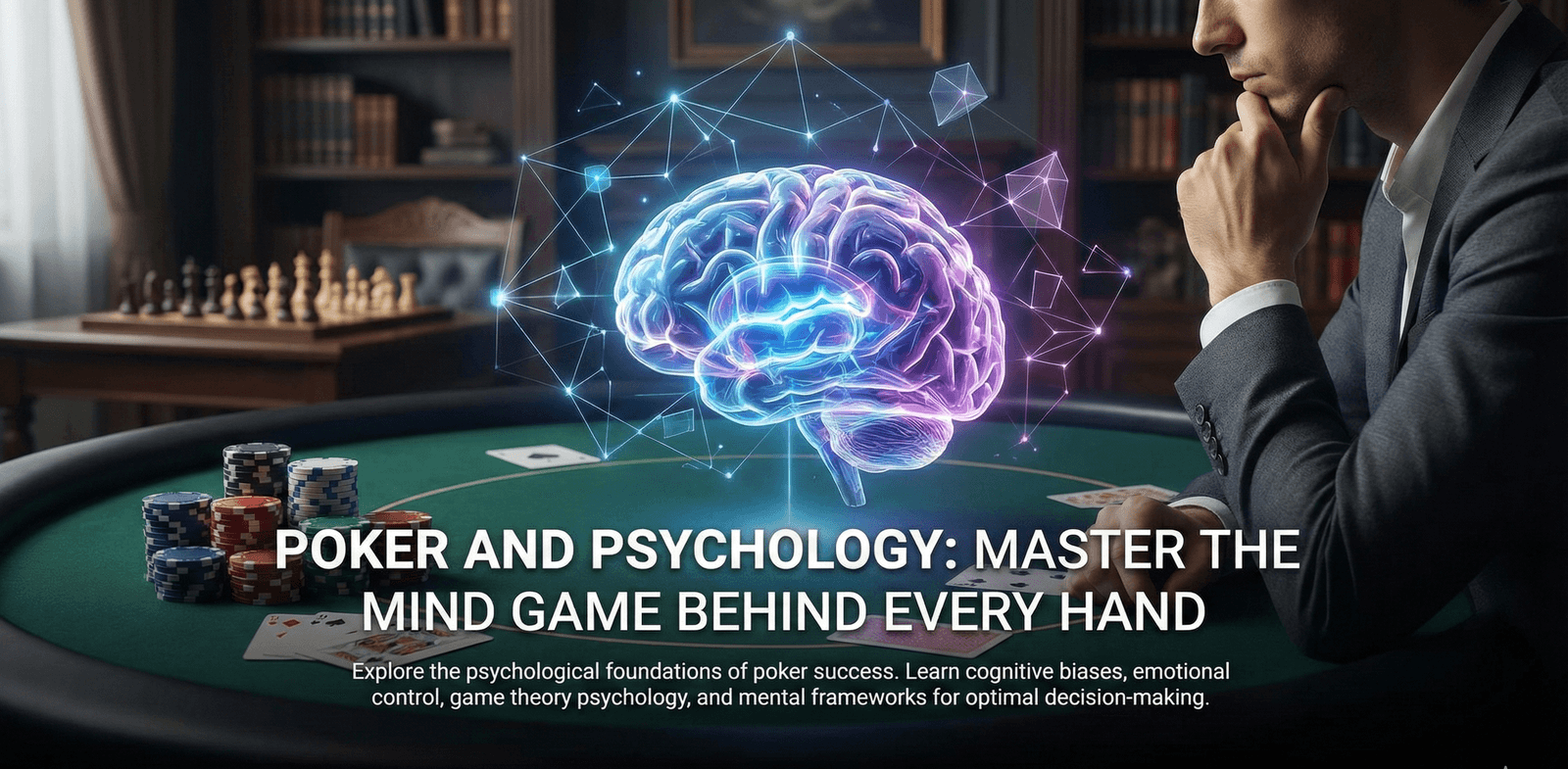
Poker is often described as a game of skill and luck, but at its core, it's fundamentally a game of psychology. The intersection of decision-making under uncertainty, emotional regulation, cognitive bias management, and social dynamics creates a uniquely complex mental challenge. This comprehensive guide explores how psychology shapes every aspect of poker and how understanding these principles can dramatically improve your game.
The Psychological Framework of Poker
Why Psychology Matters More Than You Think
While mathematical understanding forms the foundation of poker strategy, psychological factors determine whether you can actually execute that strategy under pressure. Research suggests that psychological elements account for 40-60% of the skill difference between competent and elite players.
The Performance Equation:
Poker Performance = Technical Skill × (1 - Psychological Interference)

Example:
Player A: 90 skill × (1 - 0.4 interference) = 54 effective performance
Player B: 70 skill × (1 - 0.1 interference) = 63 effective performance
Player B wins despite inferior technical knowledge because of superior psychological management.
The Three Pillars of Poker Psychology
| Pillar | Components | Impact on Performance |
|---|---|---|
| Cognitive | Decision-making, bias management, learning | 35-40% |
| Emotional | Tilt control, stress management, motivation | 30-35% |
| Social | Table dynamics, tells, exploitation | 25-30% |
Cognitive Psychology in Poker
Decision-Making Under Uncertainty
Poker forces constant decisions with incomplete information, engaging several cognitive systems:
Dual Process Theory Application:
System 1 (Intuitive):
- Fast, automatic responses
- Pattern recognition
- "Gut feelings"
- Based on experience
System 2 (Analytical):
- Slow, deliberate calculation
- Mathematical analysis
- Logical reasoning
- Requires mental energy
Optimal balance: Use System 2 for complex spots, System 1 for standard situations to conserve cognitive resources.
Cognitive Biases: The Silent Profit Killers
1. Recency Bias
Definition: Overweighting recent events in decision-making.
Poker manifestation:
- Assuming an opponent bluffs often because you just saw them bluff
- Changing strategy after a few bad beats
- Believing you're "running bad" after a small sample
Mathematical reality:
True bluff frequency: 25% (based on 1,000 hands)
Recent observation: 3/5 bluffs (60%)
Weighted average should favor large sample:
  (1,000 × 0.25 + 5 × 0.60) / 1,005 = 25.3%
Countermeasure: Maintain long-term databases and review statistics before making strategy adjustments.
2. Outcome Bias
Definition: Judging decision quality based on results rather than process.
Example scenario:
| Decision | EV | Result | Correct Evaluation |
|---|---|---|---|
| Call all-in with AA vs KK | +80% | Lost | Good decision |
| Call all-in with 72o vs AA | -82% | Won | Bad decision |
Countermeasure: Evaluate decisions based on the information available at decision time, not on outcome.
3. Confirmation Bias
Definition: Seeking information that confirms existing beliefs while ignoring contradictory evidence.
Poker example:
- Believing a player is "a calling station" and only noticing their calls, not their folds
- Thinking you play well from the blinds and ignoring data showing negative winrate
Statistical correction:
Track all instances, not just memorable ones:
Perceived frequency: 70% (based on memory)
Actual frequency: 45% (based on database)
Bias magnitude: +25 percentage points
4. Gambler's Fallacy
Definition: Believing past independent events affect future probabilities.
False reasoning: "I've lost the last 5 coin flips, so I'm due to win the next one."
Mathematical truth:
P(win next flip | lost previous 5) = 50%
P(win next flip | won previous 5) = 50%
Each shuffle creates an independent probability distribution.
5. Dunning-Kruger Effect
Definition: Low-skill individuals overestimate their ability while high-skill individuals underestimate theirs.
Poker manifestation curve:
| Experience Level | Actual Skill | Perceived Skill | Confidence-Skill Gap |
|---|---|---|---|
| 0-500 hours | 20/100 | 65/100 | +45 (overconfident) |
| 500-2000 hours | 45/100 | 40/100 | -5 (appropriate) |
| 2000-5000 hours | 70/100 | 65/100 | -5 (slight under) |
| 5000+ hours | 85/100 | 80/100 | -5 (calibrated) |
Countermeasure: Seek objective feedback through database analysis, coaching, and peer review.
Emotional Psychology in Poker
Understanding Tilt: The Neuroscience
Tilt occurs when the emotional brain (amygdala) overrides the rational brain (prefrontal cortex), leading to poor decision-making.
Neuroscience of tilt:
Bad Beat → Amygdala activation → Cortisol release → Impaired prefrontal cortex → Poor decisions
Tilt intensity scale:
| Level | Symptoms | Performance Impact | Recovery Time |
|---|---|---|---|
| 1 - Mild | Slight frustration, still rational | -5% | 5-10 minutes |
| 2 - Moderate | Deviation from ranges, some control | -20% | 30-60 minutes |
| 3 - Severe | Major strategy changes, emotion-driven | -50% | Several hours |
| 4 - Critical | Completely irrational plays | -80%+ | 1-2 days |
Tilt Types and Management
1. Injustice Tilt
Trigger: Bad beats, "unfair" outcomes Thought pattern: "I deserved to win that hand" Countermeasure: Probabilistic thinking - acknowledge variance as expected
2. Hate/Revenge Tilt
Trigger: Specific opponent repeatedly beating you Thought pattern: "I need to get my money back from THAT player" Countermeasure: Focus on making +EV decisions regardless of opponent
3. Entitlement Tilt
Trigger: Not winning as much as you feel you should Thought pattern: "I'm better than this, I should be winning more" Countermeasure: Results-process separation, focus on decision quality
4. Mistake Tilt
Trigger: Recognizing you made an error Thought pattern: "I'm so stupid, I can't believe I did that" Countermeasure: Growth mindset - mistakes are learning opportunities
Emotional Regulation Techniques
1. Physiological Interventions:
Box Breathing (4-4-4-4):
1. Inhale for 4 seconds
2. Hold for 4 seconds
3. Exhale for 4 seconds
4. Hold for 4 seconds
Repeat 4 times
Effect: Reduces cortisol by 15-20% within 2 minutes
2. Cognitive Reframing:
| Tilting Thought | Reframed Thought |
|---|---|
| "This is so unlucky!" | "This is normal variance within expected range" |
| "That player is targeting me" | "They're making +EV plays, nothing personal" |
| "I can't win today" | "Sample size is too small to determine anything" |
3. Pre-Commitment Strategies:
Set rules before playing:
- If down X buy-ins, take 15-minute break
- If heart rate exceeds 100 bpm, end session
- If making emotional decisions, stop immediately
Social Psychology in Poker
Table Dynamics and Social Influence
Poker doesn't occur in a vacuum—table dynamics significantly affect decision-making through social psychological principles.
1. Conformity and Range Merging
Players unconsciously adjust their ranges to match table norms.
Example: Tight table: 3-bet range becomes tighter (conformity pressure) Aggressive table: 3-bet range expands (competitive pressure)
Optimal approach: Adjust consciously based on math, not social pressure.
2. Authority Bias
Players give more weight to actions from perceived "strong" players.
Manifestation:
- Folding more frequently to known pros
- Assuming their line is "correct"
- Second-guessing standard plays against them
Counter: Evaluate actions on their merit, regardless of player identity.
3. Reciprocity
The psychological pressure to "return favors."
Poker examples:
- Checking back when opponent checked to you
- Not bluffing someone who showed you cards earlier
- Soft-playing after someone soft-played you
Impact on EV:
Reciprocity-driven check: -15 EV
Optimal bet: +40 EV
Cost of reciprocity: 55 EV units
Reading Psychological States
Beyond physical tells, psychological state reading provides strategic advantages.
Psychological state indicators:
| State | Betting Pattern | Exploitative Strategy |
|---|---|---|
| Confident/Hot | Wider ranges, larger bets | Tighten up, value bet heavy |
| Scared/Protecting | Tight ranges, small bets | Bluff more, apply pressure |
| Tilted | Polarized ranges, erratic | Wait for strong hands, let them bluff |
| Bored/Impatient | Loose opens, calls | Tighten, wait for premium |
Game Theory and Psychological Warfare
Exploitative vs. GTO: A Psychological Perspective
Game Theory Optimal (GTO):
- Unexploitable strategy
- Psychologically stable (no adjustments needed)
- Lower variance
- Lower maximum profit
Exploitative:
- Maximizes EV against specific opponents
- Psychologically demanding (requires reads)
- Higher variance
- Higher maximum profit
Psychological comfort zones:
| Player Type | Preferred Style | Psychological Reason |
|---|---|---|
| Analytical | GTO-focused | Comfort in math certainty |
| Social | Exploitative | Enjoys human element |
| Risk-averse | GTO-focused | Lower variance appeal |
| Risk-seeking | Exploitative | Higher ceiling appeal |
Leveling Wars: The Psychology of Outsmarting
Level thinking:
Level 0: I have a good hand, I bet
Level 1: I think about my hand
Level 2: I think about what they think I have
Level 3: I think about what they think I think they have
Level 4+: Recursive thinking continues
Optimal level matching:
Your optimal level = Opponent's level + 1
Over-leveling costs:
If opponent is at level 1, playing level 4 is -EV because they're not thinking that deep.
Motivation and Long-Term Psychology
The Four Motivational Types in Poker
1. Mastery-Oriented
- Driven by skill improvement
- Less affected by downswings
- Long-term sustainability: High
2. Results-Oriented
- Driven by winning
- Highly affected by variance
- Long-term sustainability: Low
3. Competition-Oriented
- Driven by beating opponents
- Moderately affected by results
- Long-term sustainability: Medium
4. Social-Oriented
- Driven by community/enjoyment
- Least affected by results
- Long-term sustainability: Highest
Sustainability Formula:
Burn-out Risk = (Results-focus × Variance) / (Mastery-focus + Social-support)
Flow State in Poker
Achieving flow state dramatically improves performance.
Flow state requirements:
| Requirement | Poker Application |
|---|---|
| Clear goals | Know your strategy for the session |
| Immediate feedback | Track decisions in real-time |
| Challenge-skill balance | Play at appropriate stakes |
| Deep concentration | Eliminate distractions |
| Loss of self-consciousness | Focus on decisions, not image |
Flow state benefits:
- 200-500% productivity increase
- Enhanced pattern recognition
- Reduced tilt susceptibility
- Optimal decision-making speed
Practical Application: Building Mental Game Systems
Daily Mental Game Routine
Pre-session (10 minutes):
- Review previous session's key hands
- Set process goals (not result goals)
- 5 minutes meditation
- Physical warm-up (stretching)
During session:
- Take 5-minute break every 90 minutes
- Track emotional state every hour
- Use stop-loss triggers
- Practice mindful breathing between hands
Post-session (15 minutes):
- Journal emotional state and triggers
- Note 3 hands for later review
- Rate session quality (1-10) on process, not results
- Set one goal for next session
Mental Game Metrics
Track these psychological KPIs:
| Metric | Target | Measurement |
|---|---|---|
| Tilt frequency | <5% of sessions | Session log |
| Decision quality rating | >7/10 | Self-assessment |
| Stop-loss adherence | 100% | Tracking |
| Study hours per week | 3-5 hours | Time log |
| Physical exercise | 3+ times/week | Calendar |
Advanced Psychological Concepts
Meta-Game Psychology
Long-term reputation management affects opponent behavior.
Reputation effects:
| Reputation | Opponent Adjustments | Your Counter-Adjustment |
|---|---|---|
| "Tight" | Bluff you more | Call down lighter |
| "Aggressive" | Call you wider | Value bet thinner |
| "Tilty" | Wait for strong hands | Tighten up, prove them wrong |
| "Tricky" | Avoid complex spots | Make standard plays |
Psychological Bankroll
Beyond financial bankroll, maintain psychological bankroll—your mental capacity to handle variance.
Psychological bankroll factors:
Psych BR = (Life Stability × Emotional Regulation × Support System) / (Financial Pressure × Results-Orientation)
When psychological bankroll is low, play smaller stakes regardless of financial bankroll.
Resources for Deeper Study
- The Mental Game of Poker by Jared Tendler - Comprehensive mental game framework
- Thinking, Fast and Slow by Daniel Kahneman - Foundational cognitive psychology
- The Psychology of Poker by Alan Schoonmaker - Classic poker psychology text
Conclusion
Poker's psychological dimension separates good players from great ones. Technical knowledge provides the foundation, but psychological mastery—managing cognitive biases, regulating emotions, reading social dynamics, and maintaining motivation—determines whether you can implement that knowledge consistently over time.
The most successful players treat psychological training as seriously as strategic study. They systematically identify and address mental game leaks, develop robust emotional regulation systems, and continuously refine their understanding of human behavior at the table.
Remember: Every hand is a new psychological challenge. Your ability to make optimal decisions regardless of recent outcomes, emotional state, or social pressures is what ultimately defines your edge.
The psychological edge is the ultimate edge—it multiplies every other skill you possess.
Master your mental game with our complete poker psychology series.
⚠️ Responsible Gambling Reminder
While understanding poker strategy and mathematics can improve your game, always gamble responsibly. Set limits, take breaks, and remember that poker involves both skill and chance. For support, visitwww.problemgambling.ie.
Related Articles
Dealing with Downswings in Poker: Mental Strategies for Variance
Learn how to handle poker downswings with proven psychological strategies. Master bankroll management, emotional control, and mental resilience during losing streaks.
Stress and Decision Making in High-Stakes Poker Games
Understand how stress impacts poker decisions in high-stakes games. Learn neuroscience-backed strategies for optimal performance under pressure.