Live Blackjack Ireland — Real Dealer Tables & Bonuses
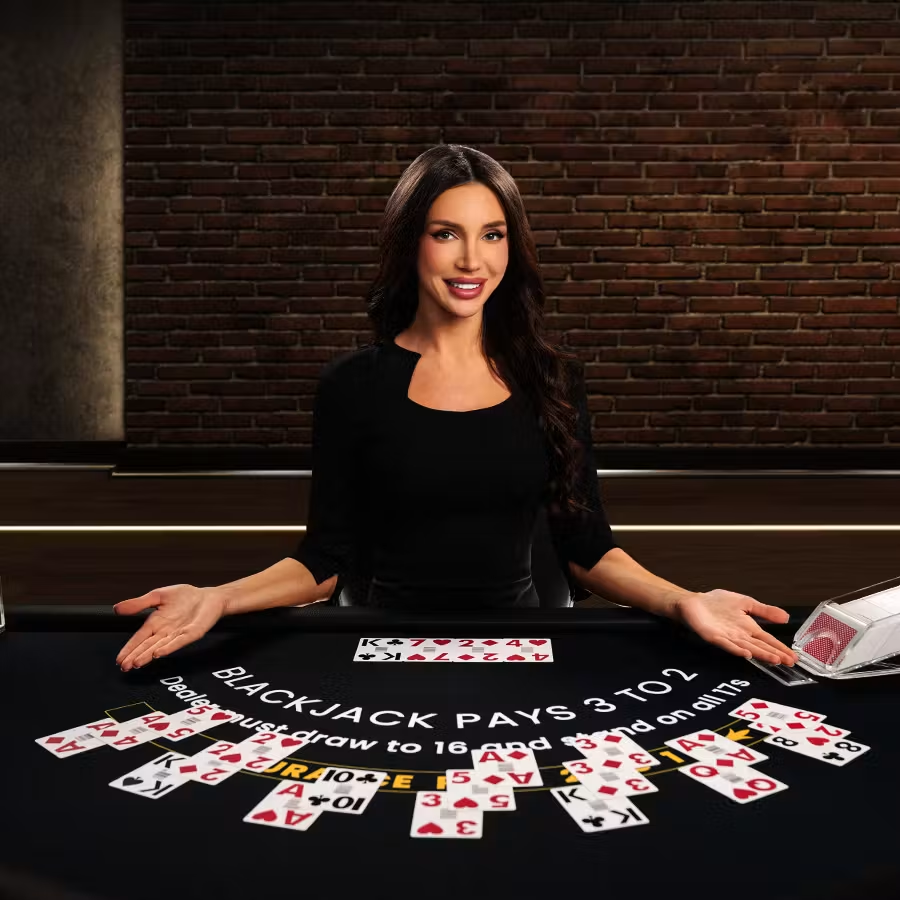
Live blackjack brings the classic 21 to your screen with a real dealer streaming from a studio in real time, instead of a random number generator deciding the shuffle. You place your bets, watch the cards land, and chat with the dealer just like you would at a physical table — only from your phone or laptop. For rules, 3:2 vs 6:5, basic strategy, and RNG demo play, see our online blackjack guide.
How we rate casinos: we check licensing for every listed brand, then score bonuses, games, payments, support and trust across five rating pillars. Where we run hands-on account tests — signup, deposit and withdrawal timings — those findings feed the score for that brand. Read our trust methodology.
It's the closest thing to a Vegas or Monte Carlo table you'll get without leaving home, and for a lot of Irish players it's simply more fun to watch a real shuffle than to trust an algorithm. It's also more transparent: you see every card dealt, in order, on camera.
This page goes deeper than our main live casino guide specifically on blackjack — the variants available, how the rules differ between them, and which Irish-facing casinos actually have the table range and stakes to match what you're looking for. For payouts, house edge, and basic strategy that apply to both RNG and live tables, see online blackjack.
How Live Blackjack Works
Once you load a table, you'll see a live HD video feed of the dealer and the table, a betting panel along the bottom, and a chat window to the side.
Betting window: Each round opens with a betting timer, usually 12–15 seconds, during which you place your main bet (and any side bets) using the on-screen chip panel.
The deal: Once betting closes, the dealer deals two cards to each active seat and two to themselves — one of the dealer's cards is shown face up.
Your turn: Buttons appear for hit, stand, double, and split where applicable. You have a short window (usually 10–15 seconds) to act before the system defaults to standing.
Side bets: Most tables offer optional side bets alongside the main hand — Perfect Pairs (betting your first two cards form a pair) and 21+3 (combining your first two cards with the dealer's up card into a poker hand) are the two you'll see most often.
Chat box: You can talk to the dealer and other players at the table between hands. Keep it friendly — dealers moderate the chat, and disruptive behaviour can get you removed from a table.
Payout: Winnings are settled automatically and added to your balance the moment the round resolves.
Live Blackjack Variants
Not all live blackjack tables play the same. Here's how the main variants you'll find at Irish-facing casinos differ:
Vegas Blackjack
The standard, classic ruleset most players learn first — dealer stands on soft 17, splits and doubles follow familiar Vegas-style rules, and it's usually available at multiple stake levels at any given casino. This is the one to start on if you're new to live blackjack.
Live Common Draw Blackjack
A shared-card format where every player at the table acts on the same dealt cards rather than each player getting their own hand — it plays faster and supports far more seats per table than a standard format, since players aren't waiting on individual card sequences.
Macau Blackjack
Popular with high rollers, Macau Blackjack tables typically run at higher stakes with a studio styled after Asian VIP rooms. Ruleset is close to Vegas Blackjack, but the higher table limits are the main draw.
Speed Blackjack
Cuts the betting window and decision time roughly in half compared to a standard table — cards are dealt to all seven seats simultaneously and players act at the same time rather than in turn, so far more hands get played per hour. Good for players who find standard tables slow-paced.
Infinite Blackjack
Removes the seat limit entirely — any number of players can join a single table and bet on the same hand, so there's never a wait for a spot. Comes with an expanded set of side bets (typically including Bust It and Hot 3), and often slightly different payout rules on certain double/split scenarios to balance the unlimited-seat format, so it's worth checking the table's specific rule sheet before you sit down.
Power Blackjack
Built around a "draw and double" mechanic: the initial 10s and 5s are removed from the deck, and players can double on any number of cards, not just their first two. This shifts the odds and pacing meaningfully compared to a standard game, so it plays quite differently even though the goal is still 21.
Blackjack Rules & Basic Strategy
The core aim never changes: get closer to 21 than the dealer without going over. Face cards count as 10, aces count as 1 or 11, and everything else counts at face value.
Hit: Take another card.
Stand: Keep your current hand and end your turn.
Double (double down): Double your bet in exchange for exactly one more card, then stand.
Split: If your first two cards match in value, split them into two separate hands, each with its own bet.
House edge varies by variant and by the specific rule set (number of decks, whether the dealer hits or stands on soft 17, doubling restrictions), but a well-played standard blackjack table typically sits in the 0.5%–1% range when following basic strategy — among the lowest house edges of any casino game.
Deck count itself has a small but real effect: a single-deck game deals a natural blackjack around 4.8% of the time, against roughly 4.6% in an eight-deck shoe. It sounds marginal, but it's enough that single- and double-deck tables generally carry a slightly lower house edge than the six- or eight-deck shoes most live tables use — worth factoring in if a casino offers both.
Basic strategy is a set of mathematically-derived decisions for every possible hand versus every possible dealer up card — it tells you the statistically best play (hit, stand, double, or split) without tracking or predicting future cards. It's entirely legal to use at any table, live or otherwise. The full chart and 3:2 vs 6:5 notes are in our blackjack rules guide. We'd note that card counting — tracking the ratio of high to low cards remaining in the shoe to predict future hands — is a different technique that most live casinos actively guard against with continuous shuffling machines or frequent reshuffles, and isn't something we cover or recommend here.
Blackjack Basic Strategy Chart
The statistically correct play for every hand, based on your two cards and the dealer's up card. Tap a tab to switch between hard totals, soft totals, and pairs.
HHit
SStand
DDouble (Hit if not allowed)
PSplit
Your Hand
2
3
4
5
6
7
8
9
10
A
17+
S
S
S
S
S
S
S
S
S
S
16
S
S
S
S
S
H
H
H
H
H
15
S
S
S
S
S
H
H
H
H
H
14
S
S
S
S
S
H
H
H
H
H
13
S
S
S
S
S
H
H
H
H
H
12
H
H
S
S
S
H
H
H
H
H
11
D
D
D
D
D
D
D
D
D
H
10
D
D
D
D
D
D
D
D
H
H
9
H
D
D
D
D
H
H
H
H
H
8 or less
H
H
H
H
H
H
H
H
H
H
Assumes standard multi-deck rules: dealer stands on soft 17, double after split allowed, no surrender. Some tables vary — check the rules on your specific table before relying on this chart.
Why the chart tells you to stand on high totals
Your chance of going bust climbs fast as your hand total increases — which is exactly why standing becomes the statistically better play at 12+ against most dealer up cards.
Total 12
31%
Total 13
39%
Total 14
56%
Total 15
58%
Total 16
62%
Total 17+
69%+
Two mistakes come up constantly even among experienced players: standing on a soft 18 (an ace and a 7) against a dealer 9 or 10, when hitting gives you a real chance to improve without busting; and splitting a pair of 10s out of habit, when standing on 20 is almost always the stronger play. The chart above accounts for both.
If a dealer's up card is an ace, you'll usually be offered an insurance side bet — essentially a wager on whether the dealer has blackjack. It pays out if they do, but it carries a notably higher house edge than the main game, so most basic-strategy players skip it rather than treat it as a hedge.
Live Blackjack Tournaments
Tournament blackjack is a different format from the regular tables above — instead of playing against the house for your own bankroll, you're competing against other players over a set number of hands, with prizes going to whoever finishes with the most chips or the highest leaderboard score.
Online Casino Blackjack Tournaments
This is where most real-money blackjack tournaments actually happen for Irish players. The common formats are:
Leaderboard tournaments: You play blackjack hands as normal during a set window (often a weekend or a week), and every wager or win earns you points toward a live leaderboard. Prizes — cash, free spins, or bonus funds — go to the top finishers when the window closes.
Buy-in tournaments: A smaller number of players pay a fixed entry fee and are given an equal starting chip stack, then compete head-to-head over a fixed number of hands, similar in structure to a poker tournament. These are less common on live dealer platforms specifically and more typical of RNG blackjack tournament software.
Freerolls: No entry fee required, usually tied to a loyalty programme or a promotional event, with a fixed prize pool split among top finishers.
If you're looking for one, check the promotions or "tournaments" tab of your chosen casino rather than the live lobby itself — they're usually run as a separate promotional feature layered on top of the regular tables, and entry terms (minimum stake per hand, eligible tables, wagering on any prize won) vary by operator, so read the specific rules before entering.
Blackjack Tournaments at Land-Based Casinos in Ireland
It's worth being upfront about this: dedicated, regularly scheduled blackjack tournaments are hard to find at Ireland's land-based venues. Ireland's licensed gaming scene is built mostly around private members' clubs rather than full casinos, and where those clubs run structured tournaments, they're almost always poker, with blackjack offered as a standard house game rather than a tournament format.
Macau Sporting Club in Cork operates a full casino floor with blackjack, roulette, and other table games, but its scheduled tournament programme centres on nightly and weekly poker events rather than blackjack.
The Eglinton in Galway is a members' card club offering Texas Hold'em and Omaha tournaments through its Tournament League, with blackjack available as one of the house games rather than as a competitive tournament format.
For a one-off blackjack tournament — a birthday, work event, or fundraiser — companies like Fundraising Events Group hire in blackjack and roulette tables for "fun casino" nights. It's worth noting this is play-money entertainment rather than licensed real-money gambling, so it's a different category from everything else on this page.
If you specifically want to compete in a blackjack tournament for real money, an online casino tournament is currently the more realistic route for Irish players than a dedicated land-based event.
How We Review Live Blackjack Tables
We test blackjack specifically at every casino we recommend: sitting at Vegas, Speed, and Infinite tables to check actual seat availability during peak hours, confirming the displayed min/max stakes match what loads at the table, timing the betting window and decision clock, and checking stream quality and dealer pace across multiple sessions. Table counts and variant lists in the comparison below reflect what we found live, not what's listed in the casino's marketing copy.
No. Every card is dealt live on camera by a human dealer using a physical deck (or a certified automatic shuffler), so there's no algorithm deciding outcomes behind the scenes the way there can be a perception around RNG games. Reputable providers like Evolution Gaming and Pragmatic Play Live are independently audited by testing labs such as eCOGRA or iTech Labs, and licensed Irish-facing casinos are required to use certified, regulated software.
What's the minimum bet for live blackjack in Ireland?
It varies by casino and table. Standard Vegas Blackjack tables often start as low as €0.50–€1, while Macau or VIP-style tables can start at €25 or higher. Check the table thumbnail in the lobby before joining — minimum and maximum stakes are always displayed.
Can I play live blackjack for free?
No — live blackjack requires real money betting, since a real dealer and studio are involved in every hand. If you want to practise the rules or basic strategy risk-free first, use an RNG blackjack demo — our online blackjack guide covers demo vs live — then move to a live table once you're comfortable.
What's the house edge on live blackjack vs RNG blackjack?
They're broadly similar — both typically sit around 0.5%–1% with basic strategy on a standard ruleset, since the underlying game rules (not the delivery method) are what drive the edge. Specific live variants like Power Blackjack or Infinite Blackjack can shift the edge slightly due to their modified rules, so it's worth checking a table's specific payout sheet if the exact percentage matters to you.
Are there real blackjack tournaments I can enter in Ireland?
Yes, but mostly online. Several Irish-facing casinos run periodic blackjack leaderboard tournaments or freerolls as promotions — check the "tournaments" or "promotions" tab. Land-based options are more limited: Ireland's licensed venues, such as Macau Sporting Club in Cork or The Eglinton in Galway, run structured tournament programmes around poker rather than blackjack, though blackjack tables are available to play. For a one-off event, private "fun casino" companies can hire in blackjack tables for entertainment purposes, though that's play-money rather than real-money gambling.