The Complete Guide to Casino Licences: What Irish Players Need to Know in 2026
Selecting the site where you'd like to play your online casino games includes more elements apart from game variety and free spins. For Ireland-based players, getting a gambling license that ensures fairness and security behind a casino is the main reason that the place is trusted and you are protected by law. From a global perspective, iGaming industry has been going through many exciting changes as well as new developments, Ireland also has been introducing its new Gambling Regulatory Authority - the Gambling Regulatory Authority of Ireland (GRAI). Until GRAI issues remote-gaming licences, the Malta seal Irish players use most is covered on MGA casinos, the UK Gambling Commission seal is on UKGC casinos, Gibraltar’s Gambling Division is on Gibraltar casinos, and post-LOK Curaçao (OGL vs legacy JAZ) is on Curaçao casinos. For the Act itself — dates, advertising, tax and penalties — see gambling regulations in Ireland. For a shorter player FAQ — is this legal for me? — see Irish gambling laws for players. Live betting-vs-gaming dates stay on the GRAI licence tracker.
How we rate casinos: we sign up, deposit, check bonuses, games, payments, support, withdrawals, and licensing, then score each site across five rating pillars. Read our trust methodology.
The grid above mixes regulators. For Malta-only brands we have reviewed, see MGA casinos. For UK Gambling Commission brands, see UKGC casinos. For Gibraltar Gambling Division brands, see Gibraltar casinos. For Curaçao (CGA/OGL) brands, see Curaçao casinos. Ireland's own GRAI casino-licence status is on GRAI casinos.
Along with explaining each casino license the world has to offer, this guide rates them from the point of view of an Irish player, and tells you precisely which license logo to look for before you make the deposit of a euro.
How We Check & Rate Gambling Licence
We rate the areas of gambling regulation on factors like how strong regulations are, how players are protected, market access, banking integration, trustworthiness, and how well Irish residents will be treated. In this section, we have gone through Gambling Regulation Act 2024, UK Gambling Commission fee schedules (1 October 2026), Malta Gaming Authority structures, and GRAI official documents, among others, to come to the final ranking of regulators.
What Is a Casino Licence?
A casino licence is a formal authorization from a government authorities/regulators which allows the gambling house operator to run the games legally. A licence Still is much more than just a piece of document paper; actually it is a binding commitment to a contract which, by its very nature, compels the operator to meet the stringent requirements.
Why a licence matters
The presence of a licence makes the operator the regulator's accountable. In case of a licensed casino which does not pay your winnings, which loses your data or what is worse, which has rigged you out, you will be able to file the complaint with the competent authority. An illegal gambling operator does not give you any kind of guarantee.
Licensed operators have to:
Adhere to country and state gambling laws
Put Anti-Money Laundering (AML) and Know Your Customer (KYC) measures into place
Keep apart the customers' funds - this means the player's money is physically separate from the casino business
Deploy certified Random Number Generators (RNGs) in all gambling products to ensure fair games
Provide players with responsible gambling facilities - deposit limits, voluntary exclusion, reminders
Periodically be audited by third-party testing laboratories
Pay up the stakes quickly upon winners and handle the rest of the issues formally through the designated departments within a casino
Ireland's New Gambling Landscape: The GRAI Era
The Gambling Regulation Act 2024
Ireland has undergone its most significant gambling reform in nearly a century. The Gambling Regulation Act 2024 replaces the outdated Betting Act 1931 and Gaming and Lotteries Act 1956, establishing a modern, centralized framework. Casino-licence status lives on GRAI casinos. Live betting-vs-gaming dates stay on the GRAI licence tracker.
Key milestones
Oct 2024 — Act signed into law
Mar 2025 — GRAI formally established
9 Feb 2026 — GRAI licensing function commenced; B2C betting applications open
1 Dec 2026 — Old in-person betting licences expire; GRAI in-person betting licences required
2027–2028 — Remote gaming (casino) licence applications open (GRAI phasing) — none issued yet as of August 2026
What changes for players (at GRAI-licensed operators)
Credit card gambling ban
National Gambling Exclusion Register
Deposit caps set by the GRAI
Watershed advertising ban (5:30 am – 9:00 pm)
VIP and high-roller schemes banned
Fines up to €20 million or 10% of turnover
GRAI Licence Types
The GRAI issues three broad categories of licences:
1. Business-to-Consumer (B2C) Licences
Licence Type
Description
Remote Betting Licence
Authorises betting activities offered online, by phone, or via remote means to Irish residents
In-Person Betting Licence
Authorises betting services from physical premises in Ireland
Remote Betting Intermediary Licence
Authorises betting exchanges and prediction markets
Remote Gaming Licence
Authorises online casino games (slots, table games, live dealer)
In-Person Gaming Licence
Authorises casino-style games at physical premises
Remote Lottery Licence
Authorises online lottery products
Hybrid (In-Person & Remote)
Combined licence for operators conducting both physical and online gambling
2. Business-to-Business (B2B) Licences
Permits the sale or supply of gambling products and services to other licensed businesses — game developers, platform providers, risk management services, and software suppliers. Previously, B2B providers did not need a licence in Ireland.
3. Charitable/Philanthropic Licences
For non-profit organisations running gaming or lottery activities for fundraising. At least 30% of proceeds must go toward a recognised charitable goal.
GRAI vs MGA vs UKGC vs Gibraltar — What Irish players gain
GRAI (Ireland — future): Domestic legal protection, National Exclusion Register, credit card ban, deposit caps, and direct enforcement by an Irish regulator. No offshore jurisdictional barriers.
MGA (Malta — now): Full EU legal standing, GDPR data protection, 10-year licence stability, and the widest pool of premium operators already serving Ireland. Verify a number and see the brands we list on MGA casinos.
UKGC (UK — now): The strictest affordability checks, mandatory problem-gambling levies, stake limits on slots, and the most rigorous dispute resolution in the world. Verify an account number and see the brands we list on UKGC casinos.
Gibraltar (now): A Tier 1 alternative with a smaller operator pool. Verify a Gaming Operator on the official holders list and see the brands we list on Gibraltar casinos.
Bottom line: Until GRAI casino licences are live, MGA, UKGC and Gibraltar offer the strongest protection for Irish players. Once GRAI remote gaming opens, it will become the domestic gold standard.
Important legal note (as of August 2026): The GRAI is still in a phased rollout. The Act, advertising watershed, tax summary and penalties are on gambling regulations in Ireland. Betting licences are in the first wave (remote from 1 July 2026; in-person from 1 December 2026). No GRAI remote gaming (casino) licences have been issued yet — we track that status on GRAI casinos. Gaming and lottery applications open later; B2B follows after that. Until then, Irish players continue to rely on offshore-licensed casinos (typically MGA or Estonian). Credit card bans, VIP bans, and the National Exclusion Register apply to GRAI-licensed operators — not automatically to every MGA or UKGC site serving Ireland. Any operator claiming to hold a "GRAI casino licence" today should be treated with extreme scepticism.
The Global Licence Tier System
Not all licences are created equal. We rate casino licences on a three-tier system based on regulatory strength, player protection, market access, and credibility.
AI generated image
🥇 Tier 1 — Elite Regulators
The most prestigious, strictly regulated licences. Highest player protection, rigorous compliance, recognised by major banks. For Irish players, these are the safest options.
Reputable jurisdictions with strong frameworks but slightly less oversight than Tier 1. Good player protection and reasonable credibility.
Examples: Estonia, Kahnawake, Nevis
🥉 Tier 3 — Offshore / Lighter Regulators
Faster market entry with lighter compliance. Player protection is limited, and Irish/EU banking restrictions are more common. Post-LOK Curaçao is no longer cheap, but it still sits below Tier 1/2 on recourse and reputation. Proceed with caution.
Under the old Curaçao regime, operators could run under a "master licence" or "sub-licence" without direct regulatory oversight. The LOK 2023 reform eliminated this system. If you see a casino still referencing a Curaçao "sub-licence" or "master licence holder," that model no longer exists — verify they hold a direct CGA licence instead. How to tell an OGL number from a legacy 8048/JAZ string is on Curaçao casinos.
Detailed Licence Profiles & Ratings for Irish Players
Unmatched player protection and dispute resolution
Mandatory contributions to problem gambling programmes
Strict stake limits (£5 spin for 25+; £2 for 18–24)
Recognised by Irish banks and payment providers
Full legal recourse for Irish players
Cons
Very expensive for operators (six-figure annual fees common at mid/large GGY)
High compliance burden (LCCP customer interaction, assurance statements) means fewer operators hold it
Does not grant legal operation in Ireland alone
The UKGC is widely regarded as the strictest and most respected iGaming regulator globally. UK-licensed operators must adhere to world-class anti-fraud, AML, and responsible gambling policies. Fees sit under the Gambling (Licence Fees and Annual Fees) Regulations 2022 and are banded by gross gambling yield (stakes minus winnings).
The UKGC recently introduced a mandatory annual levy generating ~£100 million for problem gambling research, prevention, and treatment programmes.
Irish Player Rating: ⭐⭐⭐⭐⭐ (5.0/5) — The Gold Standard
The player-facing UKGC guide — how to verify an account number, stake limits, the ADR path, and the brands we list — is on UKGC casinos.
The MGA is the most prestigious EU gambling licence. It enforces strict compliance with EU directives on data protection, consumer rights, and AML. MGA-licensed casinos are the most common among premium European brands serving Ireland. How to verify a Malta number, licence types, and the brands we list are on MGA casinos.
MGA Game Types:
Type 1: Games of chance against the house (slots, roulette, blackjack, virtual sports)
Type 2: Fixed-odds betting (sportsbook)
Type 3: Peer-to-peer games (poker, bingo, betting exchange)
Type 4: Controlled skill games (fantasy sports)
Irish Player Rating: ⭐⭐⭐⭐⭐ (5.0/5) — The EU Gold Standard
The player-facing MGA guide — how to verify a number, licence types, and the brands we list — is on MGA casinos.
Gibraltar has been a major European iGaming hub for decades. Gibraltar-licensed operators are widely recognised by EU financial markets. How to verify a holder on the Gambling Division register, licence categories, and the brands we list are on Gibraltar casinos.
Irish Player Rating: ⭐⭐⭐⭐½ (4.5/5) — Premium EU Alternative
The player-facing Gibraltar guide — how to verify a Gaming Operator on the official holders list, and the brands we list — is on Gibraltar casinos.
Alderney is a respected Channel Islands regulator known for its eGambling certificates and strong B2B framework. Many large operators host their platforms on Alderney servers while holding customer-facing licences elsewhere. For Irish players, AGCC is a strong signal when you see it — but it is less often the primary B2C seal in the footer than UKGC or MGA. Treat it as Tier 1 infrastructure and B2B credibility, not a substitute for checking the operator's main player-facing licence.
Estonia is the leading EU jurisdiction for crypto-friendly and tech-driven gambling. For Irish players interested in blockchain casinos, an Estonian licence signals both EU legitimacy and technological sophistication.
Irish Player Rating: ⭐⭐⭐⭐ (4.0/5) — Best for Tech & Crypto Players
Kahnawake offers 0% gaming tax and is recognised for strict fair play policies. However, its recognition among Irish banks is weaker than EU/UK licences. Note: Kahnawake is a Mohawk Territory regulator with a long track record, distinct from the newer Tobique (First Nation) licence which offers less oversight.
Irish Player Rating: ⭐⭐⭐½ (3.5/5) — Solid Mid-Market Option
App: €4,600 + due diligence; Annual: €48,000; Monthly: €4,000
B2B Cost (Post-LOK)
App: €4,600 + due diligence; Annual: €24,600
Application Time
2–3 months
Licence Duration
1–2 years
Player Protection
Basic (improving under LOK)
Pros
Covers multiple activities under one licence
Fast application process
Crypto payments now legalised
Direct CGA oversight (no more master licences)
Cons
Costs rose sharply post-LOK (~€100,000+ all-in first year for B2C)
Reputation concerns among EU regulators
US, UK, Australia block Curaçao operators
Weaker player protection than Tier 1
Banking restrictions in Ireland possible
Curaçao is undergoing its biggest reform in decades (LOK 2023): direct licensing, stricter AML/KYC, and a new Curaçao Gaming Authority. The old master/sub-licence system is abolished — all operators now need a direct CGA licence with physical presence required in Curaçao. Costs have increased significantly, making it less of a "budget" option than before. How to verify an OGL number, click a cert.cga.cw seal, and the Curaçao-licensed brands we review are on Curaçao casinos.
Legacy warning:If a casino still claims to hold a Curaçao "sub-licence" or references a "master licence holder" that model no longer exists under LOK 2023. Verify they hold a direct CGA licence instead.
Irish Player Rating: ⭐⭐⭐ (3.0/5) — Reformed Offshore, Still Weaker Protection
🇰🇲 Anjouan Gaming Licence
Tier 3★ 2.5
Anjouan Offshore Finance Authority
Attribute
Details
Jurisdiction
Anjouan, Union of the Comoros
Best For
Startups; rapid launch
Cost
Approx. €17,000 – €25,000 annually
Application Time
1–2 months
Licence Duration
1–2 years
Tax
No corporate or gaming tax
Player Protection
Minimal oversight
Pros
Lowest cost and quickest approval
No corporate or gaming tax
Crypto-friendly
Cons
Very limited industry recognition
Basic regulatory framework
Minimal player protection
Potential banking issues in Ireland
Anjouan is the cheapest and fastest licence to obtain, but offers the least protection for Irish players.
Irish Player Rating: ⭐⭐½ (2.5/5) — Entry-Level Only
🇨🇦 Tobique Gaming Licence
Tier 3★ 2.5
Tobique Gaming Authority
Attribute
Details
Jurisdiction
Tobique First Nation, Canada
Best For
Small operators; rapid entry
Cost
Approx. €18,000 – €36,000 annually
Application Time
2–3 weeks
Licence Duration
1–2 years
Player Protection
Minimal
Pros
Very quick approval (2–3 weeks)
Low cost
Cons
Limited global recognition
Minimal player protection
Weak banking support in EU/Ireland
Tobique is a Canadian First Nation licensing jurisdiction offering fast, affordable entry. It is distinct from the older and more established Kahnawake (Mohawk Territory) licence. Like Anjouan, it is suitable for startups but offers limited safeguards.
Irish Player Rating: ⭐⭐½ (2.5/5) — Entry-Level Only
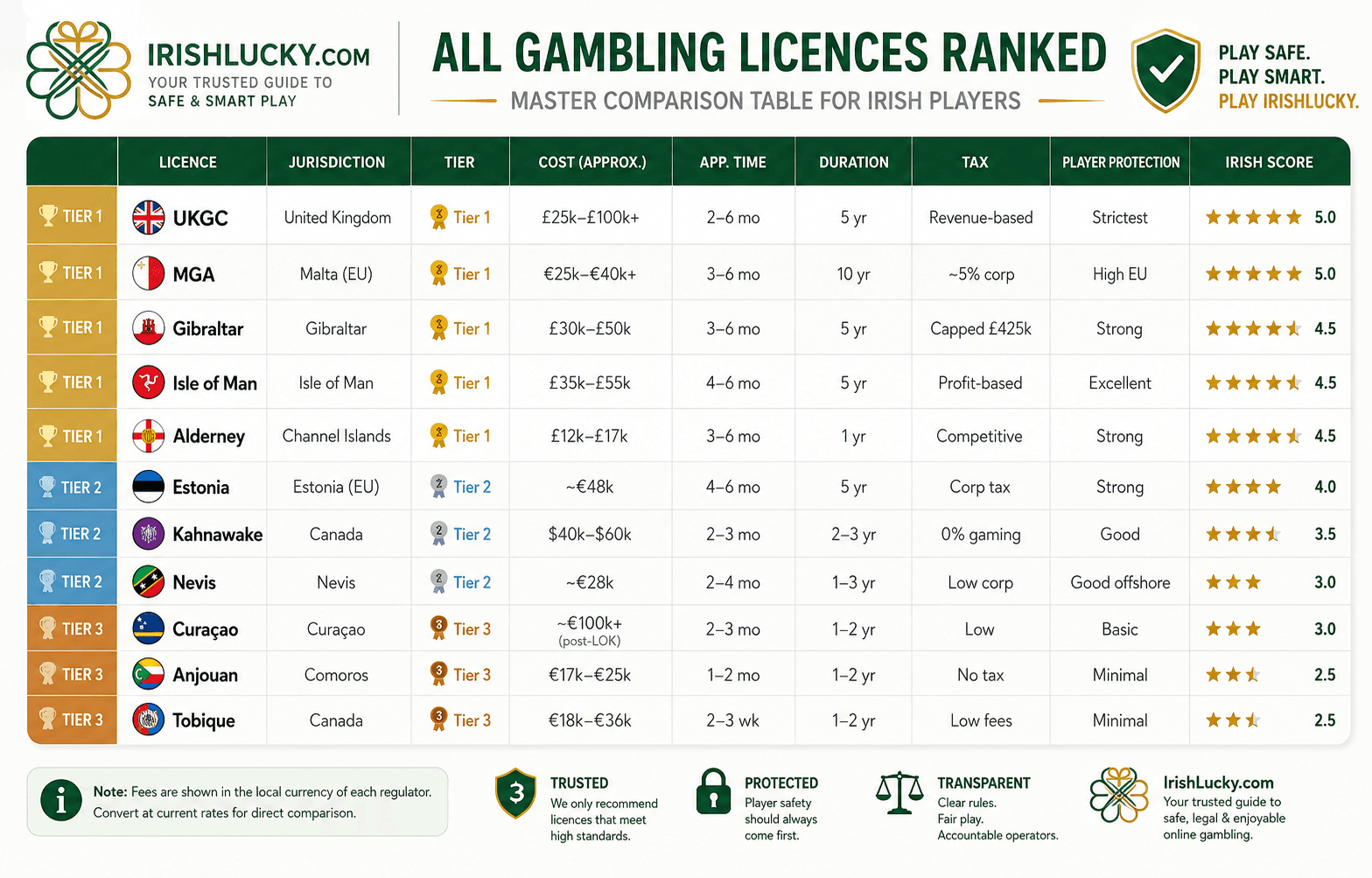
Master Comparison Table: All Licences Ranked for Irish Players
Note: Fees are shown in the local currency of each regulator. Convert at current rates for direct comparison.
The Absolute Gold Standard. For Irish players, the UKGC represents the pinnacle of gambling regulation. Its strict affordability checks, mandatory problem gambling levies, stake limits, and world-class dispute resolution make it the safest choice. Any casino displaying the UKGC logo has undergone the most rigorous vetting process on Earth. Irish banks and PayPal/Revolut readily process payments to UKGC sites. Player-facing verification and our UKGC list live on UKGC casinos.
The EU Gold Standard. The MGA is equally strong for Irish players, with the added benefit of full EU legal standing. Its 10-year licence duration signals operator stability, and GDPR compliance means your data is protected under EU law. MGA-licensed casinos are the most common among premium European brands serving Ireland. Player-facing verification and our Malta list live on MGA casinos.
The Premium Alternatives. Gibraltar and the Isle of Man offer Tier 1 player-facing protection comparable to UKGC/MGA for Irish players. Alderney is also Tier 1, but more often appears as B2B/hosting infrastructure alongside another customer-facing licence — check the primary B2C seal in the footer as well. Player-facing verification and our Gibraltar list live on Gibraltar casinos.
🥉 3 — Estonia
The Tech & Crypto Leader. For Irish players interested in cryptocurrency casinos or cutting-edge platforms, Estonia offers the best regulated environment. It is fully EU-compliant while embracing blockchain innovation.
⚠️ Tier 3 Warning: Anjouan and Tobique licences are best viewed as "starter licences" for new operators. They offer minimal oversight and limited recourse if something goes wrong. Irish players should be very cautious and only play at these casinos if they have strong independent reputations and provably fair systems.
Before you trust a footer seal, run the player checklist in how to choose a safe online casino — it covers licence-register checks, fake review sites, and rogue-casino warning signs. Licensed operators also run identity checks: casino KYC verification explains what documents are typically requested and why.
What Irish Players Should Look For
1
Check the licence logo
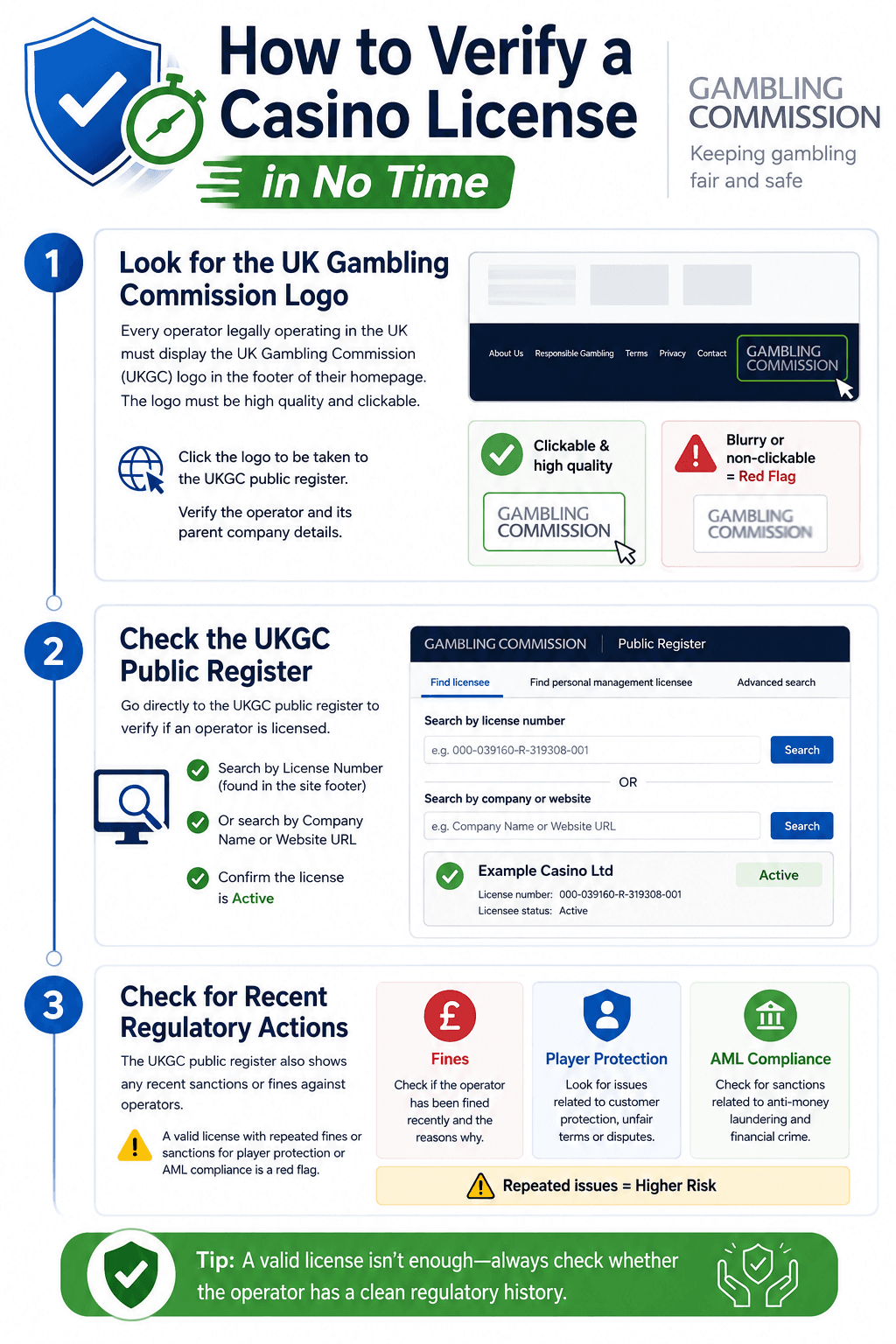
Look for UKGC, MGA, Gibraltar, or Isle of Man seals first. Alderney is a strong Tier 1 signal too, but often sits beside another B2C licence. Click the logo to verify it links to the regulator's public register.
2
Verify independent testing
Look for eCOGRA, GLI, or iTech Labs certification. These agencies test RNG fairness and payout accuracy. For how to verify a fairness certificate isn't faked, see Spotting Rigged Casinos.
3
Check responsible gambling tools
Deposit limits, self-exclusion, reality checks, and links to GambleAware should be clearly visible in the footer or account settings.
4
Confirm Irish-friendly payments
Support for EUR, Visa, Mastercard, PayPal, Revolut, and bank transfer ensures smooth deposits and withdrawals.
5
Read bonus T&Cs carefully
Check wagering requirements, max bet rules, game weighting, and expiry dates before claiming any offer.
The current list of GRAI casino licences — empty until the first remote-gaming licence appears — is on GRAI casinos.
As the GRAI continues its phased rollout, Irish players can expect a new domestic gold standard:
Betting licences first: remote from 1 July 2026, in-person from 1 December 2026 (when old Revenue / premises licences expire)
Remote gaming licences (casinos, slots, live dealer) opening throughout 2027 and 2028; none issued yet as of August 2026
B2B licences and lottery arrangements following after B2C gaming
A public register of all licensed operators
The National Gambling Exclusion Register — self-exclude from all licensed operators with a single registration
Strictest advertising, consumer protection, and AML rules in Irish history
Fines up to €20 million or 10% of turnover for breaches
Once the GRAI remote gaming licence is live, Irish players should prioritise GRAI-licensed operators for the strongest domestic legal protection, followed by UKGC, MGA and Gibraltar as the next best alternatives. Until then, no operator can legally claim a GRAI casino licence — we publish the first names on GRAI casinos. Malta-licensed brands we list today are on MGA casinos. UKGC-licensed brands are on UKGC casinos. Gibraltar-licensed brands are on Gibraltar casinos.
Conclusion
For Irish players in 2026, the licence behind a casino is the difference between a safe, fair experience and a potential nightmare. The UK Gambling Commission and Malta Gaming Authority remain the two strongest licences available today, offering unmatched player protection, legal recourse, and banking integration. Gibraltar, Isle of Man, and Alderney round out the Tier 1 elite. As Ireland's own GRAI regime matures, a new domestic gold standard will emerge.
The Golden Rule: If you don't see a UKGC, MGA, Gibraltar, or Isle of Man logo (or Alderney alongside a clear B2C licence), proceed with caution. If you see Curaçao, Anjouan or Tobique as the primary licence, do extensive research before depositing. Your money and your data deserve Tier 1 protection.
Casino Licence FAQ
What is the strongest casino licence for Irish players?
The UK Gambling Commission (UKGC) and Malta Gaming Authority (MGA) are tied for the top spot. Both offer strict player protection, independent dispute resolution, and full recognition by Irish banks. The UKGC is slightly stricter on affordability checks, while the MGA offers the benefit of full EU legal standing and GDPR protection. How to check a UKGC account is on UKGC casinos. How to check a Malta number is on MGA casinos.
Is it safe to play at a Curaçao-licensed casino from Ireland?
Curaçao-licensed casinos can be legitimate, but they offer weaker player protection than Tier 1 EU/UK regulators. Under the new LOK 2023 reforms, standards are improving and the old master/sub-licence system is abolished, but costs have risen sharply. Irish players may still face banking restrictions and limited dispute resolution. Always verify independent audit certificates (eCOGRA, iTech Labs) and read player reviews before depositing. How to check an OGL number vs a legacy /JAZ footer is on Curaçao casinos.
What is the GRAI and when will it licence online casinos?
The Gambling Regulatory Authority of Ireland (GRAI) is Ireland's new independent regulator established under the Gambling Regulation Act 2024. Remote betting licences opened in February 2026. No GRAI remote gaming (casino) licences exist yet — applications open throughout 2027 and 2028. Be sceptical of any operator claiming to hold a GRAI casino licence today. Live dates stay on the GRAI licence tracker.
Can an Irish player legally complain to the UKGC or MGA?
Yes. Both regulators accept complaints from players regardless of residency. The UKGC operates an Alternative Dispute Resolution (ADR) scheme, and the MGA has a formal player support unit. Irish players have full legal recourse to these bodies if a UKGC- or MGA-licensed operator mistreats them. The UKGC complaint path is on UKGC casinos. The MGA complaint path is on MGA casinos.
What licence logos should I look for on an Irish casino site?
Prioritise: UKGC, MGA, Gibraltar, or Isle of Man seals (and Alderney when it appears with a clear B2C licence). Also look for independent trust marks like eCOGRA, iTech Labs, or GLI. Be cautious with Curaçao, Anjouan, or Tobique as the primary licence — these offer weaker oversight. Always click the logo to verify it links to the regulator's public register. UK steps are on UKGC casinos. Malta steps are on MGA casinos. Gibraltar steps are on Gibraltar casinos. Curaçao steps are on Curaçao casinos.
What is a B2B gambling licence?
A Business-to-Business (B2B) licence is for companies that supply gambling products or services to other licensed operators — such as game developers, platform providers, and payment processors. B2B licences do not allow a company to accept players directly; they need a B2C (Business-to-Consumer) licence for that. The GRAI now requires B2B suppliers to hold a licence too.
What are the new UKGC stake limits?
The UKGC introduced maximum bet limits on online slots: £5 per spin for players aged 25 and over, and £2 per spin for players aged 18–24. These limits are among the strictest in the world and demonstrate the UKGC's commitment to reducing gambling harm.
Are crypto casinos legal for Irish players?
Irish law does not explicitly ban crypto gambling, but the GRAI's new regime will bring it under formal oversight. Currently, Estonia-licensed crypto casinos offer the strongest regulatory protection for Irish players, as Estonia is an EU member with a crypto-friendly but strictly regulated framework. Avoid unlicensed crypto casinos entirely.
What happened to Curaçao master licences and sub-licences?
The old system is abolished. Under the LOK 2023 reform, the Curaçao Gaming Authority (CGA) now issues all licences directly. Operators can no longer run under a "master licence holder." If a casino still references this model, it is outdated — verify they hold a direct CGA licence with a physical presence in Curaçao. Full OGL vs 8048/JAZ checks are on Curaçao casinos.
Page Updates
Casino list now shows every reviewed brand except blocked operators, with a licence filter for MGA, UKGC, Gibraltar and Curaçao. GRAI stays unavailable until Ireland issues the first remote-gaming licences.
Gibraltar player guide and reviewed Gibraltar-licensed brands moved to the child page /licensed-casinos/gibraltar/.
UKGC player guide and reviewed UKGC-licensed brands moved to the child page /licensed-casinos/ukgc/.
MGA player guide and reviewed MGA-licensed brands moved to the child page /licensed-casinos/mga/.
GRAI casino-licence status moved to the child page /licensed-casinos/grai/. Other regulator deep-dives stay on this pillar until researched.
Updated with GRAI phased rollout timeline (betting 1 Jul / 1 Dec vs gaming later), UKGC GGY fee note, MGA compliance bands, Curaçao LOK reform, Alderney AGCC, Kahnawake vs Tobique, and currency consistency note.
Added Estonia crypto-friendly framework and Kahnawake 0% tax structure. Verified UKGC fee schedule effective 1 October 2026.
Initial publish. Cross-referenced Gambling Regulation Act 2024, UKGC fee tables, MGA licensing frameworks, and GRAI application templates.
Sources
Primary legislation, regulator registers, and safer-gambling references used for this guide. Always verify licence status on the live public register before depositing.
Last updated: 2 August 2026. Information based on the Gambling Regulation Act 2024, GRAI official documentation, UK Gambling Commission fee schedules (effective 1 October 2026), Malta Gaming Authority licensing frameworks, and global iGaming regulatory data. All fees shown in the local currency of each regulator. 18+ only. Gamble responsibly.