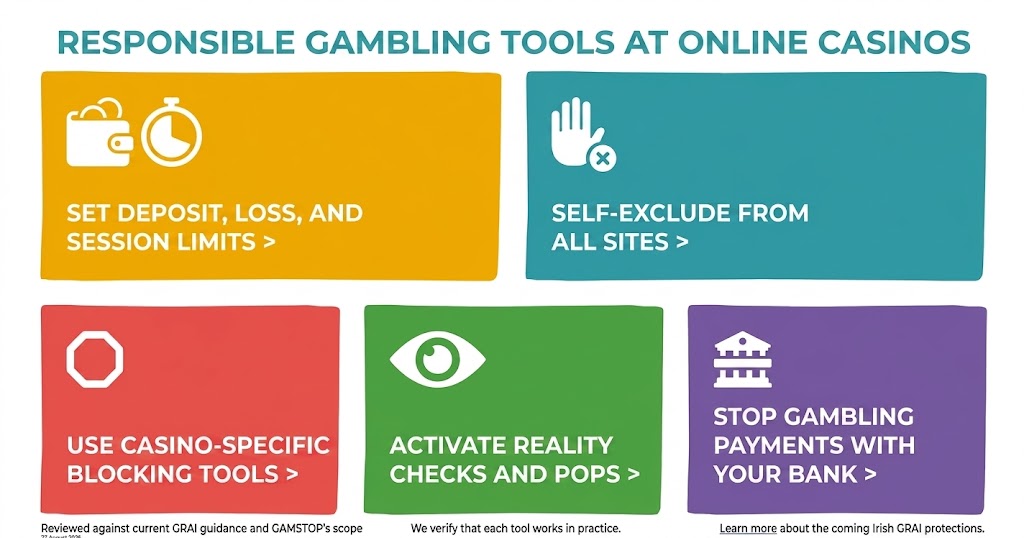
Responsible gambling tools are account settings that let you cap what you spend, limit how long you play, or shut an account down. UKGC- and MGA-licensed operators are required to offer a core set of these controls; other licences (for example Curaçao or Anjouan) may offer similar menus without the same binding rules. Knowing how to set deposit limits, and what self-exclusion does once switched on, is the fastest way to keep gambling as something you control.
This page walks through each tool on offer at Irish-facing casinos: deposit, loss, and session limits; reality checks and cooling-off periods; self-exclusion and account closure; device and bank blockers while Ireland’s national exclusion register is not live; and why GAMSTOP is a UK scheme that Republic of Ireland residents generally cannot use.
If you're not sure whether you need any of this yet, our Signs You Should Use These Tools section further down is a quicker read than the rest of the page.
Irish Lucky is reader-supported. Some links on this site are affiliate links — full advertising disclosure. 18+ only.
What Responsible Gambling Tools Are
The short version
Responsible gambling tools are account-level controls — limits, timers, breaks, and exit options. UKGC and MGA licence conditions require operators to provide them. They work best when set before play escalates, not after.
Irish-facing sites sit under different seals. Prefer operators that publish clear Safer Gambling menus. Ireland’s GRAI regime is live for remote betting; remote gaming (casino) licences are still phased — see Gambling Regulations in Ireland. Until then, most casino brands you use hold offshore licences, and tools still have to be set operator by operator.
The tools fall into a few families:
Limits — deposit, loss, wager, or time caps you set yourself
Checks — pop-ups reminding you how long you've played or spent
Breaks — cooling-off periods that lock the account temporarily
Exit — self-exclusion or permanent closure
You set these from your account page without explaining yourself to support. On a proper implementation, support should not remove or shorten a limit you have set; decreases apply immediately, and increases are delayed (see below).
For operators we rate highest overall for safety and clear player-protection menus, see our Safe Online Casinos Ireland guide.
Deposit, Loss, and Session Limits Explained
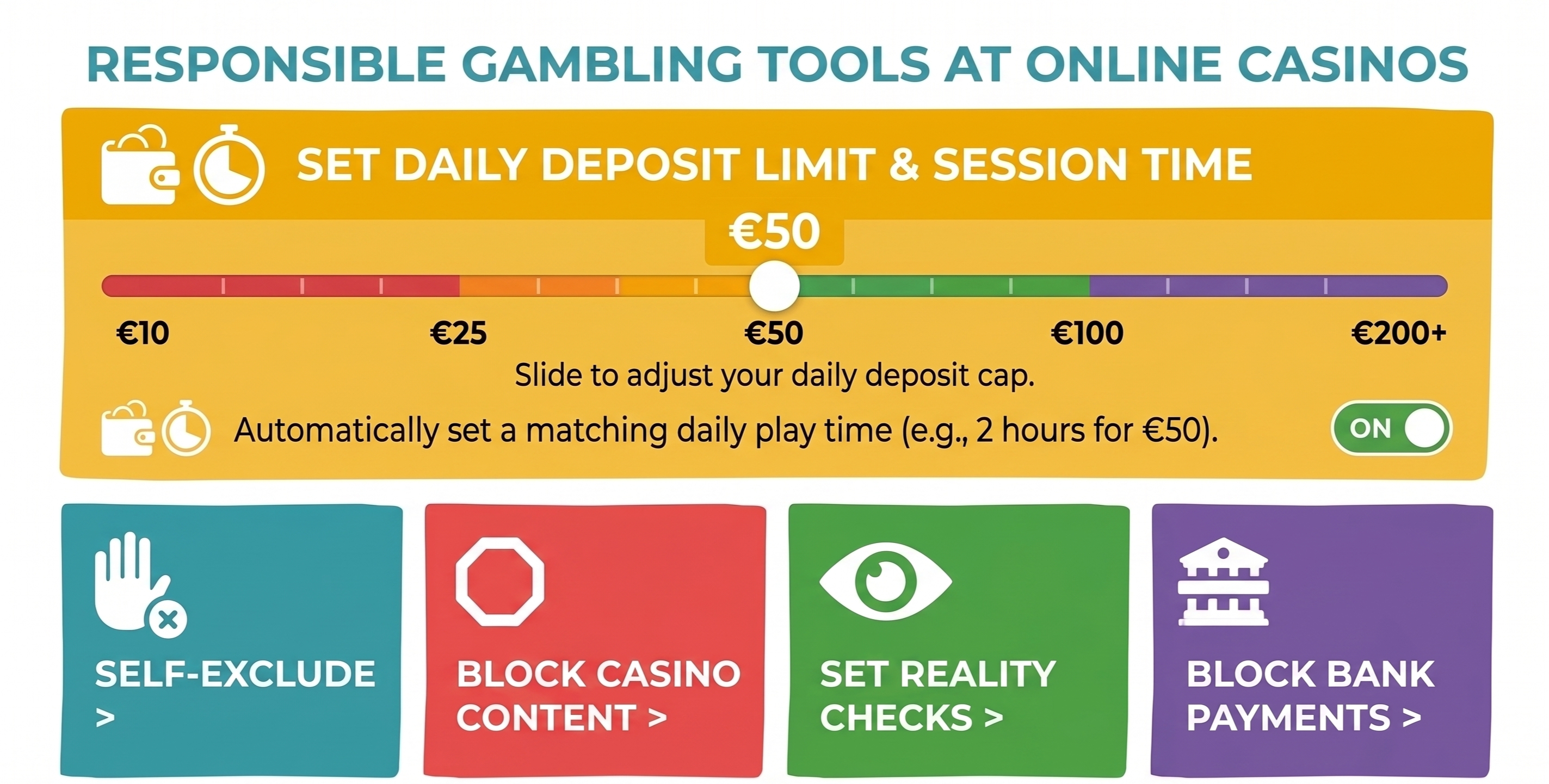
Deposit, loss, and session limits are the day-to-day controls most players need first.
1
Find the limits page
Log in and look under Account, Profile, or Safer Gambling — most casinos group deposit, loss, and session limits together on one screen.
2
Pick a limit type
Deposit limits cap what you can add to your balance (daily, weekly, monthly). Loss limits cap net losses over the same periods. Session limits cap how long you can be logged in.
3
Set the amount and period
Start lower than you think you need. On UKGC- and MGA-style systems, decreases usually apply immediately. Increases are typically delayed by about 24–72 hours — that delay is common operator practice under those regimes, not a single Irish statute for every offshore site.
4
Confirm it's active
Check your account settings show the new limit before you deposit again. If a casino lets you raise a limit instantly with no delay, treat that as a weak implementation and prefer operators with a clear cooling-off on increases.
Setting a deposit limit is a self-service account control. UKGC- and MGA-licensed operators are required to provide these facilities; Curaçao- or Anjouan-licensed sites may offer similar menus without the same enforceable delay rules.
Reality Checks and Cooling-Off Periods
Reality checks are pop-ups — usually every 30 or 60 minutes — that show your session length and net spend so far, with an option to keep playing or log out. They're passive by design: nothing locks unless you act on what the check tells you.
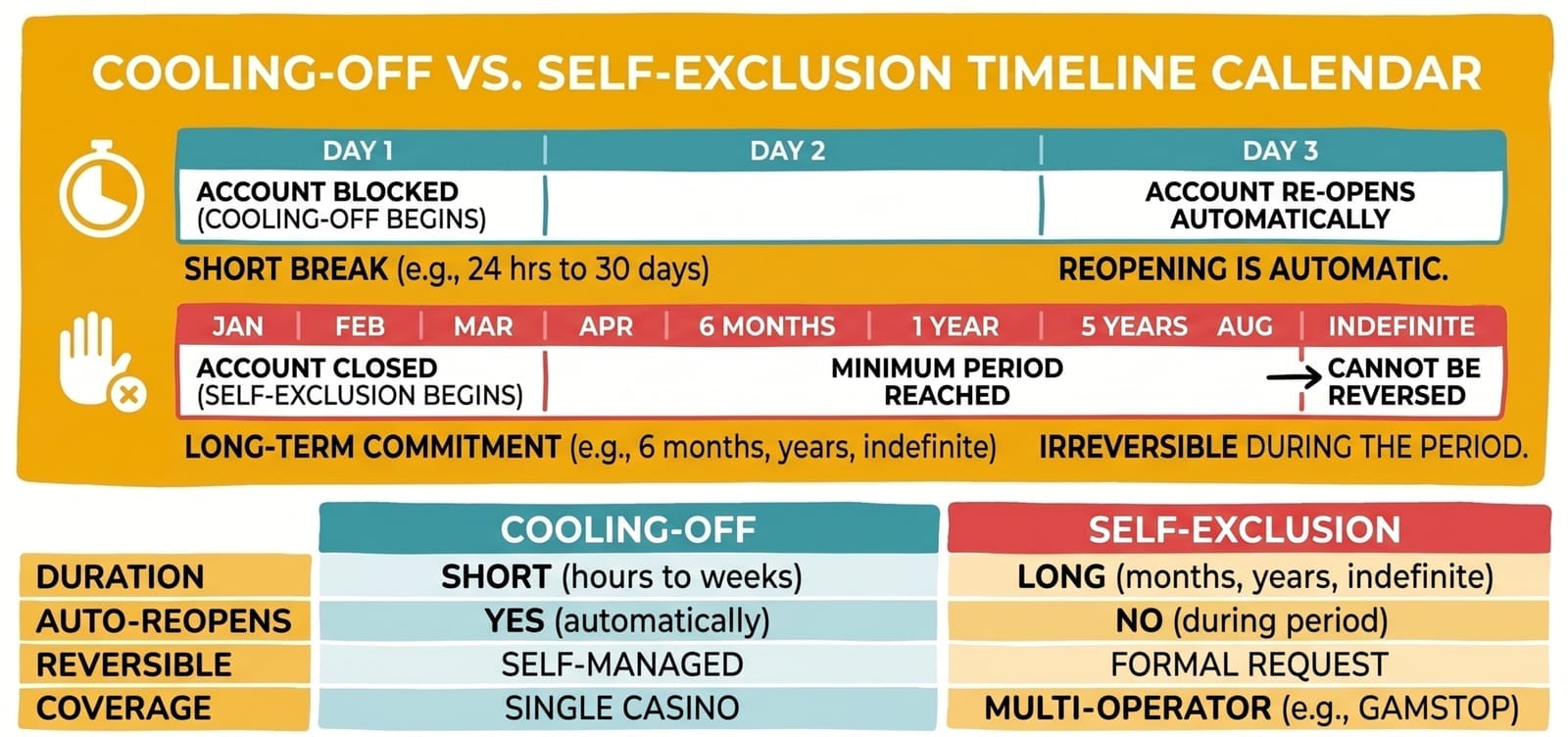
Cooling-off periods go a step further. Choosing 24 hours, 7 days, or a month locks the account for that exact window — no logging in and no early reversal on a proper build. Unlike self-exclusion, the account reopens automatically once the period ends, which makes cooling-off the right tool for “I need a short break” rather than “I want this closed for good.”
Self-Exclusion and Closing an Account
Self-exclusion is the stronger exit at a single casino.
1
Locate self-exclusion in settings
It's usually separate from the limits page, often under Responsible Gambling or Account Closure, precisely so it isn't set by accident.
2
Choose a duration
Individual operators commonly offer periods such as 6 months, 1 year, or indefinite self-exclusion. Once confirmed, it should not be reversed early by you or by support. (GAMSTOP’s own UK periods are different — see below.)
3
Expect marketing to stop
A genuine self-exclusion also removes you from promotional emails and SMS — if offers keep arriving afterwards, that's a sign the tool wasn't applied properly.
Self-exclusion at one operator locks that account only. It does not cover other brands. That gap is why national registers and multi-operator schemes exist. For fuller mechanics, including what happens to an existing balance, see our self-exclusion guide.
Permanent account closure is different again — it ends the relationship with that casino but isn't a formal exclusion scheme and doesn't stop you opening an account elsewhere with the same details.
Blocking Tools Beyond the Casino
While Ireland’s National Gambling Exclusion Register is not live, device and bank tools can add a layer that no single casino menu covers.
BetBlocker — free blocking tool that restricts gambling sites and apps for a period you choose.
Gamban — multi-device gambling blocker (7-day trial, then paid).
Irish bank / card gambling blocks — many Irish banks and card issuers let you switch off gambling merchant transactions on debit cards. Check your bank’s app or support pages; products differ by lender.
These do not replace operator self-exclusion, and they are not a national register — but they help while GRAI’s register is still offline.
GAMSTOP vs Irish Player Protections
GAMSTOP (UK only)
Free multi-operator self-exclusion for people living in the United Kingdom (Great Britain and Northern Ireland) — GAMSTOP register
Republic of Ireland residents generally cannot register (a UK address is required)
Covers online gambling companies licensed in Great Britain (UKGC)
Exclusion periods: 6 months, 1 year, 5 years, or 5 years with auto-renewal
Does not cover MGA-, Curaçao-, or Anjouan-only sites
Irish protections (GRAI path)
Remote betting licences: applications opened in early 2026; issuance from 1 July 2026
Remote gaming (online casino) licences: not issued yet
Credit-card gambling payments banned for GRAI licensees (in force under commenced Act provisions)
GAMSTOP is a UK scheme. If you live in the Republic of Ireland, you generally cannot use it. Northern Ireland residents are in the UK scheme and can register. Even for UKGC brands, GAMSTOP does not lock MGA- or Curaçao-only accounts. Our older GAMSTOP Ireland guide goes into registration limits in more depth — treat the UK-resident rule above as the current line. For licence seals we score, see Licensed Casinos and Trust & Methodology.
Signs You Should Use These Tools
You don't need to hit a crisis point before setting a limit. Use this short self-check:
You are topping up more often than you planned
You are chasing losses to “get even”
You lose track of how long you have been playing
You are using money meant for bills, rent, or essentials
You hide gambling from people close to you
You feel anxious or irritable when you are not playing
None of that needs a diagnosis attached — it is simply what the tools on this page are designed for.
Where to get help in Ireland
Gambling Care — National Helpline 1800 936 725 (free, confidential) — GamblingCare.ie
Yes. Deposit limits, session limits, reality checks, cooling-off, and self-exclusion are free account features at operators that provide them — never a paid add-on on a proper Safer Gambling menu.
Can casino support override a limit I've set?
Support should not be able to remove or shorten a limit you have set. Decreases usually apply immediately. Increases are delayed (often about 24–72 hours on UKGC- and MGA-style systems) so you cannot undo a tighter limit in the heat of the moment.
Does self-exclusion at one casino cover others?
No. Self-exclusion is account-specific. GAMSTOP only covers Great Britain–licensed sites for UK residents. Ireland’s National Gambling Exclusion Register is not live as of 4 October 2026.
What's the difference between cooling-off and self-exclusion?
Cooling-off is a short lock (for example 24 hours to a month) that reopens automatically when the period ends. Operator self-exclusion is longer (commonly 6 months, 1 year, or indefinite) and should not reopen early even if you ask. GAMSTOP’s UK periods are 6 months, 1 year, or 5 years (with an auto-renewal option) — that scheme is separate from a single casino’s menu.
Will I still get marketing emails after self-excluding?
You shouldn't. A properly applied self-exclusion also stops promotional contact — continued marketing is a sign the exclusion wasn't processed correctly.
Can I use GAMSTOP if I live in the Republic of Ireland?
Generally no. GAMSTOP is for people living in the United Kingdom (Great Britain and Northern Ireland). Republic of Ireland residents should use per-operator self-exclusion, device blockers, bank gambling blocks, and Irish helplines until GRAI’s national register is live.
Updated GRAI remote-betting licensing context and national register status.
Initial publication and first editorial review of deposit-limit, cooling-off, and self-exclusion sections.
How We Check These Tools
We describe how Safer Gambling menus are meant to work under common licence regimes (especially UKGC and MGA), and we cross-check claims against regulator and helpline primary sources linked above. We do not claim a live tool test on every Irish-facing casino for this guide.
Irish Lucky is a comparison site. This guide is educational and not a substitute for professional support. We may earn a commission if you sign up through a casino link, but this never affects which tools we describe. 18+ only.