Mines Casino Game: How to Play, Payouts & Strategy
Mines is a grid-based pick game: set your stake, choose how many mines are hidden, and reveal tiles one at a time. Every safe tile you find raises your win multiplier — but hit a mine and the round ends, taking your stake and any unbanked winnings with it. Use the free Spribe demo below, then read the rules, the payout math, and what actually helps (and doesn't) when it comes to strategy. Real-money play is 18+ only.
How we rate casinos: we check licensing for every listed brand, then score bonuses, games, payments, support and trust across five rating pillars. Where we run hands-on account tests — signup, deposit and withdrawal timings — those findings feed the score for that brand. Read our trust methodology.
These operators carry a Mines-style pick game in their instant games catalogue. Check each site's own grid size, mine range and RTP before you deposit — see how we score operators in our trust methodology.
Play the Mines demo
This is Spribe's official Mines demo (play money, nothing withdraws). Click Play demo to load it — the game does not start until then. If the frame is blank after that, the provider may block embedding; open the same demo on Spribe's site, or search Mines in a casino lobby's free-play mode. Other operators' Mines builds can differ on grid size and mine range.
Demo vs real money
Demo credits do not withdraw. Each tile is still random. What a demo cannot teach you is how it feels to click "one more tile" on a real euro stake. Practise mine count and cash-out timing here, then set a hard stop before you switch to cash play. 18+.
What Is Mines?
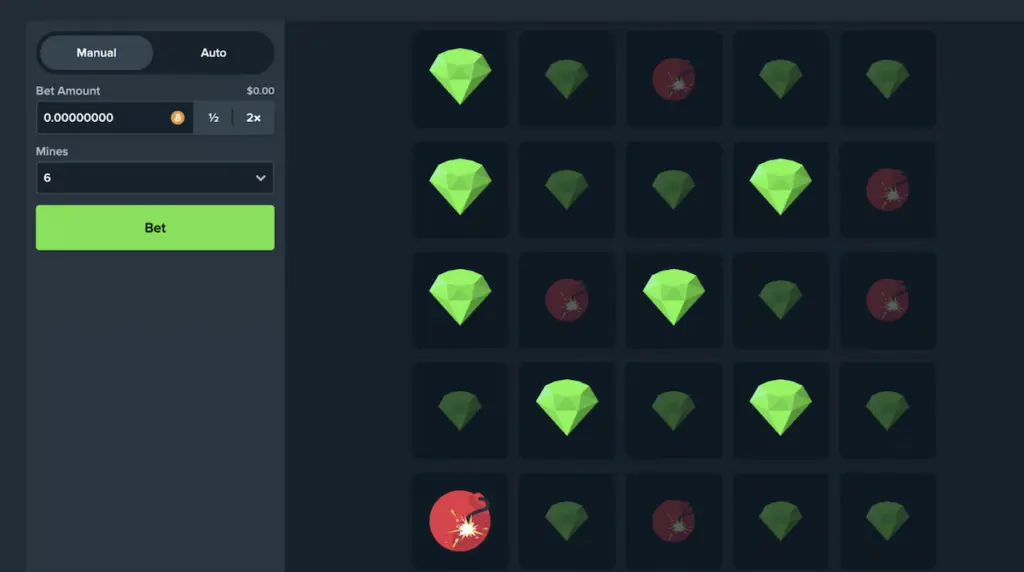
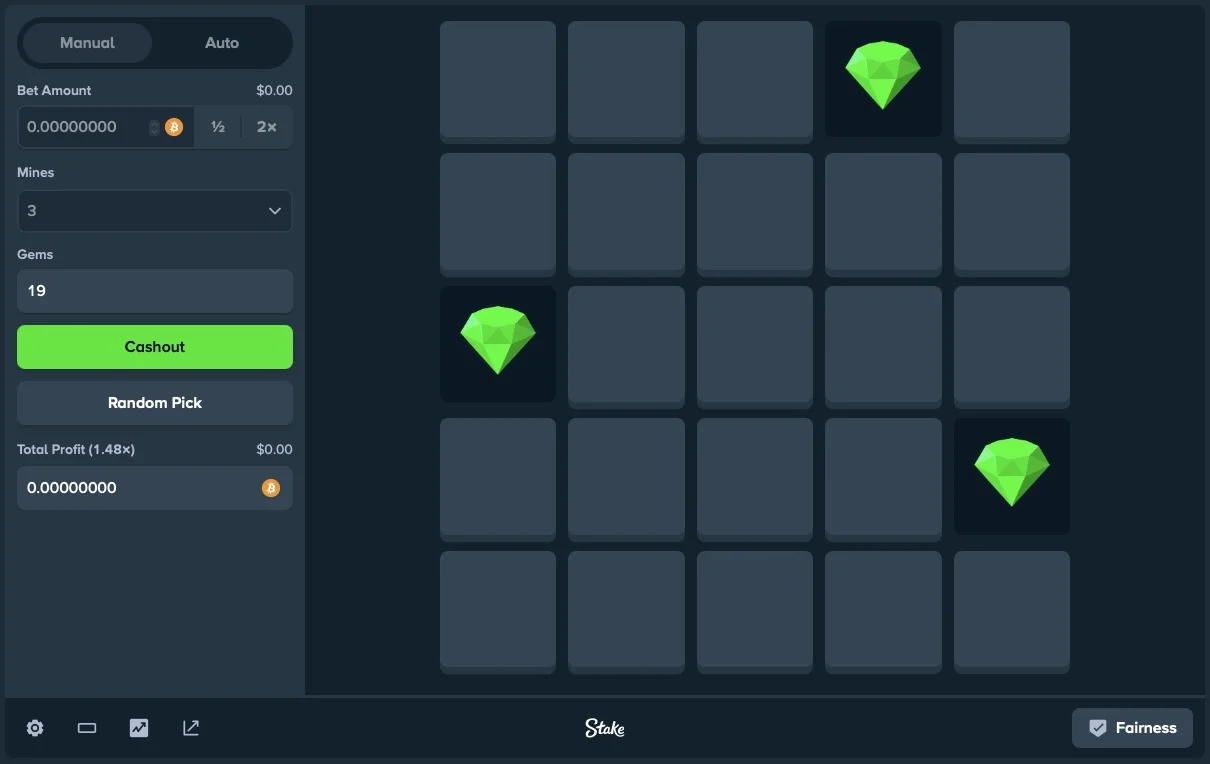
Mines takes the logic of the classic tile-clicking puzzle and turns it into a betting game. You set a stake and choose how many mines are hidden among the grid's tiles — the rest are diamonds. Reveal tiles one at a time: each diamond you find increases your win multiplier, and you can cash out after any successful reveal. Hit a mine, and the round ends immediately — your stake and any winnings built up that round are lost. One source traces the concept back to Minesweeper, reportedly created by Robert Donner and Curt Johnson in the 1980s, though this gambling version is fully randomised round to round rather than using a fixed puzzle layout.
Unlike a crash game, there's no clock and no rising multiplier you have to react to in real time — the pressure in Mines comes entirely from deciding whether to reveal one more tile.
Mines At a Glance
Feature
Detail
Grid size
5×5 (25 tiles) is the standard version — some operators offer larger variable grids, from 3×3 up to 9×9
Mines selectable
1–24 on a standard 5×5 grid — larger-grid variants can go up to 80
RTP
Typically around 95–97%, depending on the operator and how many mines you choose — check the in-game info panel
Min bet
Around €0.10
Max bet
Around €100, though this varies by casino
Max win
Figures as high as 10,000x are cited for larger-grid variants — check your chosen operator's own paytable
Platforms
Browser-based, desktop and mobile
How to Play Mines
1
Set your stake and mine count
Choose your bet amount, then pick how many mines to hide in the grid. Fewer mines means safer, smaller wins; more mines means bigger multipliers but a much higher chance of hitting one early.
2
Reveal tiles one at a time
Click a tile to reveal a diamond or a mine. Each diamond found increases your current win multiplier.
3
Cash out before you hit a mine
After any successful reveal, you can stop and collect your current winnings. Keep going and the multiplier grows, but so does the risk of the round ending with nothing.
Mines Payouts & RTP Explained
Published payout tables show that Mines' return is designed to sit close to ~95% for most mine counts once you're two or more mines into the grid — regardless of how many tiles you choose to reveal before cashing out. The exception is the 1-mine setting: return is strong if you stop after just one diamond, or push all the way to all 24, but drops sharply in the middle of that range — in some published tables as low as roughly 41% for certain pick counts. In practical terms: a 1-mine game rewards an all-or-nothing approach, while multi-mine games behave consistently no matter when you decide to stop.
If you're choosing 1 mine, the maths favours either a very short session (cash out after your first diamond) or an extremely long one (aim for all 24) — the middle ground is where the return dips hardest.
Auto Mode, Turbo Mode & Demo Play
Auto/Autoplay mode — runs a set strategy (mine count, bet size, stop conditions) across multiple rounds without manual input each time.
Turbo mode — speeds up tile reveals and round pacing for players who want a faster session (available on some versions).
Demo mode — lets you play with virtual credits before staking real money. The Spribe embed at the top of this page is play money only; it uses the same underlying randomness as real-money play, so it's a genuine way to get a feel for how quickly a promising multiplier can turn into nothing.
Licensing: Why It Matters
Playing Mines for real money only makes sense on a licensed operator. A valid licence means the game runs on an independently tested RNG, player funds are kept separate from operating funds, and there's a formal route to dispute resolution if something goes wrong. An operator that skips ID checks or promises unusually fast payouts with no licence reference is a red flag, whatever jurisdiction you're in — the risk isn't just losing a stake, it's having no recourse at all if a withdrawal doesn't go through.
Always confirm an operator's current licence directly with the regulator's own register before depositing — see our sources below, and our trust methodology.
Mines Strategy: What Actually Helps
No approach changes the underlying house edge — each tile is independently randomised, and past picks don't influence what's still hidden in the grid. What does make a measurable difference is discipline around when you stop:
Lower mine counts, consistent cash-out point — choosing 1–2 mines and cashing out after a fixed number of safe tiles every time keeps sessions predictable, even though individual wins stay modest.
Set a target multiplier before the round starts — deciding in advance (for example, "I stop at 2.00x") avoids the common trap of turning a decent multiplier into a loss by pushing for "just one more tile."
Treat mine count as your real risk dial — more mines means bigger potential multipliers per diamond found, but a much higher chance of hitting one early. Match it to how much variance you actually want in a session.
Avoid the Martingale
Doubling your bet after every loss (the Martingale system) doesn't change the odds on any individual round and can wipe out a bankroll quickly during a losing streak. Treat it as high-risk rather than a genuine edge.
Pros & Cons
Pros
Flexible betting range and adjustable risk via mine count
Provably fair verification on reputable operators
Autoplay and demo modes for hands-off or risk-free play
Frequent small payouts on lower mine counts
Simple, fast rounds with no fixed time pressure
Cons
RTP varies by operator and game configuration — check your operator's own published figure
No jackpot feature or bonus rounds
Grid size and maximum mine count vary significantly between operators, so payout potential isn't standard across sites
Play within your limits
Mines rounds are quick, and it's easy to keep clicking "one more tile" after a near-miss. Set a deposit limit before you start, and use self-exclusion tools if you ever feel like you're chasing losses rather than playing for fun — read more on our responsible gambling page.
How We Review
We score pick-style games like Mines on payout transparency, fairness verification, grid/mine-count flexibility, and how clearly a provider communicates risk. See our trust methodology.
Regulatory references cited in our research — UK-specific detail is noted as such rather than applied to other jurisdictions.
Regulators
1UK Gambling Commission — licensing standard referenced for UK-facing operators; Irish players should confirm the equivalent current licence held by their chosen operator before depositing
A grid-based pick game where you reveal tiles hoping to find diamonds and avoid hidden mines. Each diamond raises your win multiplier; hitting a mine ends the round and forfeits your stake.
What is Mines' RTP?
Commonly cited around 95%, though figures as high as 97% (average) are also reported, and RTP can vary by operator and by how many mines you select. Check your chosen casino's own game information page for the exact figure.
Does the number of mines I choose affect my odds?
It changes the risk and reward profile of each tile, not the underlying fairness. More mines means a higher chance of hitting one early but bigger multipliers per diamond found; fewer mines means steadier, smaller wins.
Can I play Mines for free?
Yes. Click Play demo on this page for Spribe's play-money version. It does not pay out. Many operators also offer their own Mines demo in the lobby. Real-money versions use the same mechanic, but a real euro stake feels different.
Is there a strategy that improves my odds in Mines?
No strategy changes the house edge, since each tile is independently randomised. Setting a fixed cash-out target and choosing a mine count that matches your risk tolerance is the closest thing to good practice — it manages your bankroll rather than the odds.
What is the Martingale strategy, and should I use it in Mines?
It means doubling your bet after each loss to try to recover previous losses on a win. It doesn't change the odds of any individual round and carries a real risk of large losses during a losing streak — treat it with caution.
Is Mines legal and fair to play?
At a properly licensed operator, yes — the RNG is independently tested and the game's theoretical return is published. Always confirm your operator holds a current, valid licence before depositing.
Page Updates
Guide compiled from published Mines mechanics, payout tables and licensing guidance, cross-checked across multiple sources. Added Spribe play-money demo embed.
Affiliate disclosure. Irish Lucky may earn a commission if you sign up through our links. That does not change our scores. Always read the operator's promotional T&Cs (18+). Play responsibly — responsible gambling.