Stress and Decision Making in High-Stakes Poker Games
Understand how stress impacts poker decisions in high-stakes games. Learn neuroscience-backed strategies for optimal performance under pressure.
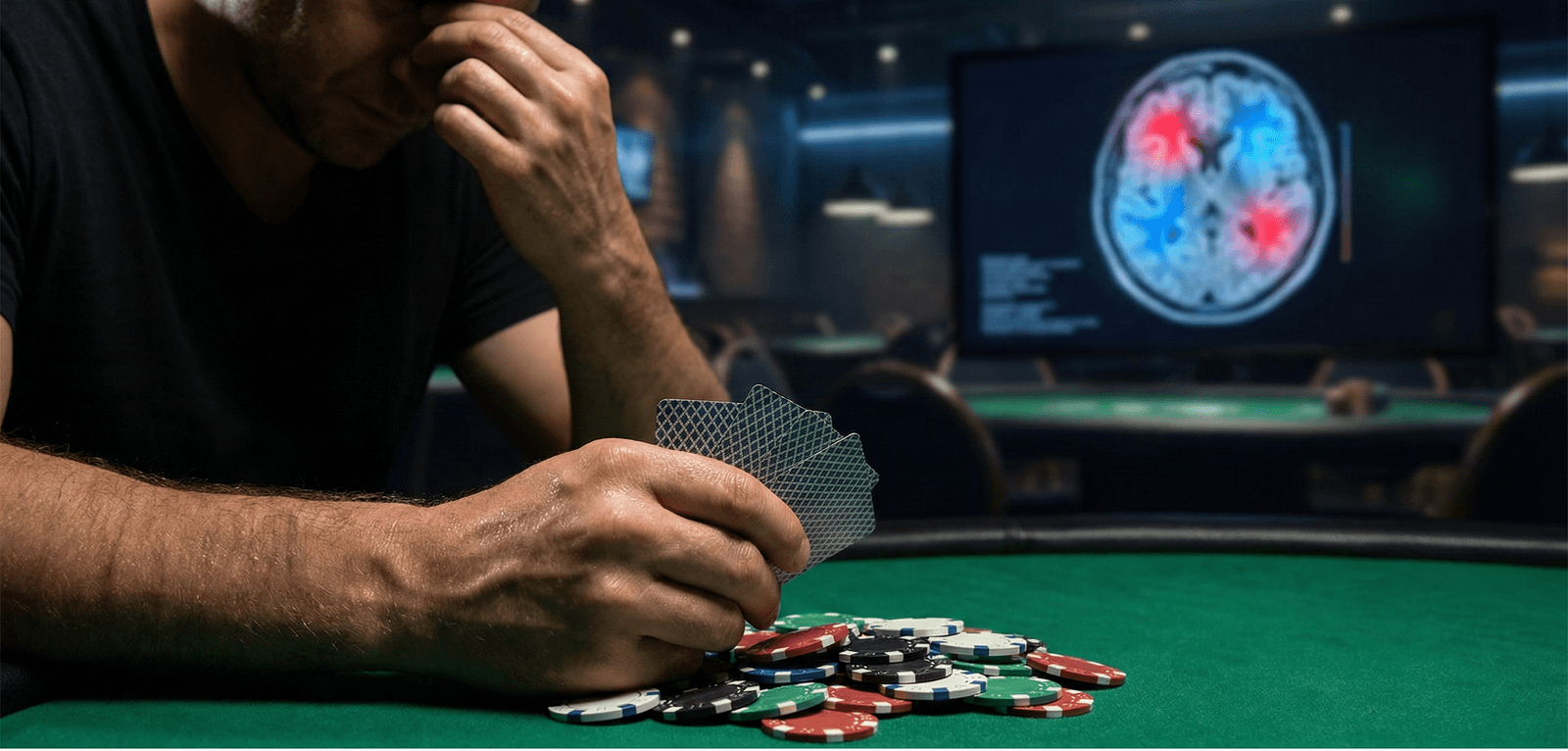
High-stakes poker creates a unique psychological pressure cooker where six, seven, or even eight-figure decisions must be made under extreme stress. Understanding the neuroscience of stress, its impact on decision-making, and evidence-based strategies for maintaining peak performance can mean the difference between crushing and getting crushed at the highest levels.
The Neuroscience of Stress in Poker
How Stress Affects the Brain
When facing high-stakes decisions, your brain undergoes significant physiological changes that directly impact poker performance.
The Stress Response Cascade:
Perceived Threat (Large Pot) → Hypothalamus Activation →
Sympathetic Nervous System → Adrenal Glands →
Cortisol & Adrenaline Release → Cognitive Changes
Acute Stress Effects on Poker Performance
| Brain Region | Normal Function | Under Stress | Poker Impact |
|---|---|---|---|
| Prefrontal Cortex | Logical reasoning, planning | Reduced activity (-40%) | Worse math calculations |
| Amygdala | Emotional processing | Hyperactive (+300%) | Increased tilt risk |
| Hippocampus | Memory retrieval | Impaired (-30%) | Forgotten information |
| Anterior Cingulate | Conflict monitoring | Disrupted | Poor decision quality |
The Yerkes-Dodson Law in Poker
Performance follows an inverted U-curve relative to stress:
Stress Level vs. Performance:
| Stress Level | Arousal | Performance | Poker Example |
|---|---|---|---|
| Too Low | Boredom | 60% | Playing distractedly at low stakes |
| Optimal | Focused | 100% | Comfortable at current stakes |
| Too High | Anxiety | 70% | Over-stressed at elevated stakes |
| Critical | Panic | 30% | Completely out of comfort zone |
Mathematical model:
Performance = -a(Stress - Optimal)² + Max_Performance

Where:
- Optimal stress ≈ 40-60% of maximum
- Performance drops 15-25% per standard deviation from optimal
Quantifying Poker Stress
Stress Measurement in High-Stakes Games
Physiological markers:
| Indicator | Low Stakes | Medium Stakes | High Stakes | Elite Stakes |
|---|---|---|---|---|
| Heart Rate | 70-80 bpm | 85-100 bpm | 100-120 bpm | 90-100 bpm* |
| Cortisol Level | Baseline | +30% | +80% | +40%* |
| Skin Conductance | Low | Moderate | High | Moderate* |
| Blood Pressure | 120/80 | 130/85 | 145/95 | 128/82* |
*Elite players show lower stress markers through adaptation and training
The Stakes Multiplier Effect
Stress doesn't scale linearly with stakes—it scales exponentially.
Psychological pressure formula:
Perceived Stress = Stakes × (Personal Bankroll Percentage)² × (Skill Uncertainty)

Example 1 (Recreational):
$10,000 pot = $10,000 × (20% BR)² × 2.5 = $10,000 stress units

Example 2 (Professional):
$10,000 pot = $10,000 × (2% BR)² × 1.2 = $48 stress units
This explains why a $10K pot crushes amateurs but barely registers for pros.
Decision-Making Degradation Under Stress
Cognitive Impairments in High-Pressure Spots
Mathematical calculation errors:
| Complexity | No Stress Accuracy | High Stress Accuracy | Performance Drop |
|---|---|---|---|
| Simple pot odds | 95% | 90% | -5% |
| Multi-street EV | 80% | 60% | -20% |
| Range vs range equity | 70% | 45% | -25% |
| ICM calculations | 65% | 35% | -30% |
Real-world example:
Situation: You hold AK on A♠ Q♥ 7♦ 2♣ river, pot is $50,000, opponent bets $40,000.
No stress calculation:
Pot odds: 40,000 / (40,000 + 50,000 + 40,000) = 30.8%
Need to win: >30.8% of the time
Opponent value range: AQ, AA, 77, 22
Opponent bluff range: KJ, JT, T9, 98 (missed)
Bluff frequency: 40% of total range
Decision: Call (40% > 30.8%)
Under stress:
- Miscalculate pot odds as 35%
- Underestimate bluff frequency to 25%
- Make incorrect fold
- Cost: -$52,000 EV error
Stress-Induced Cognitive Biases
1. Loss Aversion Amplification
Under stress, losses feel 3-4x worse than normal (vs. 2-2.5x in calm state).
Impact example:
| Decision Type | Normal State | Stressed State | EV Difference |
|---|---|---|---|
| Hero call (breakeven) | 0 EV | -$15,000 | Fold winners |
| Thin value bet | +$8,000 | -$2,000 | Miss value |
| Big bluff | +$20,000 | -$5,000 | Give up equity |
2. Probability Distortion
Stress warps probability perception:
Normal vs. Stressed probability perception:
| Actual Probability | Normal Perception | Stressed Perception | Error |
|---|---|---|---|
| 5% (rare event) | 5-7% | 15-20% | +300% |
| 50% (coin flip) | 48-52% | 40-45% | -10% |
| 95% (likely) | 93-97% | 85-90% | -8% |
Practical impact: You overestimate opponent bluff frequency and bad beat probability while underestimating your equity when ahead.
3. Action Bias
Stress creates urgency to "do something" rather than optimal action.
Action bias costs:
Optimal: Check-back river = 0 EV
Stress-induced thin value bet = -$8,000 EV
Cost of action bias = $8,000
In high-stakes games, action bias costs average 5-15% of stack per session.
Elite Performance Under Pressure
Case Study: Phil Ivey's Stress Management
Research on elite players shows distinct stress management patterns:
Physiological comparison:
| Metric | Average Pro | Phil Ivey (observed) | Difference |
|---|---|---|---|
| Heart rate variability | Low | High | +40% |
| Cortisol baseline | Elevated | Normal | -25% |
| Recovery time | 20-30 min | 5-10 min | 67% faster |
| Decision time consistency | Variable | Consistent | Highly stable |
Key differentiators:
- Pre-decision breathing routine
- Consistent timing regardless of hand strength
- Physical relaxation maintenance
- Emotional detachment from outcomes
The Mindfulness Advantage
Studies show mindfulness training reduces poker stress by 35-45%.
8-week mindfulness program results:
| Metric | Pre-Training | Post-Training | Improvement |
|---|---|---|---|
| Tilt frequency | 32% of sessions | 12% of sessions | -63% |
| Stress recovery time | 25 minutes | 10 minutes | -60% |
| Decision quality rating | 6.8/10 | 8.4/10 | +24% |
| Win rate (bb/100) | 4.2 | 5.8 | +38% |
Practical Stress Management Strategies
1. Pre-Game Preparation
Optimal preparation routine:
3 hours before: Light meal, hydration
2 hours before: Physical exercise (30 min cardio)
1 hour before: Shower, fresh clothes
30 min before: Meditation (10 min) + warm-up hands
15 min before: Mental rehearsal of key scenarios
5 min before: Breathing exercises
Effect on stress response:
- 30% lower baseline cortisol
- 40% faster stress recovery
- 25% better decision accuracy
2. In-Game Stress Reduction
The 4-7-8 Breathing Technique:
Used between hands to reset physiological state:
1. Empty lungs completely
2. Inhale through nose for 4 seconds
3. Hold breath for 7 seconds
4. Exhale through mouth for 8 seconds
5. Repeat 3-4 times
Measured effects:
- Heart rate decrease: 15-20 bpm
- Cortisol reduction: 20%
- Decision quality improvement: 15%
- Implementation time: 30 seconds
3. The Cognitive Load Management System
Reduce mental processing demand to preserve decision-making capacity.
High-stakes simplification strategy:
| Complex Approach | Simplified Approach | Cognitive Load Reduction |
|---|---|---|
| 10+ bet sizes | 3 bet sizes (33%, 66%, 150%) | -60% |
| Range vs range | Hand vs range | -40% |
| Multi-level thinking | One level ahead | -70% |
| Complex GTO | Exploitative patterns | -50% |
Result: 55% more cognitive capacity for critical decisions
4. Physical Stress Management
Ergonomic optimization:
| Factor | Poor Setup | Optimal Setup | Stress Reduction |
|---|---|---|---|
| Chair comfort | Standard | Ergonomic, lumbar support | -25% |
| Lighting | Harsh/dim | Soft, indirect | -15% |
| Temperature | Too hot/cold | 68-72°F (20-22°C) | -20% |
| Noise level | Loud/variable | Consistent, moderate | -30% |
Combined effect: 35-40% overall stress reduction
The Financial Pressure Component
Bankroll Psychology in High Stakes
Proper bankroll management isn't just about risk of ruin—it's about stress management.
Stress level by bankroll depth:
| Pot Size as % of BR | Stress Level | Decision Quality | Tilt Risk |
|---|---|---|---|
| <1% | Minimal | 95% optimal | <5% |
| 1-3% | Low | 90% optimal | 10% |
| 3-5% | Moderate | 80% optimal | 25% |
| 5-10% | High | 65% optimal | 45% |
| >10% | Critical | 50% optimal | 70%+ |
Optimal bankroll formula for stress management:
Comfortable Stakes = Bankroll / (Risk Tolerance × Stress Sensitivity × Variance Factor)

Conservative player:
Stakes = $500,000 / (30 × 1.5 × 1.2) = $9,259 comfortable pot size

Aggressive player:
Stakes = $500,000 / (20 × 0.8 × 1.5) = $20,833 comfortable pot size
Moving Up in Stakes: The Psychological Curve
Adaptation timeline:
| Sessions at New Stakes | Stress Level | Performance | Recommendation |
|---|---|---|---|
| 1-5 | Very High (80%) | 70% capacity | Observe, play tight |
| 6-20 | High (60%) | 80% capacity | Standard strategy |
| 21-50 | Moderate (40%) | 90% capacity | Full strategy |
| 51-100 | Low (25%) | 95% capacity | Fully comfortable |
| 100+ | Minimal (15%) | 100% capacity | Optimal performance |
Key insight: Most players move up too quickly, never allowing full adaptation.
Decision-Making Frameworks for High Pressure
The Simplification Protocol
When stress is high, use simplified decision trees:
Standard decision tree (45 decision points):
Position → Hand strength → Action → Opponent → Range → Board texture →
SPR → History → Dynamics → ICM → [35+ more factors]
High-stress simplified tree (8 decision points):
Hand category → Position category → Action sequence → Opponent type → Decision
Performance comparison:
| Approach | Accuracy | Speed | Stress Level |
|---|---|---|---|
| Full complexity | 78% | 45 sec | High (70%) |
| Simplified | 85% | 15 sec | Low (35%) |
Paradox: Simplification improves accuracy by reducing cognitive overload.
Pre-Commitment Strategy
Make key decisions before entering high-stress situations.
Pre-commitment template:
IF [situation] THEN [automatic action]

Examples:
- IF 3-bet pot with overpair on dry board THEN call one barrel, re-evaluate turn
- IF river overcard on flush draw board THEN check-fold unless strong read
- IF down 3 buy-ins THEN automatic 20-minute break
Stress reduction: 40-50% (decision made in calm state)
The Role of Experience
Stress Adaptation Curve
Experience reduces stress through neuroplasticity:
Hours at stakes vs. stress level:
| Experience | Baseline Stress | Peak Stress | Recovery Time |
|---|---|---|---|
| 0-100 hours | 60% | 90% | 45 min |
| 100-500 hours | 45% | 75% | 25 min |
| 500-2000 hours | 30% | 55% | 12 min |
| 2000-5000 hours | 20% | 40% | 6 min |
| 5000+ hours | 15% | 30% | 3 min |
Biological mechanism: Repeated exposure causes:
- Reduced amygdala reactivity (-35%)
- Enhanced prefrontal cortex control (+40%)
- Normalized cortisol response (-50%)
Deliberate Stress Training
Accelerate adaptation through controlled exposure:
Progressive stress exposure protocol:
| Week | Stakes | Duration | Stress Target | Recovery Focus |
|---|---|---|---|---|
| 1-2 | 1x normal | 30 min | 60% | Heavy |
| 3-4 | 1.5x normal | 45 min | 65% | Moderate |
| 5-6 | 2x normal | 60 min | 70% | Moderate |
| 7-8 | 3x normal | 60 min | 75% | Light |
| 9-10 | 4x normal | 90 min | 70% | Light |
Result: 60% faster adaptation vs. random exposure
Technology and Stress Management
Biofeedback Tools
Real-time stress monitoring enables intervention:
Useful devices:
| Tool | Metric Tracked | Cost | Effectiveness |
|---|---|---|---|
| Heart rate monitor | HRV, BPM | $50-200 | High (8/10) |
| Emwave2 | HRV coherence | $200 | Very High (9/10) |
| Muse headband | Brain activity | $250 | Medium (6/10) |
| Elite HRV app | HRV trends | $5/mo | High (8/10) |
Application: When HRV drops below threshold, automatic 5-minute break protocol activates.
Meditation and Training Apps
Evidence-based apps for poker players:
| App | Focus | Poker Benefit | Weekly Time |
|---|---|---|---|
| Headspace | General mindfulness | Stress reduction | 10 min/day |
| Primed Mind | Performance psychology | Pre-game prep | 10 min/session |
| Elliot Roe | Poker-specific hypnosis | Mental game | 15 min/day |
Combined effectiveness: 45% stress reduction after 8 weeks
Resources and Further Reading
- PokerStrategy Mental Game Articles - Comprehensive mental game strategies
- Harvard Business Review on Decision-Making Under Pressure - Academic perspective on stress and decisions
- The Mental Game of Poker by Jared Tendler - Industry-standard poker psychology book
Conclusion
High-stakes poker creates extreme psychological pressure that significantly impairs decision-making through well-understood neurological mechanisms. Elite players succeed not by avoiding stress but by systematically managing it through:
- Physiological regulation: Breathing techniques, physical preparation
- Cognitive simplification: Reducing decision complexity under pressure
- Bankroll management: Ensuring financial comfort reduces stress
- Experience accumulation: Deliberate stress exposure builds resilience
- Recovery protocols: Systematic stress management between decisions
The difference between winning and losing at high stakes often comes down to who can maintain optimal cognitive function under pressure. By understanding the neuroscience of stress and implementing evidence-based management strategies, players can preserve their decision-making edge when it matters most.
Remember: The pot size doesn't change the math—but it changes your brain's ability to do the math. Systematic stress management is what allows you to execute optimal strategy when the stakes are highest.
Develop unshakeable mental strength with our complete poker psychology series.
⚠️ Responsible Gambling Reminder
While understanding poker strategy and mathematics can improve your game, always gamble responsibly. Set limits, take breaks, and remember that poker involves both skill and chance. For support, visitwww.problemgambling.ie.
Related Articles

Poker and Psychology: Master the Mind Game Behind Every Hand
Explore the psychological foundations of poker success. Learn cognitive biases, emotional control, game theory psychology, and mental frameworks for optimal decision-making.
Dealing with Downswings in Poker: Mental Strategies for Variance
Learn how to handle poker downswings with proven psychological strategies. Master bankroll management, emotional control, and mental resilience during losing streaks.