Only the Tip of the Tree: Advanced Game Theory Applications
Dive deeper into poker game theory beyond basic decision trees. Explore multi-street complexity, information sets, subgame perfect equilibrium, and computational poker solutions.

Only the Tip of the Tree: Advanced Game Theory Applications
The AKQ game provides an elegant introduction to game theory optimal (GTO) poker, but it represents only the simplest branch of a vastly complex decision tree. Real poker involves billions of decision points, continuous bet sizing, multiple streets, and incomplete information that extends far beyond what human calculation can manage. This article explores the depth and complexity that lies beyond the basics.
The Complexity Explosion
From AKQ to Hold'em: A Mathematical Leap
AKQ Game Complexity:
- Possible starting situations: 6 (3 cards × 2 players)
- Decision points: ~12 nodes
- Pure strategies: ~100
- Solvable by hand: Yes
Texas Hold'em Complexity:
- Possible hand combinations: 1,326 (for one player)
- Possible boards: ~2.6 million (flop, turn, river)
- Decision nodes: ~10¹⁸ (with bet sizing options)
- Pure strategies: Essentially infinite
- Solvable by hand: Absolutely not
The Scaling Challenge:
| Game Feature | AKQ | Heads-Up Hold'em |
|---|---|---|
| Betting rounds | 1 | 4 |
| Bet sizes | 1 option | Continuous spectrum |
| Hand combinations | 3 | 1,326 |
| Community cards | 0 | 5 (from 52) |
| Decision nodes | ~10 | ~10¹⁸ |
| Time to solve (by hand) | Minutes | Impossible |
Why This Matters
Real poker's complexity means:
- Perfect play cannot be computed in real-time
- Approximate solutions are necessary
- Strategic abstractions are required
- Computational power determines solution quality
Information Sets and Imperfect Information
Beyond Perfect Knowledge
Unlike games like chess where all information is visible, poker operates on information sets—groups of game states that are indistinguishable to a player.
Information Set Definition:
An information set contains all possible game histories that:
- Lead to the same observed situation
- Require the same decision
- Are indistinguishable to the acting player
Example in Hold'em:
You hold A♠ K♠ on board Q♠ J♠ 2♥ 7♣ 3♦
Your opponent bets river. Their possible hands include:
- Sets (QQ, JJ, 77, 33)
- Two pairs (QJ, Q7, Q3, J7, J3, 73)
- Straights (KT, T9, 98)
- Bluffs (missed draws, weak pairs)
Information Set Size: ~500 combinations
You must make one decision for your entire information set, even though opponent could have any of these hands.
The Information Advantage
Position creates information advantages:
In Position (Acting Last):
- See opponent's action first
- Can respond to information
- Smaller information sets
Out of Position (Acting First):
- Must act without opponent's information
- Larger information sets
- More uncertainty in decision-making
Mathematical Impact:
Studies show in-position player has ~10-15% EV advantage in heads-up hold'em due purely to information structure.
Subgame Perfect Equilibrium
Beyond Single-Street Solutions
The AKQ game solves for Nash Equilibrium on one street. Real poker requires subgame perfect equilibrium across multiple streets.
Subgame Definition:
A subgame is any point in the game tree from which:
- Future play can be analyzed independently
- Prior actions are fixed
- Optimal strategy can be determined
Requirement for Subgame Perfection:
Strategy must be optimal:
- In every subgame
- Not just at the start of the hand
- Considering all future streets
- Accounting for opponent's optimal response
The Turn Decision Example
Flop Action: You bet, opponent calls Turn: You must decide whether to barrel
This creates subgames:
- Subgame 1: You check, opponent checks
- Subgame 2: You check, opponent bets
- Subgame 3: You bet, opponent folds
- Subgame 4: You bet, opponent calls
- Subgame 5: You bet, opponent raises
Each subgame branches into river subgames!
Optimal turn strategy must account for optimal play in ALL future subgames.
Range-Based Decision Making
From Cards to Ranges
Fundamental principle of advanced poker: Think in ranges, not hands.
Your Decision Tree:
Instead of: "I have A♠ K♠, should I bet?"
Think: "My range contains value hands, bluffs, and marginal hands. How should I construct my betting range?"
Range Construction Mathematics:
Given betting range of X% of your total range:
- Value hands: X × (P + B) / B
- Bluffs: X × P / B
- Where P = pot, B = bet size
Example:
Range: 100 combinations Pot: $100 Bet: $75
- Bluff frequency: 75 / (100 + 75) = 42.9%
- Value frequency: 57.1%
From 100 combos:
- Value: 57 combinations
- Bluffs: 43 combinations
Multi-Street Range Morphing
Ranges change as hand progresses:
Preflop Range: Broad (100+ combos) ↓ Flop arrives Flop Range: Narrower (60 combos continue) ↓ Flop action occurs Turn Range: Focused (30 combos after betting) ↓ Turn action occurs River Range: Polarized (15 combos, value or air)
Mathematical Principle:
Each decision point splits range into:
- Continuing range (value + some draws/bluffs)
- Giving-up range (hands with insufficient equity)
Bet Sizing Strategy: The Continuous Game
Beyond Binary Choices
AKQ offers only "bet $1" or "check." Real poker allows continuous bet sizing.
Strategic Bet Sizing Options:
| Bet Size | Strategic Purpose | Frequency | Bluff Ratio |
|---|---|---|---|
| 25% pot | High frequency, protection | Often | 1:4 (20% bluffs) |
| 33% pot | Merged ranges, cheap value | Often | 1:3 (25% bluffs) |
| 50% pot | Balanced polarization | Medium | 1:2 (33% bluffs) |
| 75% pot | Polarized ranges | Medium | 3:4 (43% bluffs) |
| 100% pot | Highly polarized | Less often | 1:1 (50% bluffs) |
| 150% pot | Maximum polarization | Rarely | 3:2 (60% bluffs) |
| 200%+ pot | Extreme polarization | Very rare | 2:1+ (67%+ bluffs) |
Geometric Bet Sizing
Modern GTO solutions often employ geometric sizing:
Geometric Principle:
Use same percentage of pot on each street, sizing bets to:
- Reach desired river all-in on final street
- Maintain consistent ranges throughout
- Simplify strategic calculations
Example Geometric Sequence:
Starting pot: $100 Stack: $300 Target: All-in by river
Calculation:
- x × x × x = 3 (where x is multiplier per street)
- x = ∛3 ≈ 1.44
- Bet 44% of pot each street
Street-by-Street:
- Flop: Bet $44 into $100 → Pot $188
- Turn: Bet $83 into $188 → Pot $354
- River: Bet $156 into $354 → Pot $666 (close to all-in)
Computational Poker Solutions
How Solvers Work
Modern poker solvers use algorithms to approximate equilibrium:
Counterfactual Regret Minimization (CFR):
- Simulate millions of hands
- Track "regret" for not taking alternative actions
- Adjust strategy to minimize cumulative regret
- Converge toward Nash Equilibrium
Computational Requirements:
Solving heads-up limit hold'em:
- Took ~4 months on supercomputer cluster
- 900 CPU cores
- 6 terabytes of strategy data
Solving No-Limit Hold'em:
- Still not fully solved
- Practical approximations available
- Requires massive computational resources
Abstraction Techniques
To make problems tractable, solvers use abstractions:
1. Card Abstraction:
- Group similar hands together
- Example: ATs and AJo might be in same bucket
- Reduces complexity while maintaining strategic similarity
2. Bet Sizing Abstraction:
- Limit bet sizes to discrete options
- Example: 33%, 67%, 100% pot only
- Reduces continuous game to manageable tree
3. Action Abstraction:
- Limit decision points analyzed
- Focus on key strategic nodes
- Sacrifice some accuracy for solvability
Trade-off:
More abstraction → Faster solving → Less precise strategy Less abstraction → Slower solving → More accurate strategy
Exploitative Play: Leaving the Equilibrium
When to Deviate from GTO
GTO provides baseline, but profit comes from exploitation:
Exploitation Decision Framework:
If EV(Exploit) > EV(GTO) AND
   Risk(Counter-exploit) < Tolerance THEN
   Deviate from GTO
ELSE
   Play GTO
Mathematical Exploitation:
Expected Value of Deviation: EV_dev = P(success) × Gain - P(failure) × Loss - Risk(counter)
Example:
Opponent folds 70% to river bets (GTO predicts 50%):
- Extra fold equity: 20%
- Average pot: $200
- Value per exploit: $40
But if opponent adjusts:
- Loss if caught: Could be $100+
- Probability of adjustment: 30%
- Expected cost: $30
Net EV of exploitation: $40 - $30 = $10 ✓ Worth it!
Multiple Opponent Dynamics
Beyond Heads-Up
Multiway pots exponentially increase complexity:
Heads-Up vs. 3-Way:
| Factor | Heads-Up | 3-Way | Increase |
|---|---|---|---|
| Opponent ranges to consider | 1 | 2 | 2× |
| Possible hand distributions | 1 | 3 | 3× |
| Strategic interactions | 1 | 3 | 3× |
| Decision complexity | 1x | ~9x | 9× |
ICM Considerations:
In tournaments with multiple players:
- Chip value is non-linear
- Survival has independent value
- Optimal ranges compress
- GTO must account for all player stacks
The Practical Limit
What Can Humans Actually Do?
Realistic Human Capabilities:
- Memorize key frequencies for common spots
- Approximate GTO in-game decisions
- Adjust based on opponent tendencies
- Review solver solutions post-session
What Humans Cannot Do:
- Calculate perfect GTO in real-time
- Track exact EV of all decision nodes
- Play perfectly balanced ranges consistently
- Execute mixed strategies with perfect randomization
The Hybrid Approach:
- Pre-session: Study solver solutions
- In-game: Use approximations and heuristics
- Post-session: Review big pots with solver
- Continuous: Update mental models
Future of Poker Theory
Emerging Developments
1. Real-Time Solving:
- More efficient algorithms
- Faster hardware
- Closer to live GTO play
2. Neural Network Approaches:
- Deep learning replacing CFR
- Faster convergence
- More intuitive strategy representations
3. Multiway Solvers:
- 3-way pot solutions
- Tournament-specific ICM solvers
- Complex payout structure optimization
4. Live Poker Adaptations:
- Physical tell integration
- Behavioral game theory
- Non-GTO opponent modeling
Conclusion
The AKQ game is indeed only the tip of the tree. Real poker extends infinitely deeper:
- Billions of decision nodes replace dozens
- Information sets replace perfect information
- Multiple streets replace single decisions
- Continuous bet sizing replaces binary choices
- Opponent modeling adds human dimension
Yet the fundamental principles remain:
- Balance prevents exploitation
- Pot odds determine frequencies
- Position provides advantages
- Optimal play requires mathematical precision
Understanding this complexity reveals both:
- Why poker remains unsolved in practical terms
- Why studying game theory provides edge
The tree extends far beyond what we can see, but studying even the visible branches illuminates the path to better play. Modern poker is a journey from simple equilibriums toward infinite complexity—and somewhere in that complexity lies mastery.
Final Thought: You'll never see the full tree, but every branch you understand makes you a better player. Keep climbing.
⚠️ Responsible Gambling Reminder
While understanding poker strategy and mathematics can improve your game, always gamble responsibly. Set limits, take breaks, and remember that poker involves both skill and chance. For support, visit www.problemgambling.ie.
Related Articles
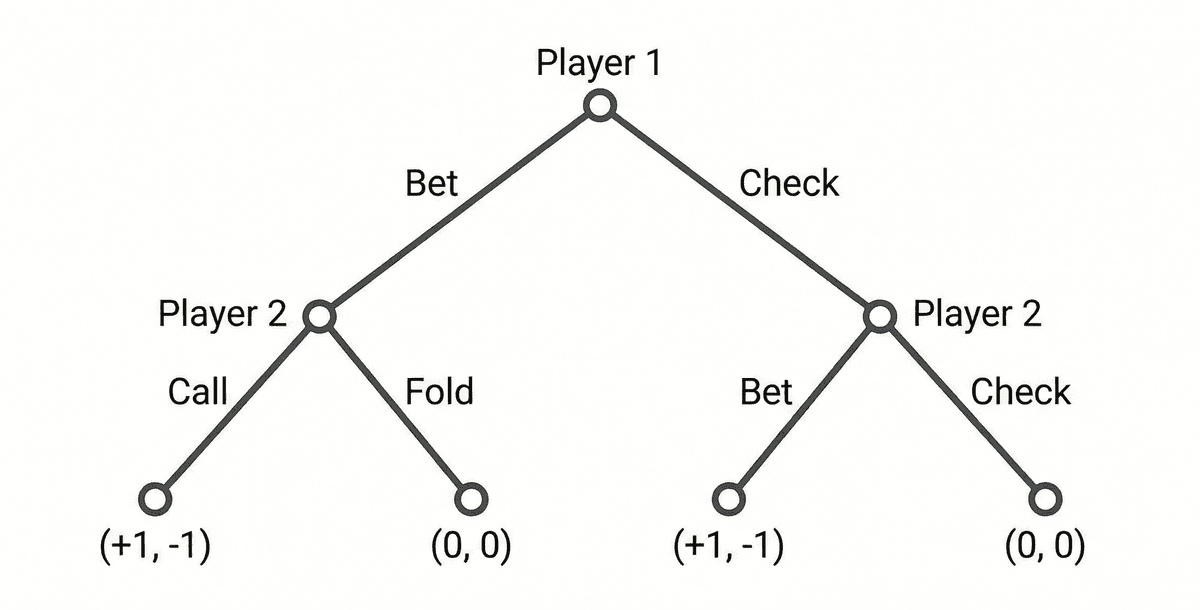
The Decision Tree for the AKQ Game: A Game Theory Analysis
Explore the classic AKQ poker game through decision tree analysis. Learn Nash equilibrium strategies, optimal betting frequencies, and the mathematical foundations of poker game theory.
Unexploitable Bluffing: Achieving Perfect Balance in Poker
Learn the mathematical principles of unexploitable bluffing strategies. Master GTO bluffing frequencies, opponent indifference, and balanced range construction.
Calculating Expected Value in Poker: Advanced Mathematical Guide
Master expected value calculations in poker. Learn EV formulas, decision trees, multi-street analysis, and advanced concepts for optimal poker strategy.