Poker Tells: Complete Guide for Beginners
Learn to read poker tells like a pro. Master physical tells, betting patterns, timing tells, and online poker tells to gain an edge at the table.
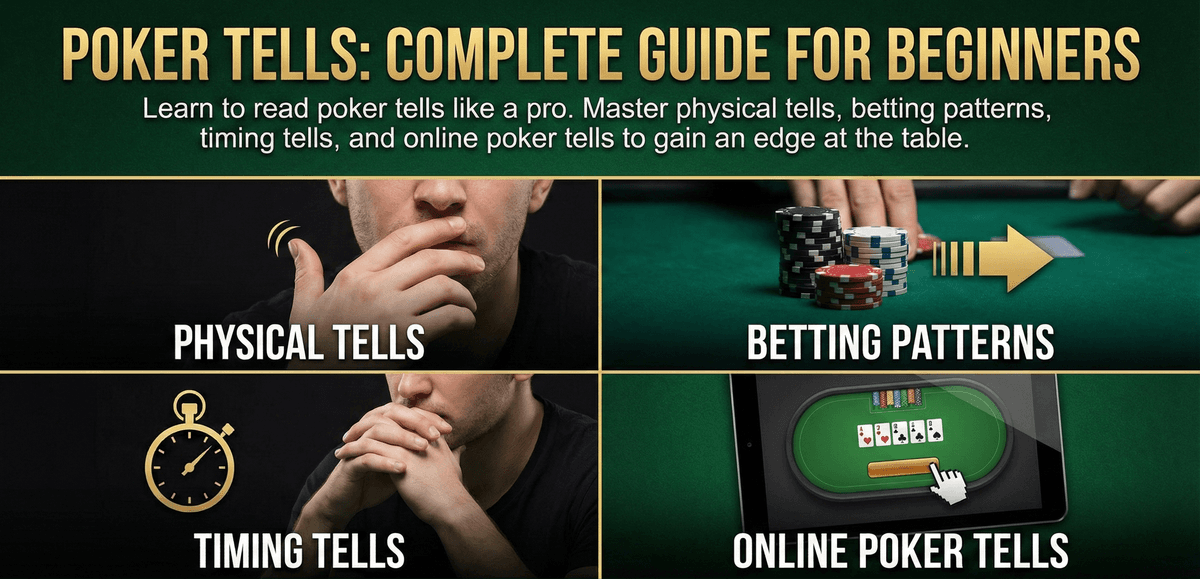
Poker Tells: Complete Guide for Beginners
Poker tells are subtle behavioral and physical cues that reveal information about a player's hand strength or intentions. While Hollywood portrays tells as obvious twitches and nervous habits, real poker tells are often much more nuanced. This comprehensive guide will teach you to identify, interpret, and exploit tells while protecting yourself from giving away information.
Understanding Poker Tells: The Foundation
What Are Poker Tells?
A poker tell is any physical action, betting pattern, or behavioral change that provides insight into a player's hand or mental state. Tells exist on a reliability spectrum from highly accurate to completely unreliable.
Tell Reliability Hierarchy
| Tell Type | Reliability | Examples |
|---|---|---|
| Unconscious physical tells | High | Genuine trembling, pupil dilation |
| Betting pattern deviations | High | Sudden bet sizing changes |
| Timing tells | Medium-High | Snap-calls, extended tanks |
| Verbal tells | Medium | Voice pitch changes, chattiness |
| Reverse tells | Low | Intentional false information |
| Hollywood tells | Very Low | Obvious sighing, fake nervousness |
The Psychology Behind Tells
Tells emerge from the conflict between conscious intention and unconscious response. When a player holds a strong hand, their limbic system (emotional brain) may trigger involuntary responses that contradict their attempted deception.
Stress Response Mechanism:
Strong Hand → Low cortisol → Relaxed behavior → Genuine confidence
Weak Hand/Bluff → High cortisol → Stress behaviors → Forced confidence
Physical Tells in Live Poker
1. Hand Tremors and Shaking
The Tell: Hands shake when placing chips or holding cards.
Interpretation:
- Likely meaning: Strong hand (adrenaline from excitement)
- Reliability: 85%+
- Why it's reliable: Extremely difficult to fake genuine trembling
Example scenario: A typically calm player suddenly has shaking hands when moving all-in. This almost always indicates a premium hand, not nervousness about bluffing.
2. Breathing Patterns
The Tell: Changes in breathing rate, depth, or holding breath.
Interpretation table:
| Breathing Pattern | Likely Hand Strength | Confidence Level |
|---|---|---|
| Held breath, then exhale | Strong hand | High |
| Rapid, shallow breathing | Bluffing or nervous | Medium-High |
| Deep, steady breathing | Calm, likely strong | Medium |
| Yawning or sighing | Weak hand, wants fold | Medium |
3. Eye Contact and Gaze Direction
Staring at opponent:
- After betting: Usually indicates strength (subconscious intimidation)
- Before acting: Often indicates weakness (trying to gauge safety of bluff)
Avoiding eye contact:
- After betting big: Often indicates bluff (fear of being "read")
- While checking cards: Typically means strong hand (trying to appear weak)
The Look-Away Tell: When a player looks away from the board immediately after a favorable card hits, it's often because they're trying to suppress excitement.
4. Chip Handling
Tell indicators:
| Behavior | Interpretation | Accuracy |
|---|---|---|
| Reaching for chips before action to you | Strength (wants you to fold) | 75% |
| Organizing chips neatly | Settling in, likely folding | 70% |
| Sloppy, aggressive chip motion | Polarized (nuts or air) | 60% |
| Counting chips carefully | Planning large bet/call | 65% |
5. Posture and Body Position
Forward lean: Engagement and interest (usually strong hand) Backward lean: Disinterest or intimidation attempt (usually bluffing) Sudden stillness: Protection mode (often weak hand) Relaxed, open posture: Comfort with hand strength
Betting Pattern Tells
Bet Sizing Tells
Mathematical analysis of bet sizing:
Standard bet sizing:
- Value bet: 60-75% pot
- Bluff: 60-75% pot
- Protection bet: 75-100% pot
Deviation tells:
| Deviation | Sample Size Needed | Likely Meaning |
|---|---|---|
| Oversized bluffs (150%+ pot) | 10+ observations | Inexperienced or tilting |
| Undersized value bets (<50% pot) | 15+ observations | Weak-passive player |
| Inconsistent sizing | 20+ observations | Unbalanced strategy |
Example calculation:
Player normally bets 66% pot for value:
- Hand 1: Bets 35% pot → Likely weak hand, fishing for call
- Hand 2: Bets 66% pot → Standard value bet
- Hand 3: Bets 110% pot → Polarized (nuts or air)
Timing Tells
Time before action distribution:
| Action Time | Online (seconds) | Live (seconds) | Interpretation |
|---|---|---|---|
| Snap-call | <1 | <3 | Strong draw or trap |
| Quick call | 1-2 | 3-7 | Marginal hand, pot odds |
| Tank-call | 10+ | 20+ | Bluff-catcher, tough decision |
| Snap-check | <1 | <2 | Gave up on hand |
| Quick bet | 1-2 | 5-10 | Confident value or auto-bluff |
| Tank-bet | 10+ | 20+ | Polarized decision |
The Hollywood Tell: When a player takes excessive time then makes an "obvious" play, they're often representing the opposite of their actual hand strength.
Verbal Tells
Statement reliability matrix:
| Statement Type | Reliability | Reason |
|---|---|---|
| "I know you have it" (while calling) | 80% | Usually strong hand |
| "This is probably bad" (while betting) | 75% | Usually strong hand |
| Asking "How much you got?" | 70% | Planning large bet |
| Excessive table talk | 60% | Often nervousness |
| Silence after talking pattern | 65% | Change in hand strength |
Pitch and tone analysis:
High-pitched voice = Tension (usually weak) Lower pitch = Confidence (usually strong) Voice cracks = Stress (unreliable direction)
Online Poker Tells
Digital Behavior Patterns
Timing tells in online poker:
Expected Action Time = Base Time + Decision Complexity

Base Time: 2-3 seconds (normal player)
Decision Complexity: 0-20 seconds (situation dependent)

Significant deviation: ±5 seconds from expected
Auto-action tells:
| Action | Likely Meaning | Confidence |
|---|---|---|
| Instant check | Gave up, weak hand | 85% |
| Instant bet (button available) | Pre-selected, likely strong | 75% |
| Instant call (button available) | Drawing hand | 70% |
| Long delay then min-bet | Weak/blocking bet | 65% |
Bet Sizing Patterns Online
Statistical analysis approach:
Track opponent over 100+ hands:
- Record bet sizes for value hands (when shown)
- Record bet sizes for bluffs (when shown)
- Compare distributions
Example data:
Value bets: Mean = 68% pot, SD = 8%
Bluffs: Mean = 72% pot, SD = 15%

Current bet: 95% pot
Z-score for value: (95-68)/8 = 3.375
Z-score for bluff: (95-72)/15 = 1.533

Conclusion: More consistent with bluff profile
Multi-Tabling Tells
Players who multi-table often reveal information through timing:
4-6 tables: Slight delays normal 8+ tables: Very quick = premium hand only Sudden table close: Often tilting or frustrated
False Tells and Counter-Tells
Recognizing Reverse Tells
Leveling concept:
| Player Level | Strategy | Counter-Strategy |
|---|---|---|
| Level 1 | Genuine tells | Read normally |
| Level 2 | Aware, minimizes tells | Focus on betting patterns |
| Level 3 | Uses reverse tells | Look for over-acting |
| Level 4 | Balances tells strategically | Focus on baseline deviations |
Reverse tell indicators:
- Overly dramatic reactions
- Inconsistent with betting line
- "Too perfect" representation
Building Your Tell Reading System
Step-by-Step Process
1. Establish Baseline (First 30 minutes):
- How do they handle chips normally?
- What's their default posture?
- How fast do they typically act?
- What's their normal emotional state?
2. Note Deviations:
Baseline Behavior → Change in Behavior → Associate with Outcome → Build Pattern
3. Categorize Reliability:
High confidence tells (3+ consistent observations) Medium confidence tells (1-2 observations) Suspected tells (noted but unconfirmed)
Tell Tracking Template
| Opponent | Baseline | Strong Hand Tell | Weak Hand Tell | Confidence |
|---|---|---|---|---|
| Player A | Quiet, steady | Chip stare, quick bet | Talks, delays | High |
| Player B | Animated | Sudden calm | More animated | Medium |
| Player C | Fast player | Normal speed | Slow then bet | Medium |
Protecting Yourself from Tells
Physical Tell Prevention
1. Develop a Standard Routine:
1. Look at cards the same way every time
2. Wait 3 seconds before acting (online and live)
3. Use same chip motion for all bet sizes
4. Maintain neutral facial expression
5. Consistent posture throughout session
2. Breathing Control: Practice 4-7-8 breathing during hands to maintain physiological consistency.
3. Physical Consistency:
- Don't look at chips when strong
- Don't avoid eye contact when bluffing
- Keep hands still whether strong or weak
- Maintain same bet announcement tone
Betting Pattern Protection
Balanced bet sizing:
Develop set percentages for all situations:
- C-bet: Always 60% pot
- Value river bet: Always 70% pot
- Bluff river bet: Always 70% pot
Timing consistency:
Use a mental count:
Receive information → Count to 3 → Decision → Count to 2 → Act
This creates uniform timing regardless of hand strength.
Common Mistakes in Reading Tells
Top 5 Errors
1. Small sample size conclusions Minimum observations needed: 3+ for high confidence
2. Ignoring context Same behavior can mean different things in different situations
3. Focusing on unreliable tells Hollywood tells and obvious acting are usually false
4. Confirmation bias Looking for tells that confirm what you want to believe
5. Overvaluing tells vs. math A tell suggesting strength doesn't beat 95% equity
The Math of Tell Reliability
Bayesian update formula:
P(Strong|Tell) = P(Tell|Strong) × P(Strong) / P(Tell)

Example:
Prior: 30% chance opponent has strong hand
Tell: 80% accurate for strong hands
P(Strong|Tell) = 0.80 × 0.30 / [(0.80 × 0.30) + (0.20 × 0.70)]
P(Strong|Tell) = 0.24 / 0.38 = 63%
This demonstrates that even reliable tells should update your probability assessment, not create certainty.
Advanced Tell Concepts
Tell Clustering
Multiple tells together increase reliability exponentially:
Single tell: 60-70% accurate Two tells: 80-85% accurate Three+ tells: 90%+ accurate
Example combo: Trembling hands + forward lean + quick bet = Extremely likely strong hand
Population vs. Individual Tells
Population tells (work for most players):
- Trembling = strength
- Sudden stillness = weakness
- Chip glance = strength
Individual tells (player-specific): Require 20+ hours of observation to establish reliable patterns.
Practical Application
In-Game Decision Framework
1. Assess mathematical situation (pot odds, equity)
2. Apply population tells (if no individual data)
3. Apply individual tells (if sufficient data)
4. Weigh tell information (10-30% of decision)
5. Make mathematically sound decision with tell adjustment
Never let tells override strong mathematical analysis.
Resources for Further Study
- Joe Navarro's Body Language Books - Expert analysis from former FBI behavioral specialist
- Zachary Elwood's Reading Poker Tells Series - Comprehensive video and book series
- PokerTells.com - Database of poker tell examples and analysis
Conclusion
Reading poker tells is a valuable skill that can provide a significant edge, but it must be developed systematically and applied appropriately. Start by establishing baselines, track deviations with sample sizes that support confidence, and always integrate tell information within sound mathematical strategy. Remember: tells are supplementary information that refines decisions—they should never be the primary basis for action.
The best players use tells to break ties in close decisions and to maximally exploit weak opponents, but they never abandon fundamental poker math in favor of behavioral reads.
Enhance your poker psychology skills with our complete guide series on mental game mastery.
⚠️ Responsible Gambling Reminder
While understanding poker strategy and mathematics can improve your game, always gamble responsibly. Set limits, take breaks, and remember that poker involves both skill and chance. For support, visit www.problemgambling.ie.
Related Articles

Poker and Psychology: Master the Mind Game Behind Every Hand
Explore the psychological foundations of poker success. Learn cognitive biases, emotional control, game theory psychology, and mental frameworks for optimal decision-making.
Stress and Decision Making in High-Stakes Poker Games
Understand how stress impacts poker decisions in high-stakes games. Learn neuroscience-backed strategies for optimal performance under pressure.
Dealing with Downswings in Poker: Mental Strategies for Variance
Learn how to handle poker downswings with proven psychological strategies. Master bankroll management, emotional control, and mental resilience during losing streaks.