Dealing with Downswings in Poker: Mental Strategies for Variance
Learn how to handle poker downswings with proven psychological strategies. Master bankroll management, emotional control, and mental resilience during losing streaks.
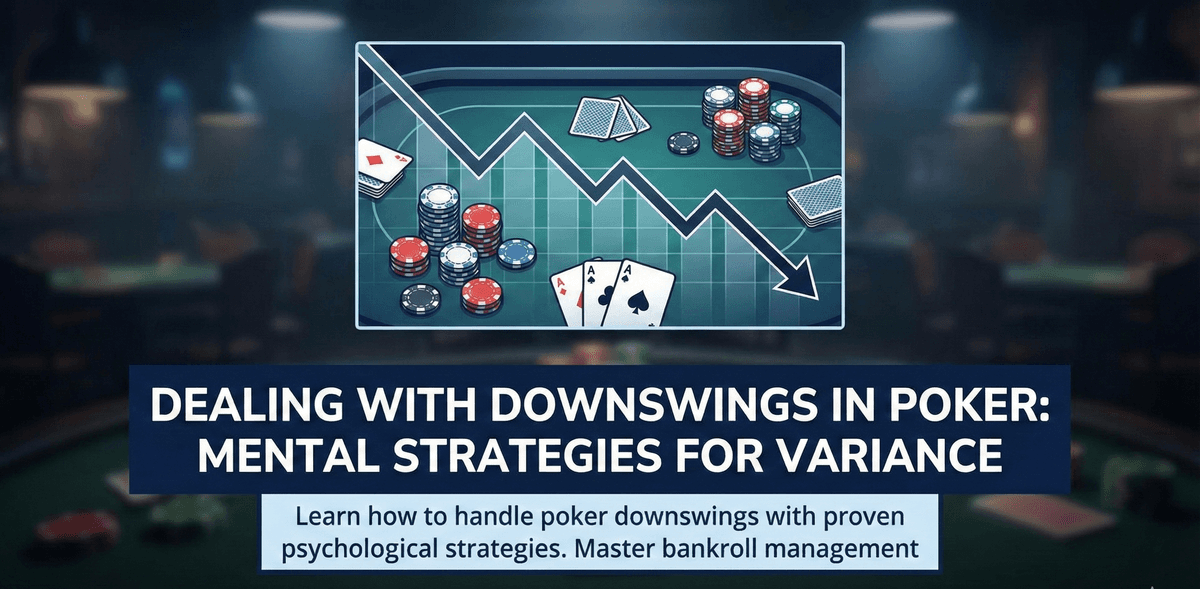
Dealing with Downswings in Poker: Mental Strategies for Variance
Downswings are an inevitable part of poker. Even the best players in the world experience extended periods of losses that can challenge their mental fortitude and bankroll. Understanding the psychological aspects of downswings and developing effective coping strategies is crucial for long-term success in poker.
Understanding Downswings: The Mathematics
What is a Downswing?
A downswing is a prolonged period where your actual results fall significantly below your expected value (EV). While variance causes short-term fluctuations, downswings can last hundreds or even thousands of hands.
The Statistics Behind Downswings
| Player Type | Expected Downswing Duration | Max Downswing (Buy-ins) |
|---|---|---|
| Tournament Player | 100-500 tournaments | 50-100 buy-ins |
| Cash Game Reg (6-max) | 10,000-50,000 hands | 20-40 buy-ins |
| Cash Game Reg (Full Ring) | 20,000-80,000 hands | 15-30 buy-ins |
| High Variance Player | 50,000+ hands | 100+ buy-ins |
Mathematical Example: Expected Downswings
Let's calculate the probability of experiencing a significant downswing:
Scenario: You're a winning player with a winrate of 5bb/100 hands and a standard deviation of 100bb/100 hands.
Formula for downswing probability:
Z = (Expected - Actual) / (SD × √n)
Over 10,000 hands:
- Expected: +500bb (5bb/100 × 100)
- 1 Standard Deviation: 1,000bb (100bb × √100)
Probability of being down after 10,000 hands: ~30%
This demonstrates that even winning players will experience periods below expectation.
The Psychological Impact of Downswings
Common Mental Challenges
-
Tilt and Emotional Responses
- Anger and frustration
- Desperation to "get even"
- Loss of confidence
- Fear-based decision making
-
Cognitive Distortions
- Believing you've "lost your edge"
- Selective memory of bad beats
- Questioning fundamental strategy
- Paranoia about being targeted
-
Behavioral Changes
- Moving up in stakes to recover losses
- Playing longer sessions than planned
- Making hero calls or bluffs
- Abandoning proven strategies
Psychological Strategies for Managing Downswings
1. Embrace Variance as Reality
Understanding that variance is mathematically inevitable helps reframe downswings from personal failures to statistical occurrences.
Mental reframing exercise:
Instead of: "I'm playing terribly and losing everything"
Think: "I'm experiencing normal variance within my expected range"
2. Bankroll Management as Psychological Armor
Proper bankroll management isn't just about preventing going broke—it's about maintaining mental stability.
| Game Type | Conservative BR | Standard BR | Aggressive BR |
|---|---|---|---|
| Cash Games (NL) | 50+ buy-ins | 30-40 buy-ins | 20-25 buy-ins |
| MTTs | 200+ buy-ins | 100-150 buy-ins | 75-100 buy-ins |
| SNGs | 100+ buy-ins | 50-75 buy-ins | 30-50 buy-ins |
Psychological benefit: When you have adequate bankroll, each individual loss becomes less emotionally charged.
3. Process Over Results Orientation
Focus on making correct decisions rather than short-term outcomes.
Daily evaluation checklist:
- Did I make mathematically sound decisions?
- Did I maintain emotional control?
- Did I stick to my game plan?
- Did I avoid revenge-motivated plays?
- Did I quit when mentally fatigued?
4. The Stop-Loss Strategy
Implement both financial and emotional stop-losses.
Financial stop-loss example:
If down 3 buy-ins in a session:
1. Take a 15-minute break
2. Review recent hands objectively
3. Assess mental state
4. Continue only if playing A-game
Emotional stop-loss indicators:
- Making decisions out of anger
- Calling with weak hands to "prove" opponents wrong
- Deviating from standard ranges
- Feeling physically tense or agitated
5. Mindfulness and Mental Reset Techniques
4-7-8 Breathing technique for tilt control:
- Inhale for 4 counts
- Hold for 7 counts
- Exhale for 8 counts
- Repeat 4 times
This activates the parasympathetic nervous system, reducing stress response.
Practical Action Plan for Downswings
Week 1: Assessment and Acceptance
Actions:
- Review your database for true winrate
- Calculate standard deviation
- Determine if you're within normal variance
- Stop playing if on severe tilt
Week 2: Strategic Adjustment
Review areas:
- Hand selection
- Position awareness
- Bet sizing
- Bluff frequency
Math check example: If you typically 3-bet 8% from the button, verify you're still in this range. Downswings often correlate with unconscious strategy drift.
Week 3: Mental Game Work
Daily practices:
- 10 minutes meditation
- Journal session results and emotional state
- Review 3 hands focusing on decision quality
- Physical exercise (30+ minutes)
Week 4: Gradual Return
Reentry checklist:
- Confirm bankroll is sufficient
- Start at lower stakes if confidence is shaky
- Limit session length to 2-3 hours
- Focus on enjoyment, not results
Warning Signs You Need a Break
Critical indicators:
| Warning Sign | Severity | Action |
|---|---|---|
| Playing to chase losses | Critical | Stop immediately |
| Emotional during hands | High | End session |
| Questioning fundamental strategy | Medium | Review with coach |
| Sleep disruption | High | Take extended break |
| Relationship conflicts due to poker | Critical | Seek professional help |
Long-Term Perspective: The Math of Resilience
Expected value over time:
Consider a player with these stats:
- Winrate: 4bb/100
- Standard deviation: 80bb/100
- Hourly hands: 600
Over 100,000 hands:
- Expected profit: 4,000bb
- 95% confidence interval: -8,000bb to +16,000bb
This massive range explains why downswings can be severe and why sample size matters immensely.
Building Mental Resilience: Advanced Techniques
1. Variance Simulation
Use tools like Primedope's Variance Calculator to visualize potential downswings. Seeing that even 10% ROI tournament players can experience 100+ tournament losing streaks normalizes the experience.
2. Community Support
Join poker discussion forums like TwoPlusTwo where players share downswing experiences. Recognizing you're not alone reduces the psychological burden.
3. Professional Mental Game Resources
Consider resources like:
- Jared Tendler's "The Mental Game of Poker" series
- Elliot Roe's hypnotherapy for poker players
- Regular sessions with a poker mindset coach
Recovery Indicators: When You're Through It
Positive signs:
- Emotional neutrality towards individual hands
- Making standard plays without hesitation
- Proper sleep patterns returning
- Enjoyment of the game restored
- Results trending toward expected value
The Silver Lining: Growth Through Adversity
Downswings, while painful, offer unique learning opportunities:
- Bankroll management lesson: Forces proper BR discipline
- Mental game improvement: Develops emotional resilience
- Strategy refinement: Motivates deeper study
- Self-awareness: Reveals psychological triggers
- Humility: Reminds us variance affects everyone
Conclusion
Downswings are not failures—they're mathematical certainties in poker. Your response to downswings defines your career longevity more than your response to upswings. By maintaining proper bankroll management, focusing on process over results, and developing mental resilience techniques, you can navigate variance without sacrificing your game or mental health.
Remember: Every successful poker player has survived multiple severe downswings. The difference between those who make it and those who don't isn't avoiding downswings—it's managing them effectively.
Additional Resources
For more on poker psychology and mental game:
- PokerStrategy Mental Game Section
- Upswing Poker Mental Game Articles
- The Mental Game of Poker by Jared Tendler
Master your mental game with our comprehensive poker psychology guides.
⚠️ Responsible Gambling Reminder
While understanding poker strategy and mathematics can improve your game, always gamble responsibly. Set limits, take breaks, and remember that poker involves both skill and chance. For support, visit www.problemgambling.ie.
Related Articles

Poker and Psychology: Master the Mind Game Behind Every Hand
Explore the psychological foundations of poker success. Learn cognitive biases, emotional control, game theory psychology, and mental frameworks for optimal decision-making.
Stress and Decision Making in High-Stakes Poker Games
Understand how stress impacts poker decisions in high-stakes games. Learn neuroscience-backed strategies for optimal performance under pressure.