What Your Irish Salary Becomes After PAYE, USC and PRSI
Gross salary is not what hits your bank. Here is how PAYE Income Tax, USC and PRSI shape Irish take-home — and how that differs from gambling winnings.
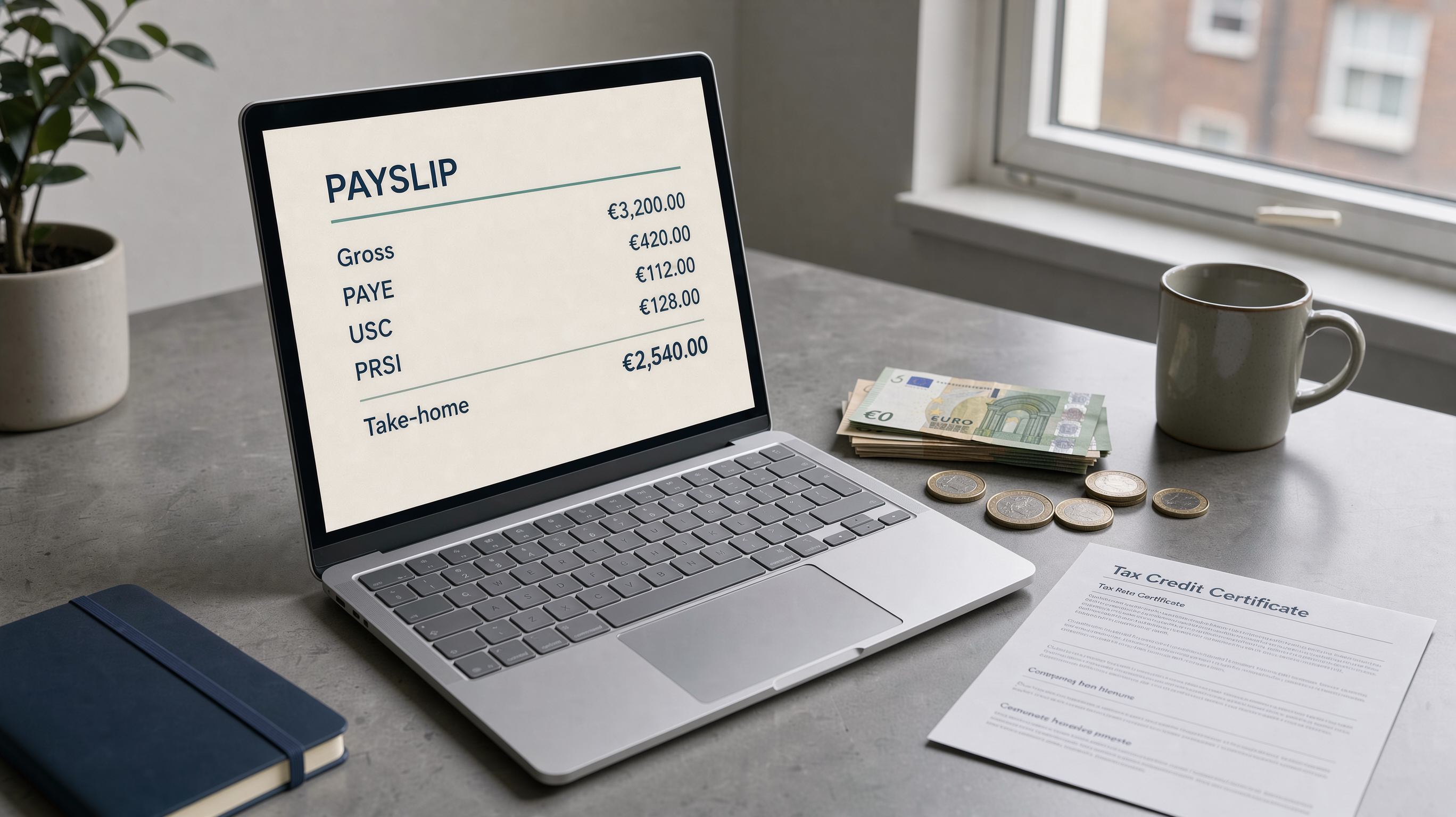
Your contract says one number. Your bank account sees another.
In Ireland that gap is mostly Pay As You Earn (PAYE) — Income Tax, Pay Related Social Insurance (PRSI), and the Universal Social Charge (USC), plus any pension or other deductions your employer runs. If you are comparing job offers, budgeting for a move, or just staring at a payslip after a raise, those three lines are the ones that matter.
This guide is informational only. It is not tax, legal or accounting advice. Confirm your own figures with Revenue (myAccount) or a registered tax professional before you act.
Recreational gambling winnings from licensed play are generally not taxed as income in Ireland — that is a different ruleset. We cover operator betting duty and player cashouts in Do you pay tax on gambling winnings in Ireland? This article is about salary take-home.
Page Updates
Published. USC standard bands checked against Revenue’s standard rates and thresholds page.
The three big pieces on an Irish payslip
1. PAYE Income Tax
If you are an employee in Ireland, your employer normally deducts Income Tax through PAYE every payday and remits it to Revenue. Tax credits reduce the Income Tax you owe and are usually spread across the year (weekly, fortnightly, monthly, or four-weekly).
Your Tax Credit Certificate (TCC) in myAccount lists credits, reliefs and rate bands. Revenue sends your employer a Revenue Payroll Notification (RPN) with totals for payroll — not a full credit-by-credit breakdown on the RPN itself.
First job in Ireland? Register in myAccount promptly. Missing registration can mean emergency tax until Revenue and your employer are aligned.
For a deeper walkthrough (including how this differs from UK “PAYE” products), see Counttaxes’ guide to PAYE in Ireland explained.
2. USC — Universal Social Charge
USC is a separate charge on gross income — not the same as Income Tax or PRSI. It usually appears as its own payslip line.
If your gross income for the year is at or under Revenue’s exemption threshold (€13,000 for both 2025 and 2026 on current guidance), you do not pay USC. Once you go over that threshold, USC applies under Revenue’s published bands.
For 2026, Revenue’s standard USC table is:
| Threshold for 2026 | Rate |
|---|---|
| First €12,012 | 0.5% |
| Next €16,688 | 2% |
| Next €41,344 | 3% |
| Balance | 8% |
Headline rates did not change from 2025 to 2026; the 2% band was widened so more mid-band income sits at 2% before 3% starts. Always confirm live figures on Revenue’s standard rates and thresholds of USC. Counttaxes also keeps a year-by-year comparison at USC rates 2025 vs 2026.
3. PRSI — Pay Related Social Insurance
PRSI funds social insurance benefits. The class and rate depend on your employment type and earnings. Treat your payslip line and Revenue / Department of Social Protection guidance as authoritative — do not rely on a third-party blog for the exact rate that applies to you.
Local Property Tax (LPT) can also be deducted at source in some cases. Pension contributions and other voluntary deductions sit on top of the statutory stack.
Why take-home maths matters (especially for movers)
People comparing offers between Ireland, the UK, the US, Australia, New Zealand and Canada need the same shape of answer: gross in → estimated net out, with every major line shown.
Counttaxes is a free take-home pay calculator that does that in the browser — no account required; inputs stay in the link hash so you can bookmark a scenario. US, UK, Australia, New Zealand and Canada estimators are live today. An Ireland calculator is coming soon (the Ireland tile is already listed under Jurisdictions).
Until that engine ships, use:
- Revenue myAccount for your live credits, RPN and year-to-date picture
- Counttaxes’ PAYE and USC guides for how the lines work
- Counttaxes for cross-border offer maths when one side of the comparison is already live
Honest limits
- Estimates and blog tables are illustrative — not advice
- Your TCC, RPN and payslip beat any article
- Confirm rates and thresholds on revenue.ie for the tax year you care about
- Gambling cashouts follow different rules — see our gambling taxes in Ireland guide
For more Irish casino guides, bonuses and reviews, start on the IrishLucky home page.
Sources
Highlights
Sum It Up
- Contract gross ≠ bank balance — PAYE Income Tax, USC and PRSI come out first.
- USC is a separate charge with its own bands (confirm on Revenue.ie).
- Recreational gambling winnings are treated differently — see our gambling tax guide.
- Use Revenue myAccount for your live Tax Credit Certificate.
- For multi-country offer maths, try a free take-home pay calculator.
A plain-language guide to Irish take-home pay: PAYE Income Tax, USC and PRSI on your payslip, plus where to check bands on Revenue. Not tax advice. 18+.
⚠️ Responsible Gambling Reminder
While bonuses can boost your play, always gamble responsibly. Set limits, take breaks, and remember that bonuses aren't guaranteed wins. For support, visit www.problemgambling.ie.
About the Author
Seamus O'Connor
Senior Casino Analyst with over 8 years of experience in the Irish gambling industry. Seamus specializes in bonus analysis and player protection.