Do You Pay Tax on Gambling Winnings in Ireland? (2026 Guide)
Recreational gambling winnings are not taxed in Ireland. See how the 2% betting duty works and who pays VAT.
If you gamble in Ireland for recreation, you do not pay tax on your winnings. Ordinary punters are not taxed on those payouts as income, and section 613(2) of the Taxes Consolidation Act 1997 also takes betting, lottery, sweepstake and prize winnings out of the capital-gains net. There is no ordinary requirement to report those profits or losses to Revenue, and income tax, USC, and PRSI do not apply to a payout from a licensed operator. The 2% figure you may have heard is betting duty — a levy on bookmakers and remote betting operators, not a deduction from your cashout.
That distinction is the whole guide. Operators account for betting duty, VAT, and corporation tax. The person who backs a Cheltenham winner or cashes an online-slot win keeps the return the operator credits.
Betting duty is charged to the operator, not taken off your withdrawal. Recreational winnings are not taxed as income for ordinary punters, and TCA 1997, s.613(2) also keeps betting, lottery and prize winnings out of capital gains. Confirm unusual cases (professional play, unlicensed sites, crypto) with a tax professional or Revenue. 18+.
Page Updates
Corrected the duty-rate history against the Department of Finance paper The Taxation of Betting in Ireland (20% until 1986, then 10%, 5%, 2%, 1% in 2006, back to 2% in 2019). Removed a duplicate 1954/1956 Gaming and Lotteries entry. Added TCA 1997 s.613(2) and the source list below.
Betting duty increased from 1% to 2%; remote betting intermediary duty on commission increased to 25% (Finance Act 2018).
We compared operator-duty rules with what players actually receive on a cashout, then checked the result against TCA 1997 s.613(2), Revenue’s betting and gaming VAT pages, the Department of Finance betting-tax history, the Gambling Regulation Act 2024, and our gambling regulations summary. Figures below are educational. They are not a Revenue assessment. See our trust methodology.
25%
Games
25%
Bonuses
20%
Trust & licensing
20%
Payments
10%
Support
What is the 2% betting duty — and who pays it?
The 2% betting duty sits in sections 67 and 67A of the Finance Act 2002. It applies to every bet a bookmaker enters into with persons in the State, including remote bets by Irish residents. The rate doubled from 1% to 2% in 2019 and is still the main gambling-tax lever.
It is an operator-side tax. Bookmakers, betting exchanges, and remote platforms pay duty on the bets they accept. They may bake it into odds or margins. They do not skim 2% off a winning ticket. If a football accumulator returns €500, you receive €500. The bookmaker has already accounted for duty in the price.
Remote betting intermediaries — exchanges that charge commission — pay a separate betting intermediary duty of 25% on those commission charges (section 67B).
| Who | What is charged | Current rate | Taken from your cashout? |
|---|---|---|---|
| Recreational player | Income tax / USC / PRSI on licensed winnings | €0 | No |
| Bookmaker | Betting duty on relevant stakes | 2% | No — operator pays |
| Betting exchange | Intermediary duty on commission | 25% | No — operator pays |
| eGaming operator | VAT on retained stakes from Irish customers | 23% | No — operator cost |
| Lottery / bingo tickets | VAT on issuing tickets | Exempt | No |
A short timeline of Irish gambling tax
Betting duty did not jump from 20% to 2% in one go. The Department of Finance paper The Taxation of Betting in Ireland sets out the sequence. Until 1986 the 20% rate was collected “paid-on” (added up-front to the cost of the bet). The Commission on Taxation called that rate irresponsible; widespread evasion followed. From 2006 the levy is collected from betting companies in their margin — it is no longer a line on the punter’s docket.
| Year | What changed |
|---|---|
| 1931 | Betting Act 1931 — the long-running basis for bookmaker licensing. |
| 1956 | Gaming and Lotteries Act 1956 — the statute that regulated gaming and lotteries (there is no separate 1954 Act of that name). Small licensed clubs could offer casino-style games; large commercial casinos stayed out. |
| Until 1986 | Betting duty 20%, collected paid-on with the bookmaker. |
| 1986 | Rate reduced to 10% — not introduced at 20%. |
| 1999 | Reduced to 5%. |
| 1 May 2002 | Reduced to 2% (Finance Act 2002, which also houses today’s duty sections). |
| 1 July 2006 | Reduced to 1%. Collection moves fully onto the operator. |
| 2015 | Betting (Amendment) Act 2015 brings remote and offshore operators serving Irish customers into the Irish duty net. |
| 1 January 2019 | Duty increased back to 2%. Remote betting intermediary duty on commission rises to 25% (Finance Act 2018). |
| 2024–2026 | Gambling Regulation Act 2024 and the GRAI replace the old Revenue-permit patchwork. Duty itself stays an operator levy. |
Online betting, remote duty, and GRAI licences
Remote bookmakers serving Irish customers must hold a valid permission and pay betting duty on bets placed by persons in the State. Industry registers in early 2026 listed on the order of 140–150 active remote bookmaker licences with the Revenue Commissioners.
GRAI’s establishment day was 5 March 2025, with Anne Marie Caulfield as CEO and Paul Quinn as Chair. Remote bookmaker licences that were due to expire on 30 June 2025 were still renewed through the old Revenue process — but only for one year, running to 30 June 2026. From 1 July 2026, remote betting operators needed a GRAI licence. (A “30 June 2025” expiry on its own is the previous renewal cycle, not the GRAI hard stop.) Remote casino (gaming) licences are a later wave — applications open Q4 2026. Until a GRAI casino licence exists, Irish players still use EU-licensed sites (typically MGA or Estonian). That licensing path does not, by itself, create a new tax on player winnings. Dates live on the GRAI licence tracker.
For you: if the operator is licensed to take Irish business, their tax bill is duty, VAT, and corporation tax. Yours is not a 2% haircut on the win. Unlicensed sites are a consumer-protection problem — see licensed casinos and safe online casinos — not a tax shortcut.
Prefer operators we already list. If a site is not licensed to serve Ireland, you have little comeback on a withheld withdrawal, and this guide’s “€0 player tax” picture does not magically protect you.
VAT: betting vs gaming
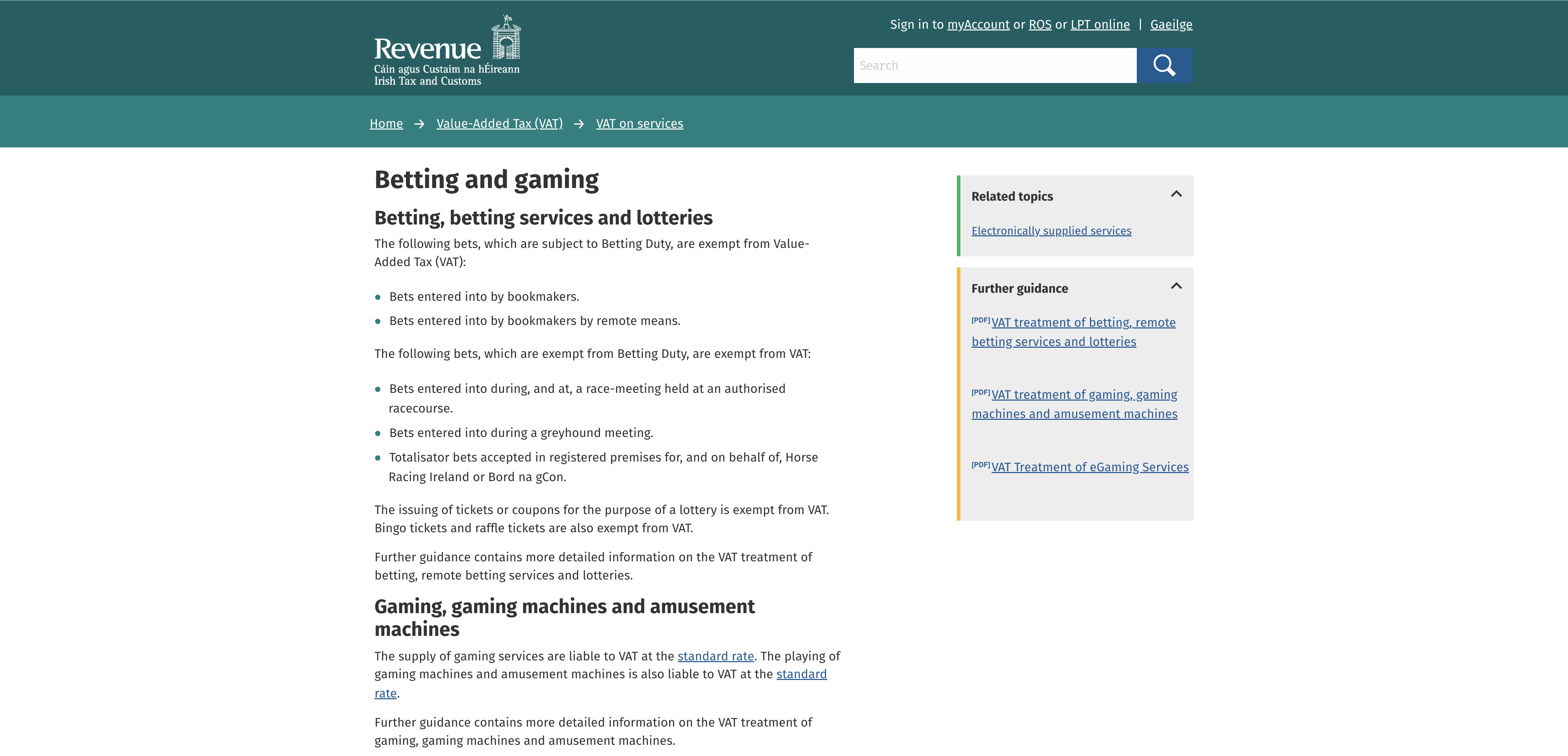
Revenue’s betting and gaming VAT pages split the two:
- VAT-exempt: bets entered into by bookmakers (including remote bets); bets at authorised racecourses and greyhound meetings; totalisator bets accepted for Horse Racing Ireland or Bord na gCon; lottery, bingo, and raffle tickets.
- Standard-rate VAT (23%): gaming services, gaming machines, amusement machines, and eGaming. Place-of-supply follows where the customer is established, has a permanent address, or usually resides.
Sports betting therefore carries no player VAT line. Casino and slots sit in a VAT-chargeable supply chain for the operator. VAT is charged on retained stakes (money the house kept), not billed to you as a player.
The 2024 Act and the GRAI — tax vs protection
The Gambling Regulation Act 2024 is the biggest rewrite of Irish gambling law since the State was founded. It folds the old Gaming and Lotteries Act 1956 and Betting Act 1931 into one framework. The Gambling Regulatory Authority of Ireland (GRAI) became operational on 5 March 2025. It licences and supervises betting, casinos, certain lotteries and bingo, gaming machines, and remote gambling. It also runs a National Gambling Exclusion Register, a Social Impact Fund, advertising and inducement rules, and enforcement.
None of that invents a new income tax on individual winnings. It does add player tools: spend limits, a credit-card ban at GRAI-licensed operators, and self-exclusion. If you need a break, use self exclusion and responsible gambling. GamStop is a UK scheme — see GamStop in Ireland if you also play on UKGC sites.
Do professional gamblers pay tax?
Section 613(2) says betting, lottery, sweepstake and prize winnings are not chargeable gains. That is the CGT side. Recreational play is also outside income tax for ordinary punters. Revenue does not publish a neat “professional gambler” box the way some other tax authorities do. If gambling is your trade — consistent, organised, substantial profit — Revenue could argue it is a profession. There is no simple public test in this guide, and we will not invent one.
If you bet at scale, keep records and speak to an Irish tax adviser before you assume the recreational picture applies. This guide covers recreational licensed play only.
How Ireland compares with the UK and the US
United Kingdom. Recreational gambling winnings are not taxed on the player. The 2005 Gambling Act left that principle in place; operator levies fund harm reduction. Irish and UK punters are in the same boat on player tax. UK operator duties (remote gaming duty, general betting duty) are a different system and are not applied to your Irish cashout.
United States. Wins are generally reportable to the IRS, with withholding on large prizes. That is why a US jackpot headline and an Irish cashout are not comparable. Ireland’s model is the UK-style one: collect from operators, leave recreational winnings alone.
Where betting-duty money goes
Duty receipts are material. Provisional January–October 2023 betting duty was about €102.7 million, with remote betting just over half. Combined betting and intermediary duty was about €99 million in 2022.
Under the 2024 Act, GRAI administers a Social Impact Fund — industry contributions toward treatment, education, and research. The ESRI’s October 2023 study estimated that 1 in 30 adults (about 3.3%, or 130,000 people) meet the threshold for problem gambling — roughly ten times the 2019 face-to-face estimate. That is a harm-reduction argument for operator levies, not a reason to tax the recreational cashout.
Proposed changes — 3% and 5% are not law
The 2% rate is not frozen forever. In May 2026 the Social Democrats called for a rise from 2% to 5%, talking about more than €165 million a year for sports and culture grants. Officials had explored 3% before the previous Budget; Labour has previously talked about the same figure. The Irish Bookmakers Association warned that 5% would “decimate local bookmakers.” Former Paddy Power co-founder Stewart Kenny has called job-loss warnings “scaremongering” and argued for higher tax on more addictive online casino products.
Until a Budget changes the Finance Act, the live rate is 2%. A 5% rise would still be an operator levy on stakes, still not a tax on your winnings.
Practical steps for Irish players
Gambling tax in Ireland FAQ
Do I pay tax on casino or betting winnings in Ireland?
Recreational winnings from licensed gambling are not taxed as income for ordinary punters, and TCA 1997 s.613(2) also keeps betting, lottery and prize winnings out of capital gains. You do not deduct 2% from a cashout. Unusual cases — professional play, unlicensed operators, crypto accounting — need personal advice, not this FAQ.
What is the 2% gambling tax?
Betting duty of 2% on relevant stakes, paid by the bookmaker under the Finance Act 2002. It is not a player income tax.
Do I have to report wins to Revenue?
Ordinary recreational wins from licensed operators are not an income-tax filing event. This page is not a tax return. If gambling is your trade, speak to a professional.
Would a 5% betting tax come out of my winnings?
No. A rise from 2% to 5% would still be an operator levy on stakes. It is a political proposal, not current law.
Is online casino play VAT-taxed for me?
eGaming is generally liable to 23% VAT on retained stakes from Irish customers — an operator cost. Lottery, bingo, and raffle tickets are VAT-exempt. Your cashout is not reduced by a player VAT line.
Are UK gambling winnings taxed?
The UK also does not tax recreational player winnings. UK operator duties are a different system and are not applied to an Irish cashout.
Does GRAI change player tax?
GRAI changes who can be licensed and which player protections apply. It does not, by itself, tax individual winnings. Follow the licence tracker for dates.
Sources
Checked 15 August 2026. Duty-rate history follows the Department of Finance paper. Player treatment: recreational winnings are not income for ordinary punters; TCA 1997 s.613(2) also excludes them from CGT.
Official
- 1Department of Finance — The Taxation of Betting in Ireland — official history of betting duty: 20% until 1986, then 10%, 5%, 2%, 1% (2006); later raised back to 2% in 2019
- 2Revenue — Betting Duty rates — current 2% bookmaker / remote betting duty; 25% intermediary duty on commission
- 3Revenue — VAT on betting and gaming — VAT-exempt bets and lotteries; standard-rated gaming, machines, and eGaming
- 4Taxes Consolidation Act 1997, section 613(2) — betting, lottery, sweepstake and prize winnings are not chargeable gains
- 5Gaming and Lotteries Act 1956 (Revised Acts) — the 1956 statute; there is no separate 1954 Gaming and Lotteries Act
- 6Gambling Regulation Act 2024 — GRAI, licensing, player protections
- 7Gambling Regulatory Authority of Ireland — regulator functions and licensing phasing
GRAI establishment and licences
Research and reporting
- 9ESRI — 1 in 30 adults, ~130,000 people — October 2023 problem-gambling estimate (about ten times the 2019 figure)
- 10RTÉ — Soc Dems call for 5% betting tax — confirms 2% as of May 2026; 5% proposal and Irish Bookmakers Association response
- 11The Journal — Stewart Kenny on gambling tax, October 2025 — industry debate on higher duty
Written by Seamus O'Connor · Reviewed by Fiona McCarthy · Not tax advice. Gambling carries financial risk. Play responsibly, 18+ only.
Highlights
Sum It Up
- You do not pay income tax on recreational gambling winnings in Ireland.
- The 2% betting duty is paid by the bookmaker on stakes, not taken off your cashout.
- Remote exchanges pay 25% duty on commission; eGaming generally attracts 23% VAT on retained stakes.
- Proposed rises to 5% would still be an operator levy — they are not current law.
- Recreational players keep the cashout; operators remit duty and VAT.
Recreational player winnings from licensed gambling are not an income-tax event in Ireland. The 2% figure is betting duty on the operator. This guide is informational only — not tax advice.
⚠️ Responsible Gambling Reminder
While bonuses can boost your play, always gamble responsibly. Set limits, take breaks, and remember that bonuses aren't guaranteed wins. For support, visit www.problemgambling.ie.
About the Author
Seamus O'Connor
Senior Casino Analyst with over 8 years of experience in the Irish gambling industry. Seamus specializes in bonus analysis and player protection.